Going Through The Motions

I was talking to a friend who is a missionary in Africa who had just experienced an interesting church service. Many times Africans will hear a worship song from a visiting group of Americans, and they will try to implement that worship song into their church services. Sometimes this can be quite beautiful.

And sometimes it’s quite comical.

These precious African saints were trying their best to imitate the English words they had heard sung in the song Friend Of God. However, their chorus sounded something like this:

I am afraid of God

I am afraid of God

I am afraid of God

He calls me Fred

Comical? Sure. But it’s also very instructional.

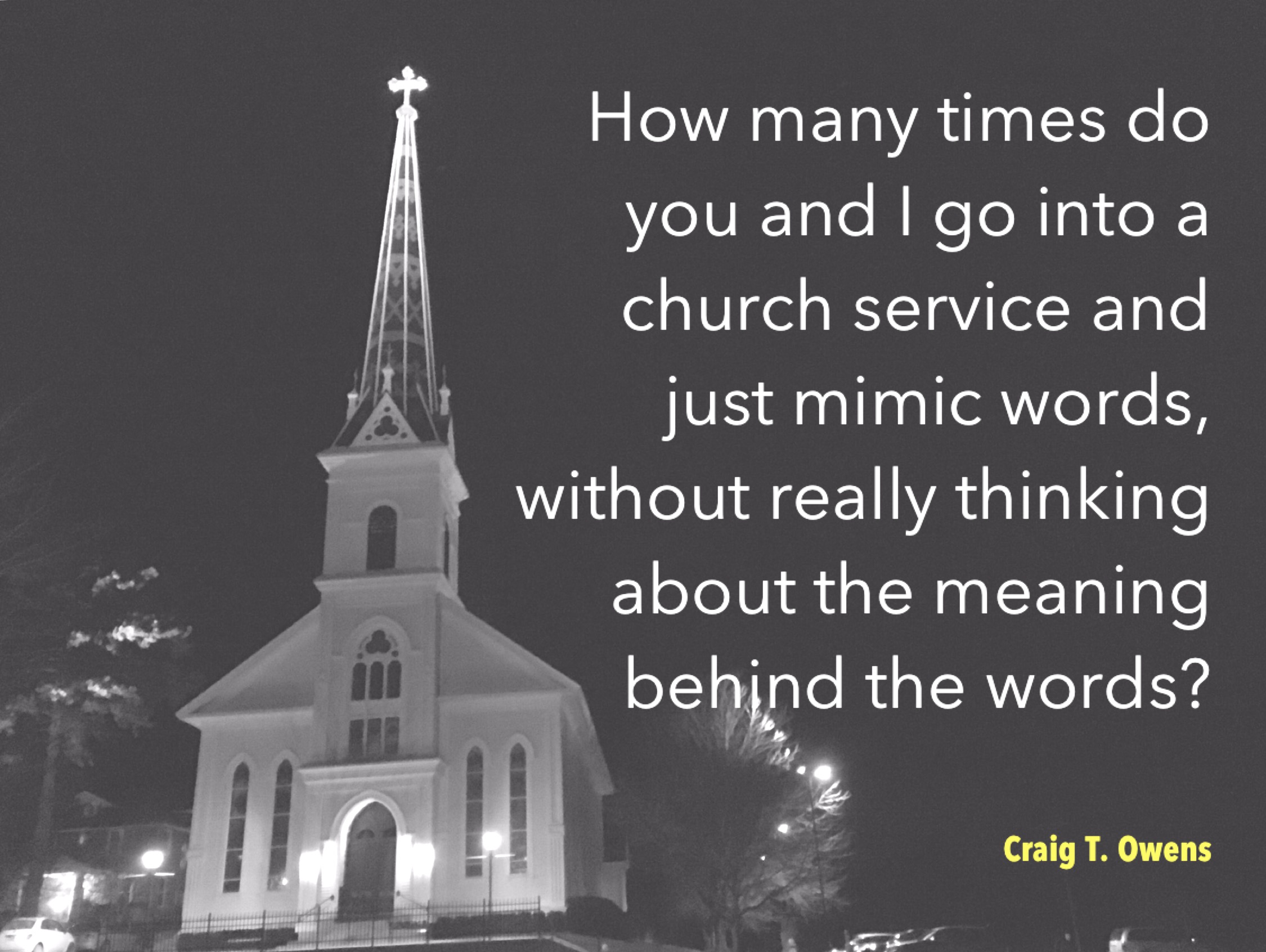
How many times do you and I go into a church service and just mimic words, without really thinking about the meaning behind the words?

We go through the motions—we imitate the sounds we have heard before—and think we are really worshiping.

Here’s what Jesus said:

And when you pray, do not heap up empty phrases… [and] think that you will be heard for your many words.

Are you going through the motions?

  • Do you pray the same prayer at every meal?
  • Do you sing the same songs the same way every time?
  • Do you worship God the same way every time you come into His presence?
  • Do you pray the same prayer every night before bed?

Do you really mean what you are saying? Or are you just going through the motions?

More Than Worship, It’s Worthship

Church has often been called a “house of worship.” But I struggle with what that means exactly. Sometimes it’s a house of singing, or a house of preaching, or a house of socializing, but not too often is the primary focus of the gathering people worship.

It seems most of the time worship is something we do at some point during the singing.

Now I will be the first to admit that the atmosphere most conducive to worship is usually created when meaningful—“worshipful”—songs are being played sung. But is that it? Shouldn’t there be something more?

The definition of worship includes:

…a condition of being worthy of honor or renown.

In fact, the Old English spelling was worthship. In other words, the greater the worth something had, the greater the honor or renown that something should be given.

In my case, the Something should have a capital “S.” The Person worthy of greatest honor and highest renown is my God and Savior Jesus Christ.

So why do I have to wait to go to a certain building to express His worth?

Why do I have to wait until the atmosphere is right?

Shouldn’t I be expressing my adoration and honor to Him always?

What does it mean to always be in a place of expressing my worthship?

I’ve been mulling over this quote from Brother Lawrence:

I know that for the right practice of it, the heart must be empty of all other things; because God will possess the heart alone; and as He cannot possess it alone, without emptying it of all besides, so neither can He act there, and do in it what He pleases, unless it be left vacant to Him.

As the Apostle Paul wrote I’m trying to capture every thought during the day and ask myself, “Is this thought taking up space in my heart that should be God’s space? Does this thought draw me closer to my Savior, or further away.” I’m trying to express His worth to me in the way I think about Him throughout the day.

Helping

A friend once told me that the greatest thing a church can do is find a need in the community and then help address it. I agree wholeheartedly.

Our church is helping address two needs in our community. We are hosting a benefit show called Rockin’ For Smiles to raise money for neuroblastoma cancer research. We became involved in this through our participation in PROJECT:Smile! (I wrote about this earlier, and you can read more here and here). I’m so proud of all of the people at Calvary who have rolled up their sleeves to help with this one. And it’s been amazing to see all of these bands that are willing to waive their appearance fee to help us.

We’re also collecting donations of diapers for our Bottom Blessing day on Mother’s Day. Alpha Family Center is a crisis pregnancy resource center. Much of the state aid that single Moms receive doesn’t cover the purchase of diapers, so we want to help Alpha help these young Moms.

What’s So Amazing About Grace (book review)

Philip Yancey calls grace “the last best word,” and I quite agree. What’s So Amazing About Grace is a challenging read because it is so painful. The truth of our almost daily practice of ungrace is confronting and convicting.

Throughout this book I wanted to say, “I’m glad I don’t behave that way.” And then I’d get a quick glance of myself in the mirror and realize how easily I slip into the same ungraceful behavior I despise. I so desperately want to be a grace-filled man.

Here are just a few of the passages that I’m meditating on, and trying to apply to my life:

  • “I yearn for the church to become a nourishing culture of grace.”
  • “Sociologists have a theory of the looking-glass self: you become what the most important person in your life (wife, father, boss, etc.) thinks you are. How would my life change if I truly believed the Bible’s astounding words about God’s love for me, if I looked in the mirror and saw what God sees?”
  • “I really only love God as much as I love the person I love the least.” (Dorothy Day)
  • “In a brilliant stroke Jesus replaces the two assumed categories, righteous and guilty, with two different categories: sinners who admit and sinners who deny.”
  • “Grace substitutes a full, childlike and delighted acceptance of our Need, a joy in total dependence. We become ‘jolly beggars.’” (C.S. Lewis)
  • “Having spent time around ‘sinners’ and also around purported ‘saints,’ I have a hunch why Jesus spent so much time with the former group: I think He preferred their company. Because the sinners were honest about themselves and had not pretense, Jesus could deal with them. In contrast, the saints put on airs, judged Him, and sought to catch Him in a moral trap. In the end it was the saints, not the sinners, who arrested Jesus.”

If you are challenged about living grace-filled in an increasingly grace-less society, you will find ample help in reading this book.

Wind Or Anchor

I so appreciate my church Board!

They are by no means a bunch of “yes men” (especially since one of our Board members is a woman!), but they are definitely great teammates. When I want to dream, they dream along with me. When I’m looking for a new way to do something, they help me explore our options. When I propose that we experiment, they give me the latitude to make the attempt.

They are the wind in my sails.

Unfortunately I’ve been around too many board members who feel it is their job to play devil’s advocate, or to hold the pastor to the time-honored traditions (without any regard to their effectiveness), or to always play everything safe.

They are an anchor around a pastor’s ankle.

French novelist Andre Gide noted,

“One doesn’t discover new lands without consenting to lose sight of the shore for a very long time.”

Thanks, Calvary A/G Board, for allowing us to lose sight of the shore every once in awhile so that we can see what new lands God will help us discover. You are definitely the wind in my sails.

What about you, dear reader? You may not be on an official board, but your comments and attitudes can either be wind or an anchor to someone close to you. Which are you?

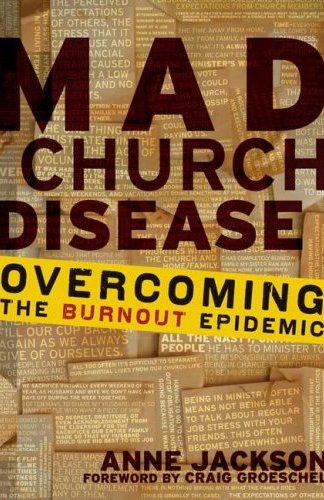
Mad Church Disease (book review)

Read this book and save your life.

Seriously.

I have seen far too many good people get burned-out in the most unlikely place. The one place where you would expect wholeness and vitality and safety and health: Church! In Mad Church Disease Anne Jackson draws the comparison to bovine spongiform encephalopathy (better known as mad cow disease) to confront mad church disease head-on.

Here’s the insidious thing about the way mad cow disease spreads: after infected cows die, they are ground up and fed to healthy cows. So unwittingly the disease is perpetuated because no one recognizes it’s there. Sadly that’s what happens far too often in the church. We have developed cultures that continue to burn-out people, and then we let those burned-out people feed (develop) new people

Anne shines the light of truth on this ugly disease. She confronts the symptoms head-on, and offers practical steps for helping people get healthy.

As someone who came very close to getting burned-out by mad church disease, I can attest how right-on-the-mark Anne’s book is. And to bolster her diagnosis, Anne interviews several leading pastors whose “second opinion” confirm the original diagnosis. I liked this observation from Bill Hybels:

“Especially as leaders in the church, we consistently need to be filled up and buoyed in our spirits because everybody takes their cue from the leader. If the leader is exhausted, then the people following that leader will feel exhausted. If the leader is wearing thin on hope, then people start losing hope too. If the leader gets pessimistic, everybody gets pessimistic.”

So who should read Mad Church Disease?

  • Pastors
  • Paid church staff
  • Volunteer church ministers
  • Counselors
  • Church board members

Whether you have been infected by mad church disease or not, you need to read this book. It will either be a source of healing for you, or an eye-opener to help protect yourself and others around you from this deadly disease.

The first step to eliminating mad church disease is recognizing its symptoms. Mad Church Disease does just that, and then goes further to talk about the steps for healing. Thanks, Anne, for a straightforward look at this serious disease.

A Sense Of Urgency?

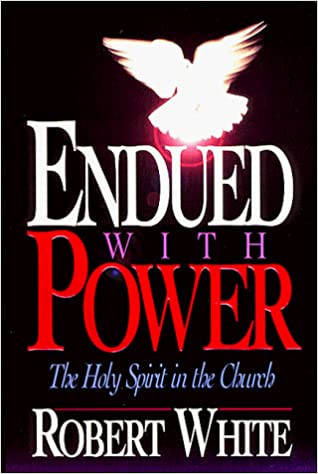
I’m reading a challenging book today called Endued With Power: The Holy Spirit in the Church. I just read a thought-provoking quote from the book:

“If the church that is claiming to be Spirit-filled is not a missionary community that is living with a sense of urgency, then its members will be caught up in the rush to respectability and social accommodation” —Steven J. Land

(1) Do we have that sense of urgency? Are we living and working and sharing like today is the day Jesus could return?

…or…

(2) Or are we more concerned about what is socially acceptable and politically correct? Are we just playing church?

I pray that I am leading our church always into that first category. I pray that I personally am always living with that sense of urgency.

Overcoming Barriers To Church Growth (book review)

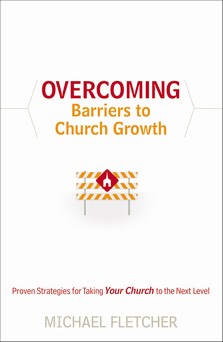
Hold on a second. I’m sure when you saw the title of Michael Fletcher’s book—Overcoming Barriers To Church Growththere were two thoughts that could have immediately popped in your mind: (1) “I’m not a pastor, so this book’s not for me”; or (2) “I am a pastor, but no one’s going to tell me how to grow my church.”

If you thought either of those things and didn’t explore this book any further, you’d really be robbing yourself.

In the case of the first objection (“I’m not a pastor”), Fletcher does a good job in making the case that church life is a team sport. The pastor cannot grow the church; the elders cannot grow the church; the attendees cannot grow the church. At least, not by themselves. Everyone needs to be involved for the church to be healthy.

In the case of the second objection (“No one’s going to tell me how to grow my church”), I would lovingly point out, “God opposes the proud, but gives grace to the humble.” Pastor Fletcher’s humble goal in writing this book was to help churches grow beyond the two natural barriers that every church will face. You’d be wise to let his hindsight be your foresight.

I found myself immediately drawn into this book. Michael’s writing style is very conversational and easy-flowing. And the concepts are uncomplicated and lend themselves to being quickly applied. The more I read the more excited I became about the potential in our church.

If you are a part of a church—pastor, elder, or attendee—you and your church will benefit from reading this book. Remember the church is a Body, so we all have our part to play in it. Arming yourself with the principles in this book will help you to play your part even better.

I’m a Bethany House book reviewer.

Is My Church Worldly?

I read this quote this morning from David F. Wells. It’s very challenging. I believe my responsibility as a pastor is to always be wrestling with issues like this.

What do you think about this quote:

“. . . Where Christian faith is offered as a means of finding personal wholeness rather than holiness, the church has become worldly.

“There are many other forms of worldliness that are comfortably at home in the evangelical church today. Where it substitutes intuition and feelings for biblical truth, it is being worldly. Where its appetite for the Word has been lost in favor of light discourses and entertainment, it is being worldly. Where it has restructured what it is and what it offers around the rhythms of consumption, it is being worldly, for customers are actually sinners whose place in the church is not to be explained by a quest for self-satisfaction but by a need for repentance. Where it cares more about success than about faithfulness, more about size than spiritual health, it is being worldly. Where the centrality of God to worship is lost amidst the need to be distracted and to have fun, the church is being worldly because it is simply accommodating itself to the preeminent entertainment culture in the world.

“Is it not odd that in so many church services each Sunday, services that are ostensibly about worshiping God, those in attendance may not be obliged to think even once about His greatness, grace, and commands? Worship in such contexts often has little or nothing to do with God.” —David F. Wells

“Gentleman, This Is A Football”

Listen to the podcast of this post by clicking on the player below, and you can also subscribe on AppleSpotify, or Audible.

After reading Mark Batterson’s book Primal, I started thinking quite a bit about the “stuff” that gets accumulated in our walk with Christ. Especially church traditions.

I find it amazing that neither Jesus nor Paul nor Peter nor any other biblical writer gave us a format for how we should “do” church. Over time we’ve just come to expect that a church service will have some songs, announcements, an offering time, some special music, and a sermon. But even changing the order of the service is so jarring to some people that they treat it like one of the Ten Commandments has been broken.

We can’t just keep doing church the way we’ve always done church. Sometimes we need to step back to ask, “Why do we do what we do?

So I’ve been spending some time reading through the Book of Psalms. I want to get back to the essence of worship.

  • What is it?
  • Is it just singing songs? If so, what songs?
  • Is there a style that is more God-honoring?
  • What instruments should we use? Should we even use instruments at all?
  • Do we sing hymns? Choruses? Both? Neither?
  • Does music only come at the beginning and the ending of a service?

Since I love sports, I frequently go back to sports analogies. Several years ago I read David Maraniss’ excellent biography on Vince Lombardi. Every year the Green Bay Packers coach went into pre-season drills with a stronger and stronger passion to win. Here’s how Maraniss describes it:

“He began a tradition of starting from scratch, assuming that the players were blank slates who carried over no knowledge from the year before. He reviewed the fundamentals of blocking and tackling, the basic plays, how to study the playbook. He began with the most elemental statement of all. ’Gentleman,’ he said, holding a pigskin in his right hand, ’this is a football.’”

“Folks, this is worship…” 

  • I know it can involve instruments, but it can also be acapella.
  • I know it can be loud shouts, but it can also be quiet whispers.
  • I know it can be hymns written 150 years ago, but it can also be spontaneously composed.
  • I know it can open a service, but it can also be throughout a service, or even at the close of a service.
  • I know it can be in a church building, but it can also be in a grocery store.

I know it is highly personal.

I know it is based on what attributes of God I have experienced firsthand.

I know God loves it when I worship Him.

As for the other details, well, I’m still wrestling with that.

►► Would you please prayerfully consider supporting this ministry? My Patreon supporters get behind-the-scenes access to exclusive materials. Like some exclusive quotes from a book I just reviewed. ◀︎◀︎