The Blessing Of Adversity (book review)

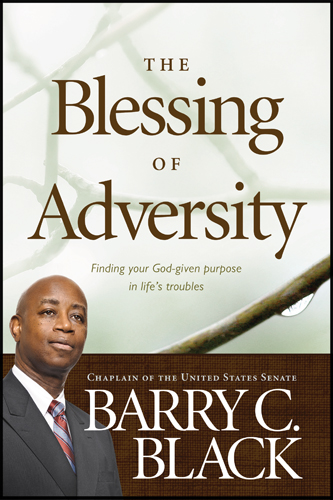
Barry C. Black has lived a full life, and that fullness has been poured into his timely book The Blessing Of Adversity: Finding your God-given purpose in life’s troubles.

A quick show of hands: how many of you have experienced trouble lately? How many of you are experiencing it right now? If you raised your hand in either category, this book could be quite helpful to you.

The Blessing Of Adversity is arranged into 23 chapters, but each chapter is broken down into several “mini chapters.” By that I mean that Chaplain Clark gives us several different ways of viewing the same topic of how to respond to adversity. He might tell you a personal story from his boyhood or his 23-year military career; or perhaps he’ll give you a modern-day example from his current ministry as chaplain to the U.S. Senate; or maybe a story from the pages of history; or a well-timed quote. Whatever his method, he always connects it with an encouraging word from the Bible to help the reader correctly process the times of adversity we all must pass through.

I found this book to be highly practical, and immediately applicable to my life. And for those of you who didn’t raise your hand earlier, there are a couple of chapters for you on how to prepare for the future adversity you are bound to face. This book would work very well as either an individual or small group Bible study.

I am a Tyndale book reviewer.

Night (book review)

Night by Elie Wiesel is not an easy read. But it is a vital read. In order to ensure that the evil perpetrated on the Jewish people by the Nazi regime never, ever happens to any other people group again, we must read what is not easy for us to read.

This book is the heart-wrenching account of the atrocities committed by the Nazis during the Holocaust. But it’s not simply a factual retelling of these horrendous events. Night takes you right into the utter despair felt by people who were completely dehumanized. People who were treated less humanely than animals. People who lived in the midst of pure Evil.

Elie Wiesel tells his firsthand account as a teenage boy forcibly removed from his home, separated from his mother and sisters, stripped of his dignity, treated in despicable ways, struggled with his anger toward God, and watched his father die right before his eyes. No one should have had to endure such things.

Elie Wiesel survived to tell his story, so that he could become the voice for the voiceless oppressed. What a great lesson for all of us to learn! We, too, should speak up for those who cannot. As Elie said in his Nobel Peace Prize acceptance speech:

We must take sides. Neutrality helps the oppressor, never the victim. Silence encourages the tormentor, never the tormented. Sometimes we must interfere. … Human suffering anywhere concerns men and women everywhere. … And action is the only remedy to indifference, the most insidious danger of all. … One person of integrity can make a difference, a difference of life and death.

Please read this book, and then be one person of integrity who makes a difference.

How The Mighty Fall (book review)

This is the third in the series of books from Dr. Jim Collins: Built To Last, Good To Great, and now How The Mighty Fall. This is a book that Dr. Collins wished he didn’t have to write, as he uncovers the markers that contributed to the failure of once-great companies.

If you are a frequent reader of my blog, you’re probably wondering why I’m reading/reviewing a business book. The answer is simple: the principles Jim Collins uncovers in his books are rock-solid principles of success and failure, regardless of the organization in which they are practiced or ignored. In all three of his books, I have mined so many great truths to apply to my personal life, as well as the organizations I lead.

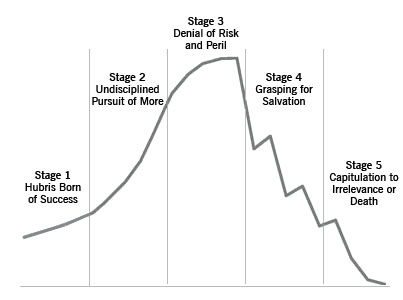
In How The Mighty Fall we learn about the five stages of decline for once-great organizations. Working backward from his evidence, Dr. Collins then gives us “markers” to look for in our own organizations that would tip us off to the stages of decline.

Why study this? Because I want to lead a great church! This quote from the book especially resonates with me:

“The point of struggle is not just to survive, but to build an enterprise that makes such a distinctive impact on the world it touches, and does so with such superior performance, that it would leave a gaping hole — a hole that could not be easily filled by any other institution—if it ceased to exist.” (emphasis added)

If you are involved in the leadership of any organization (whether for-profit or non-profit), I would encourage you to devour all three of Jim Collins’ books.

Sun Stand Still (book review)

Sun Stand Still by Steven Furtick is an amazing book!

The title and content of this book is based on an audacious, faith-filled prayer that Joshua offered in the Bible, where God actually allowed the sun to stand still so the Israelites could complete their battle before it got dark. What an amazing prayer: “God, please let the sun stand still”!

Steven leads us through the steps of getting a clear vision of what God wants to accomplish, and then activating that vision through audacious faith. He talks about the hindrances most of us will face in praying a Sun Stand Still prayer, about hanging on to faith during the waiting process, and even how to think about the times the sun goes down.

Through reading this book, I was so convicted that far too many of my prayers are puny, safe prayers; certainly not like the audacious Sun Stand Still prayer that Joshua prayed. But I was also encouraged and energized to begin to change the way I pray.

This book is easy to read and process, but it’s going to be a challenge for me to change my paradigms about praying sun-stand-still prayers.

For anyone who wants to see God do supernatural things in response to audaciously faith-filled prayers, I highly recommend this book as a valuable guide.

I am a Multnomah book reviewer.

Fasting (book review)

It’s one of the age-old practices for nearly every religion, but there is still so much mystery surrounding fasting. But Scot McKnight’s book simply entitled Fasting is a simple, straightforward explanation of how to apply this ancient discipline.

I appreciated Scot’s blending of passages from the Bible, the writings of the church fathers, and examples and excerpts from modern writers to present a well-rounded look at fasting. Scot lays the groundwork in the opening pages by giving this working definition: “The Bible presents a responsive view of fasting. Fasting is a response to a grievous sacred moment.”

Throughout Fasting, Scot reiterates that we don’t fast to try to get God’s attention, but we fast because we are heartbroken over our condition or the condition of others, and we’re so desperate to see God move. In the process of fasting, our body, soul, and spirit become fully engaged and lead us into a place where we are the ones who are changed. We begin to see those “grievous sacred moments” through God’s eyes, and we begin to feel the same pain He feels.

“Those who yearn for God the most often realize the superficiality of their intimacy with God, fast in response to that superficiality, and then (on the other side) find themselves entranced in the presence of the angels and God.”

If you yearn for greater intimacy with God, I would encourage you to check out Fasting.

I am a Thomas Nelson book reviewer.

From The Library Of A.W. Tozer (book review)

From The Library Of A.W. Tozer is an incredible gift from James Stuart Bell to not only fans of A.W. Tozer, but anyone who loves the spiritual classics.

A.W. Tozer was a prolific and influential author in the Pentecostal evangelical circles beginning in the 1960s, but his writings are still influencing thousands today. In reading Tozer, it is obvious that the Scripture is his first and foremost text, but it is equally as obvious that Tozer was a well-read student of the classics. In this compilation, James Stuart Bell gives us access to Tozer’s library. We can read for ourselves the writings that influenced the fertile and productive mind of Aiden Wilson Tozer.

Nicely arranged in eight broad sections, you will read the profound thoughts of Augustine, John Bunyan, Martin Luther, William Law, Charles Spurgeon, Dwight Moody, A.B. Simpson, and G. Morgan Campbell, to name just a few of my favorites. This is a book that you will not only pick up often, but one that will whet your appetite to read more of these classic works yourself.

A wonderful read!

I am a Bethany House book reviewer.

Costly Grace (book review)

Jon Walker comes out swinging with his timely book Costly Grace. This book is subtitled “A contemporary view of Bonhoeffer’s The Cost of Discipleship,” and it makes Dietrich Bonhoeffer’s challenging book come alive for a whole new generation.

“Cheap grace is grace without discipleship, grace without the Cross.” —Dietrich Bonhoeffer

If you have previously read Bonhoeffer’s classic work, you will appreciate the way Jon makes The Cost Of Discipleship understandable to this generation. He does this with watering down Bonhoeffer’s tone at all.

If you haven’t read The Cost Of Discipleship, Jon’s book should be just the primer you need to dive into Bonhoeffer.

In either case, be prepared: Costly Grace is no easy read. You will probably feel like your toes are being stepped on, and that Jon (and Bonhoeffer) are being too unreasonably difficult. This is a serious read for serious disciples of Jesus Christ. So if you are ready to step into a more mature walk with Christ, Costly Grace is an excellent place to start.

I am an ACU Press/Leafwood Publishers book reviewer.

Biblical Ethics (book review)

Like every book from Oswald Chambers, be prepared for Biblical Ethics to hit you right between the eyes! In my lifetime the term ethics has had so many qualifiers added to it: situational ethics … biomedical ethics … wartime ethics. As though ethics becomes something changeable if you are in a difficult situation.

But in clear, unequivocal language, Oswald Chambers brings all ethics back to the Bible.

Keying in most frequently on the teachings of Jesus from the Sermon on the Mount, Chambers helps us get to the true intention behind the ethical requirements of God’s Law. For any who would say, “But it’s too hard to figure out what Jesus actually meant,” Chambers replies,

“When we come across something we don’t like, we say we don’t understand it; it is too plain not to be understood.”

This is not light reading, but it is valuable reading. Serious disciples of Christ will be well-rewarded by reading and studying the wisdom in Biblical Ethics. If you would like to read more thoughts from Oswald Chambers, check out my weekly installment Thursdays With Oswald.

City On Our Knees (book review)

If you are familiar with the popular musician/songwriter TobyMac, you may recognize the title of this book from the song with the same name: City On Our Knees. And if you like the message of the song, you will find the book an excellent way to see the message in action.

The overriding message in the song is one of choice:

If you gotta start somewhere why not here
If you gotta start sometime why not now
If we gotta start somewhere I say here
If we gotta start sometime I say now

You and I can choose to start something that will make a difference. This book is a collection of short stories that show people who did just that: they made a choice that made a difference.

They are stories set in the present, and stores from a couple of hundred years ago; they are stories of the educated and the illiterate; the young and the old; the trained and the untrained; men and women. Everyone can find a story that will energize them and help them to choose to act… to choose to make a positive difference.

I can imagine these short stories being especially impactful around a family dinner table, in a Sunday School class, or maybe in a youth group. Wherever you read these stories, let them be the catalyst to help you start now!

I am a Bethany House book reviewer.

Remember Why You Play (book review)

The subtitle of Remember Why You Play by David Thomas is a bit of an understatement: Faith, Football, and a Season to Believe. It is so much more than another football book.

I picked up this book because I had heard the story about the Faith Christian Lions playing against the Gainesville State Tornadoes in 2008. Gainesville State is a maximum-security juvenile detention facility, and Faith Christian is a squeaky-clean Christian high school. Yet the Faith team and fans handled this game in an unbelievable way. Kris Hogan, Faith’s head coach, asked the Faith parents to cheer for the Gainesville players… to cheer against their own sons. These incredible families responded in the most loving, Christ-honoring way, leaving an indelible impact on the 14 Tornado players dressed for that game.

But, as David Thomas said, you have to go back to look at the Lions’ 2007 season to truly understand why a team—a whole school—would respond this way.

Kris Hogan is a highly successful coach in the state of Texas where football is king. Because of his success on the field, he has been offered positions at other schools, making a lot more money than Faith Christian can pay him. But he continues to coach at Faith because he believes that is where God has placed him. And because he believe that, he is much more than an Xs and Os football coach.

Football is simply the backdrop to the life lessons Coach Hogan is trying to teach his players. He views it as his mission to prepare these young men for life after high school, so football games and practices just become the means by which he can apply the valuable lessons.

Sports fans will definitely enjoy this book, as will any current or former football players or coaches. But I also believe parents of teenagers and even youth pastors will find a lot of life lessons in Remember Why You Play to pass on to the young men in their lives.

I am a Tyndale book reviewer.