


Listen to the podcast of this post by clicking on the player below, and you can also subscribe on Apple, Spotify, or Audible.
 Ahab, king of Israel, and Jehoshaphat, king of Judah, are strategizing a battle plan against Syria when they call for God’s prophet to share with them God’s counsel in this matter.
Then Micaiah said, “I did see all Israel scattered upon the mountains as sheep that have no shepherd, and the Lord said, ‘These have no master. Let each return to his house in peace.’ … Now, you see, the Lord put a lying spirit in the mouths of your prophets; and the Lord has spoken evil concerning you. … If you return at all in peace, the Lord has not spoken by me” (2 Chronicles 18:16, 22, 27).
(Check out all of the Scriptures in this post here.)
You would think this would cause these kings to scrap their battle plans and keep their armies at home. But the next verse says they utterly rejected the prophet’s warning. “So Ahab king of Israel and Jehoshaphat king of Judah went up to Ramoth-gilead” (v. 28).
What in the world is Jehoshaphat doing?!
He asked for a prophet from God and then when he hears from God that this combined army will be defeated, Jehoshaphat still goes with Ahab?!
But let’s back up: Why was Jehoshaphat even here hanging out with Ahab? And before even hearing from Micaiah, why does he commit his army and cavalry to this joint-venture (v. 3)?
I think the clue is in v. 1: Jehoshaphat “was allied by marriage to Ahab.” Jehoshaphat’s son Jehoram is married to Ahab’s daughter Athaliah (2 Kings 8:18).
Jehoshaphat thought this was a strategic move. Like a chess master moving his pieces on the board, he calculated that this alliance would give him an advantage. But instead this move resulted in years of heartache and destruction.
First, Jehoshaphat feels trapped into allying with Ahab in this ill-fated battle against the Syrians. Ahab is killed in this battle, and Jehoshaphat barely escapes with his life, although his army is embarrassed in defeat.
As he is returning to Jerusalem, another prophet meets him and pronounces this heartbreaking message, “Should you help the ungodly and love those who hate the Lord? Because of this, wrath has gone out against you from the Lord” (2 Chronicles 19:2).
Later on, Jehoshaphat again partners with Ahab’s son, “After this, Jehoshaphat king of Judah joined with Ahaziah king of Israel, who did very wickedly” (20:35).
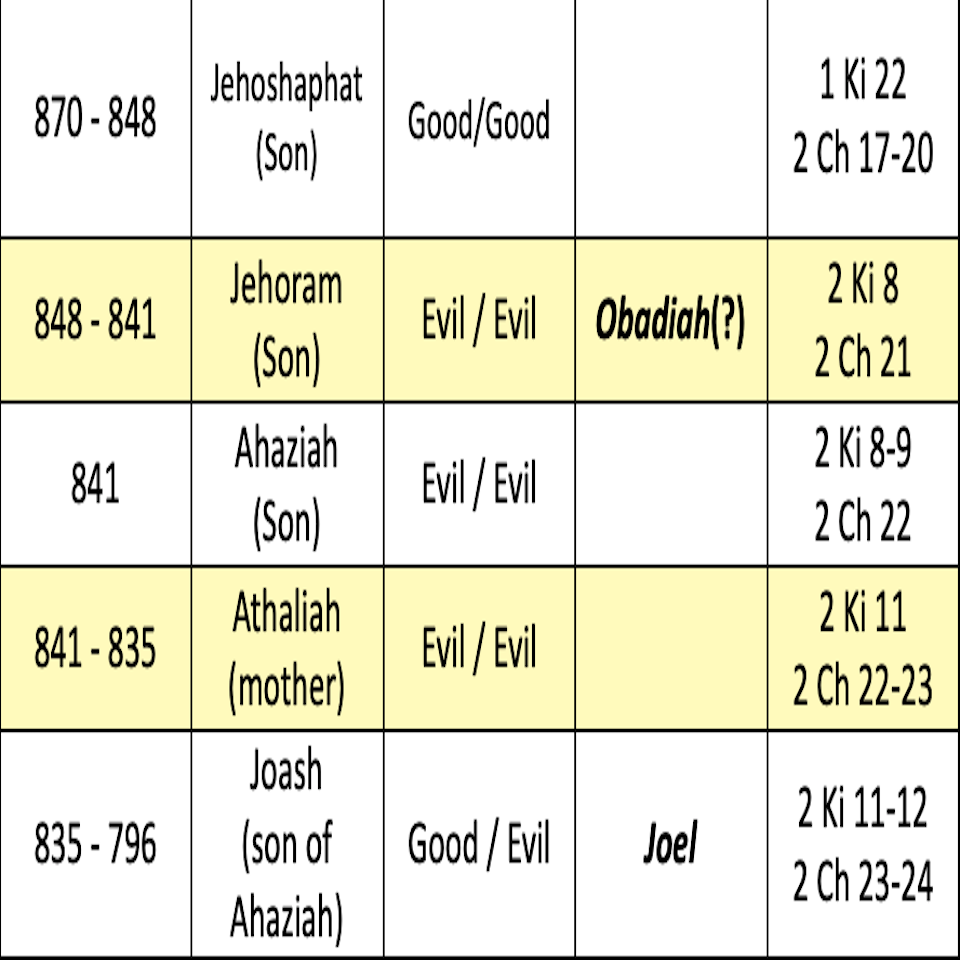 After Jehoshaphat died, his son Jehoram ascends the throne.
His reign as king is only eight years long, and is noted for him walking “in the ways of the kings of Israel” by doing evil in God’s sight (2 Kings 8:15). Jehoram was killed in battle.
Ahaziah his son then sits on the throne in Jerusalem for only a year, manipulated by his mother Athaliah. “He walked in the ways of the house of Ahab and did evil in the sight of the Lord, as did the house of Ahab, for his father was son-in-law of Ahab” (2 Kings 8:27). This alliance led to another disastrous joint military campaign with Israel. Ahaziah was killed by Jehu shortly after this.
Look what happens next: “When Athaliah the mother of King Ahaziah of Judah saw that her son was dead, she arose and destroyed all the royal descendants (2 Kings 11:1). This began a six-year reign of terror in which Athaliah assumed the throne.
Where did all of this mayhem begin? When Jehoshaphat calculated his own destiny.
We have such a limited view; whereas, God is timeless, all-knowing, all-powerful. It is the highest form or arrogance to think we can out-maneuver God’s plan, or that we can even begin to know what’s best for our lives.
The One who has all of our days written in His book is also the One who tells us that we can call to Him to learn things we don’t know and access the wisdom we don’t have (Psalm 139:16; Jeremiah 33:3; James 1:5).
Think of the misery that could have been avoided if Jehoshaphat would have heeded the counsel of his forefather Solomon: “Lean on, trust in, and be confident in the Lord with all your heart and mind and do not rely on your own insight or understanding. In all your ways know, recognize, and acknowledge Him, and He will direct and make straight and plain your paths” (Proverbs 3:5-6 AMPC).
What a miserable strategist I am when I make plans that I think are clever! Instead, I’m trying my best to follow Solomon’s counsel, and I pray you are too.
►► Would you please prayerfully consider supporting this ministry? My Patreon supporters get behind-the-scenes access to exclusive materials. ◀︎◀︎




 Craig T. Owens