Sanctuary Needed

Why is it that a bad morning at school follows you and becomes a bad afternoon at home?

Why is that a bad day at work follows you and becomes a bad evening at home?

We all have a tendency to hang on to things. But the problem is we end up taking out our problems on those who didn’t create the problem. In other words, our family takes the heat from us because we know they will still love us, even after we unload on them. So we make our problem their problem.

Yes, we all need someone to listen to us vent when we’ve had a bad day, or we’ve been snubbed by someone, or we’ve gotten an after-school detention, or we’ve been chewed out by the boss. But venting is different from transferring. Venting is when we express our hurts to someone who loves us; transferring is when we take out our hurts on someone who loves us.

Dr. Richard Dobbins gave some wise counsel on how to avoid doing this:

“Develop the mental and spiritual ability to put space between your workplace [or school] and your home life. Treat your home life like a sanctuary. Don’t bring the feelings created by being treated unfairly in the workplace [or school] home with you.”

Maybe this will help you. Here’s what I do: I have created a boundary line (in my case it’s a road) over which bad attitudes created during the day cannot cross. As I approach home I remind myself that my family was not who gave me trouble, so I’m not going to bring my trouble home to them. If I need to, I’ll stop my car and sit for a few minutes before I cross that boundary, just to make sure my attitude is right before I cross that boundary line.

Where’s your boundary? Where can you make some space, so that your home becomes (and remains) a sanctuary?

Setting A Good Example

Last week I told you about how proud (and humbled) I was by Brandon’s aware-winning essay. The story was covered in the Cedar Springs Post, and you can read it here.

Brandon is wearing a blue shirt, fifth in from the right (in front of his proud parents!).

The One To Copy

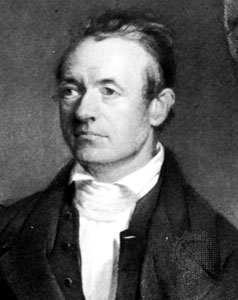
Adoniram Judson was a missionary to India and Burma in the mid-1800s. His passion for missions was so contagious that a group of students at Andover organized America’s first missionary society, and used the reports from Judson as a means to encourage other students to become involved in missions.

Local newspapers and various religious publications began to compare Judson’s missionary work to the ground-breaking and miraculous missionary trips conducted by the Apostle Paul and the other apostles of the New Testament.

Judson began to write letters to the editors, expressing his displeasure at this comparison. In one letter he wrote,

I do not want to be like them. There is but One to copy, Jesus Himself. I want to plant my feet in His footprints and measure their shortcomings by His and His alone. He is the only Copy. I want to be like Him.

Who are you copying? Your parents? Your pastor? Your mentor? Some figure from history?

Truly: There is but One to copy, Jesus Himself.

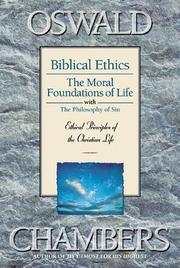
Biblical Ethics (book review)

Like every book from Oswald Chambers, be prepared for Biblical Ethics to hit you right between the eyes! In my lifetime the term ethics has had so many qualifiers added to it: situational ethics … biomedical ethics … wartime ethics. As though ethics becomes something changeable if you are in a difficult situation.

But in clear, unequivocal language, Oswald Chambers brings all ethics back to the Bible.

Keying in most frequently on the teachings of Jesus from the Sermon on the Mount, Chambers helps us get to the true intention behind the ethical requirements of God’s Law. For any who would say, “But it’s too hard to figure out what Jesus actually meant,” Chambers replies,

“When we come across something we don’t like, we say we don’t understand it; it is too plain not to be understood.”

This is not light reading, but it is valuable reading. Serious disciples of Christ will be well-rewarded by reading and studying the wisdom in Biblical Ethics. If you would like to read more thoughts from Oswald Chambers, check out my weekly installment Thursdays With Oswald.

Thursdays With Oswald—Obstinacy Or Determination?

This is a weekly series with things I’m reading and pondering from Oswald Chambers. You can read the original seed thought here, or type “Thursdays With Oswald” in the search box to read more entries.

Obstinacy Or Determination?

     It is easy to be determined, and the curious thing is that the more small-minded a man is the more easily he makes up his mind. If he cannot see the various sides of a question, he decides by the ox-like quality of obstinacy. Obstinacy simply means “I will not allow any discernment in this matter; I refuse to be enlightened.” We wrongly call this strong-mindedness. Strength of mind is the whole man active, not discernment merely from an individual standpoint. The determination in a disciple is a comprehending one, “For I determined not to know any thing among you, save Jesus Christ, and Him crucified,” says Paul.

From Facing Reality

     The difference between an obstinate man and a strong-minded man lies just here: an obstinate man refuses to use his intelligence when a matter is in dispute, while a strong-minded man makes his decision after having deliberately looked at it from all standpoints, and when opposed, he is willing to give reasons for his decision.

From Baffled To Fight Better

“The difference between perseverance and obstinacy is, that one often comes from a strong will, and the other from a strong won’t.” —Henry Ward Beecher

So in hanging onto (and defending) what I believe, am I being obstinate or justly determined? 

Hmmm? What do you think?

City On Our Knees (book review)

If you are familiar with the popular musician/songwriter TobyMac, you may recognize the title of this book from the song with the same name: City On Our Knees. And if you like the message of the song, you will find the book an excellent way to see the message in action.

The overriding message in the song is one of choice:

If you gotta start somewhere why not here
If you gotta start sometime why not now
If we gotta start somewhere I say here
If we gotta start sometime I say now

You and I can choose to start something that will make a difference. This book is a collection of short stories that show people who did just that: they made a choice that made a difference.

They are stories set in the present, and stores from a couple of hundred years ago; they are stories of the educated and the illiterate; the young and the old; the trained and the untrained; men and women. Everyone can find a story that will energize them and help them to choose to act… to choose to make a positive difference.

I can imagine these short stories being especially impactful around a family dinner table, in a Sunday School class, or maybe in a youth group. Wherever you read these stories, let them be the catalyst to help you start now!

I am a Bethany House book reviewer.

Deliver Me

My prayer based on Psalm 91

Almighty God, I resolve to live in Your shelter because it’s the only place I will find rest.
I declare this about You, Lord: You alone are my refuge, my place of safety; my surest trust.
You will rescue me from every trap and protect me from every disease.
You will cover me and shelter me with Your wings.
Your faithful promises are my armor and protection.
I will not be afraid of the terrors of the night, nor the arrow that flies in the day.
I will not dread the disease that stalks in darkness, nor the disaster that strikes at midday.
Though everyone else may give in and give up, I will cling to You for complete victory.
I have chosen to make the Lord my refuge, my shelter, my victory, my total protection.
You have ordered Your  angels to protect me wherever I go.
They will hold me up with their hands so I won’t stumble.
In Your power I will defeat every foe that comes against me.

You, O Lord, have said, “I will rescue those who love Me. I will protect those who trust in My name.
When they call on Me, I will answer; I will be with them in trouble. I will rescue and honor them.
I will reward them with a long life and give them My salvation.”

I take You at Your word, my God. Deliver me!

I love turning God’s Word into prayers! Check out this post where I elaborate on this idea.

Don’t Get Left Behind

This post is especially for the men (but, ladies, feel free to read along too).

No, I’m not talking here about the series of Left Behind books that tell a story about people who may miss out on the rapture of the Church. I’m talking about you leaving the protection of your friends and being exposed to a serious defeat.

Most times when I am counseling men who have given in to a temptation, or those who are battling the same old perplexing problems, I find a common theme. It’s not something new—it’s been around a long, long time.

Take this for example:

In the spring of the year, when kings normally go out to war, David sent Joab and the Israelite army to fight the Ammonites.

You probably know the rest of this sad story: David cannot contain his lust for Bathsheba (another man’s wife) so he seduces her, sleeps with her, gets her pregnant, and then kills her husband to try to cover it up. But look where it all started: David was alone. When he normally would have been with his brothers-in-arms, he stayed behind.

I’m a big believer in accountability, so I’ve written before about a brother who makes sure I stay on the straight-and-narrow. What about you? Are you trying to stay pure all by yourself? Are you battling temptations on your own?

Two people are better off than one, for they can help each other succeed. If one person falls, the other can reach out and help. But someone who falls alone is in real trouble. Likewise, two people lying close together can keep each other warm. But how can one be warm alone? A person standing alone can be attacked and defeated, but two can stand back-to-back and conquer. (Ecclesiastes 4:9-12)

Don’t try to go into battle all by yourself. If David—a man after God’s own heart—couldn’t win on his own, what makes you think you can?

Being Quiet

I love technology. But along with all of the technology comes a whole lot of noise. Not necessarily the noise that your ears pick up, but the noise in your mind.

  • We’ve got Facebook for the latest social updates
  • Twitter and blogs for the latest news and commentary
  • Flickr, Twitpic, and Intragram for the latest pictures
  • LinkedIn for the latest business interactions
  • Smart phones for instant messaging

And if we miss out on any of those things, we feel left behind.

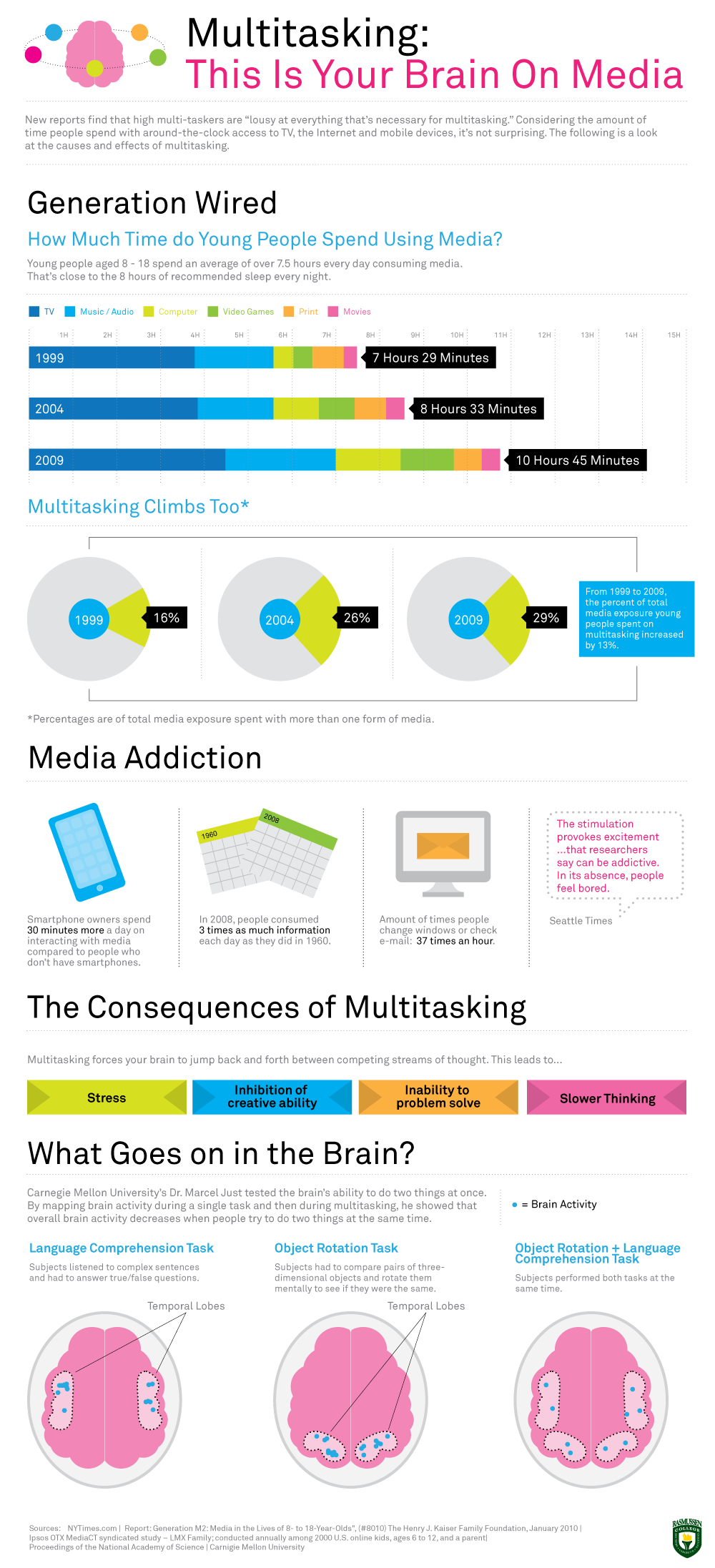
Here’s the ironic thing about all of this social media. Trying to keep up with everything and everyone raises the level of cortisol (a stress hormone) in our bodies. And cortisol actually increases anti-social behavior.

Look what multi-tasking does to our brains


In the midst of trying to tune in and keep up with all of these other voices, we often miss out on the most important Voice.

Jesus says: Listen! I am standing and knocking at your door. If [not when] you hear My voice and open the door, I will come in and we will eat together. (I added the bracketed commentary.)

Today I’m trying to quiet all of the other voices and just listen to The Voice. So today is a media/technology fast.

  • No blogging (I wrote this post yesterday)
  • No Twitter or Facebook
  • No texting
  • No iPod or TV or computer time

I’m taking time to make sure I’m tuning into the most important Voice. I challenge you to try it too. Listen to see what Jesus has to say to you.

Taking A Rest

“This Sabbath is then kept holy unto the Lord, when men, after a due preparing of their hearts, and ordering of their common affairs beforehand, do not only observe an holy rest all the day from their own works, words, and thoughts about their worldly employments and recreations; but also are taken up the whole time in the public and private exercises of his worship, and in the duties of necessity and mercy.” —Westminster Confession

“A holy rest” is usually a hard concept to grasp. When we rest we often feel one of two things:

  • There is something I should be doing <or>
  • I’m just lazy!

But rest is not the same thing as inactivity.

Rest is really different activity—rest is preparation for activity. The rabbis teach that a day of rest is supposed to be a day of distinction: a day that’s so different from the other six days of the week. Creating this day of distinction requires a lot of serious thought to prepare (“a due preparing of their hearts,” as the Confession says).

We need to take time to be OFF. You and I are not wired to be ON all the time. So as you contemplate a Sabbath day of rest for your life, think about this:

I’m going to be OFF tomorrow, so that I can be better ON to start the week.

Read the rest of this entry »