


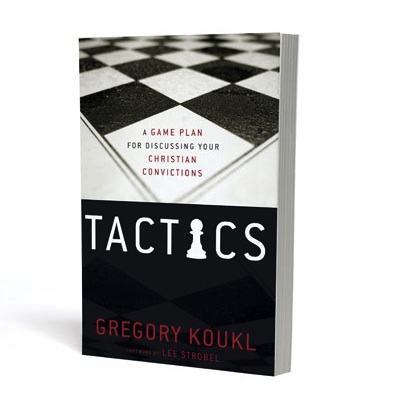
 In Tactics Greg Koukl gives Christians more how than what/why in defending the Biblical faith. It is an outstanding read that I recommend to all Christians (young or old). You can read my full book review by clicking here. Below are just a few of the quotes I highlighted in this empowering book.
“First, Christ’s ambassadors need the basic knowledge necessary for the task. They must know the central message of God’s kingdom and something about how to respond to the obstacles they’ll encounter on their diplomatic mission. … However, it is not enough for followers of Jesus to have an accurately informed mind. Our knowledge must be tempered with the kind of wisdom that makes our message clear and persuasive. This requires the tools of a diplomat, not the weapons of a warrior, tactical skill rather than brute force. Finally, our character can make or break our mission. Knowledge and wisdom are packaged in a person, so to speak. If that person does not embody the virtues of the kingdom he serves, he will undermine his message and handicap his efforts.”
“The tactical approach requires as much careful listening as thoughtful response.”
“It is not the Christian life to wound, embarrass, or play one-upmanship with colleagues, friends, or even opponents, but it’s a common vice that anyone can easily fall into.” — Hugh Hewitt
“Always make it a goal to keep your conversations cordial. Sometimes that will not be possible. If a principled, charitable expression of your ideas makes someone mad, there’s little you can do about it. Jesus’ teaching made some people furious. Just make sure it’s your ideas that offend and not you, that your beliefs cause the dispute and not your behavior.”
“The ability to argue well is vital for clear thinking. That’s why arguments are good things. Arguing is a virtue because it helps us determine what is true and discard what is false. … Paul warns against wrangling about words and quarreling about foolish speculations (2 Timothy 2:14, 23). But he also commands us to be diligent workmen, handling the word of truth accurately (2 Timothy 2:15). And, because some disputes are vitally important, Paul solemnly charges us to reprove, rebuke, and exhort when necessary (2 Timothy 4:112). This cannot be done without some confrontation, but disagreement need not threaten genuine unity.”
“If you want skeptics to believe in the Bible, don’t get into a tug-of-war with them about inspiration. Instead, invite them to listen—to engage Jesus’ words firsthand—then let the Spirit do the heavy lifting for you.”
“You have to know why Jesus is the only way before it is helpful to tell people that He is the only way.”
“There are three specific things you can do to ‘ready’ yourself to respond. You can anticipate beforehand what might come up. You can reflect afterward on what took place. And in both cases you can practice the responses you think of during these reflective moments so you will be prepared for the next opportunity.”
“Knowing when to step back requires the ability to separate the hogs and the dogs from the lost sheep looking for a shepherd. But how do you know when someone has crossed the line? When do we have an obligation to speak, and when should we save our pearls for another time? Part of the answer can be found in Jesus’ next words in Matthew 7:6: ‘…lest they trample [the pearls] under their feet, and turn and tear you to pieces.’ Be generous with the truth except with someone who shows utter contempt for the precious gift being offered him. He will simply trample it in the mud and then viciously turn on you. … There is an exception to this principle, however. I have learned from my radio show that sometimes my real audience is not the person I’m talking to, but the people who are listening in, eavesdropping on the conversation. … Lee Strobel calls this ‘ricochet evangelism.’”
“When I face an aggressive challenger, I often give him the last word. Not only is this gracious, it’s also powerful, conveying a deep sense of confidence in one’s own view. Instead of fighting for the final say-so, give it away. Make your concluding point clearly and succinctly, and then say, “I’ll let you have the last word.” But don’t break this promise. Grant him his parting shot, and then let it rest.”
“Know the truth. Know your Bible well enough to give an accurate answer. Tactics are not a substitute for knowledge. Cleverness without truth is manipulation.”
“Culture is most profoundly changed not by the efforts of huge institutions, but by individual people.” —Chuck Colson



 Craig T. Owens