Sharper

Yesterday was one of those days that I was in “receive” mode. As a pastor, I usually spend more days in the “dispense” mode: teaching, counseling, advising. But yesterday I was blessed to sit back and soak in some great counsel. And I’m sharper for it.

It’s too bad that many people never take the time to allow others to advise them. Or, if they do go through the motions of “listening” to advice, they never put that counsel into action.

I met with a seasoned pastor yesterday morning. He asked me several questions to assess where I was personally and professionally, and then he gave me some invaluable insight. He’s one of those “been-there-done-that” guys who has learned the lessons of history well, and he was gracious to share with me.

Last night I invited my Impact teaching team over to my house. After sharing dinner together I listened as they weighed in on our upcoming series in our youth services. Since they are closer in age to our students, their insight into the teenage mind was so keen. They were able to help me better understand the challenges and culture of middle and high school students. And I’m sharper for it.

A few thoughts from some other wise counselors:

“A wise man will hear, and will increase learning; and a man of understanding shall attain unto wise counsels.” —Proverbs 1:5 (KJV)

“Those who will not be counseled, cannot be helped. More souls are ruined by pride than by any other sin whatever.” —Matthew Henry

“Without good direction, people lose their way; the more wise counsel you follow, the better your chances.” —Proverbs 11:14 (The Message)

“Plans fail for lack of counsel, but with many advisers they succeed.” —Proverbs 15:22 (NIV)

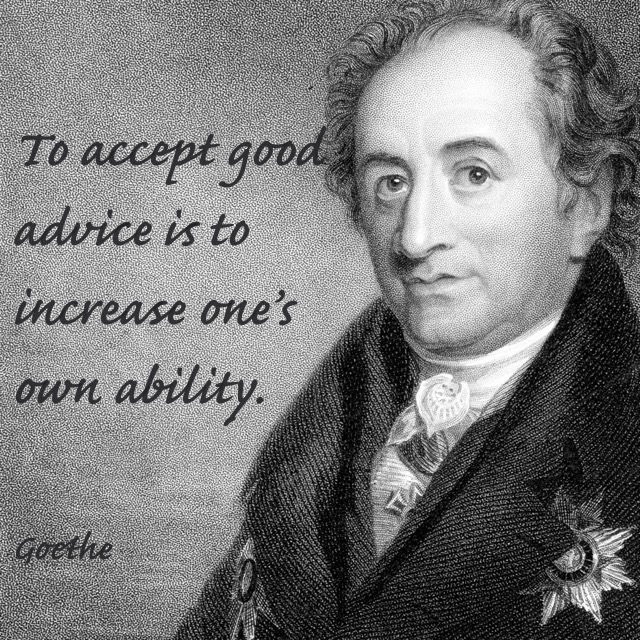
“To accept good advice is to increase one’s own ability.” —Goethe

Are you getting sharper? Are you listening to good advice?

I Am What I Think I Am

Years ago I read a book that transformed the way I read and studied. This one book probably caused me to become a more discriminating reader than any other factor. Although it’s less than 50 pages long, As A Man Thinketh by James Allen revolutionized my thinking. Over the last couple of days, I’ve been listening to the audiobook as I have been driving around.

Here’s a quote from James Allen:

A man is literally what he thinks, his character being the complete sum of all his thoughts. … A noble and Godlike character is not a thing of favor or chance, but is the natural result of continued effort in right thinking, the effect of long-cherished association with Godlike thoughts.”

This is what the Bible says about the seeds of great thoughts:

“Finally, brethren, whatever things are true, whatever things are noble, whatever things are just, whatever things are pure, whatever things are lovely, whatever things are of good report, if there is any virtue and if there is anything praiseworthy—meditate on these things.”

What are you thinking about today? What’s going in? You are making yourself by what you are thinking, so choose those thought-stimulators wisely.

Doing Thinking Doing

To think or to act? That is the question. Or maybe the question should be, which comes first: the thinking or the acting? Do I think about something and then go do it? Or do I do something first and then think about what I’ve done and how I could do it better next time?

The answer, I believe, is yes.

You could be the most creative thinker in the world, your thoughts could be off on another plane, but if you do nothing with what you’re thinking, all of those great insights are wasted.

On the other hand, many people hold to the axiom that experience is the best teacher, so they just do and do and do. But experience is not the teacher; we only learn when we stop to think about what we’ve done.

William Wilberforce was already a rising star in British politics when he experienced a deeper understanding of his relationship to God. Suddenly this man of word and action wanted to do nothing more than meditate on the greatness of God. Wilberforce believed that he could best serve God by withdrawing from society and simply thinking about God.

His good friend and future prime minister William Pitt disagreed. Pitt wrote to Wilberforce, “Why then this preparation of solitude which can hardly avoid tincturing the mind either with melancholy or superstition? … Surely the principles as well as the practice of Christianity are simple and lead not to meditation but to action.” Or as the line from Amazing Grace has it, “We humbly suggest you can do both.”

I love Oswald Chambers’ counsel—

“God will never allow us to divide our lives into sacred and secular, into study and activity. We generally think of a student as one who shuts himself up and studies in a reflective way, but that is never revealed in God’s book. A Christian’s thinking ought to be done in activities, not in reflection, because we only come to right discernment in activities.”

Whether it starts with thinking or starts with action, successful thinking-doing must include both. Think about it → act on it → think about your results → do it again better than last time.

Paul wrote to the Romans how thinking and action work together when he said, “for their own conscience and thoughts either accuse them or tell them they are doing right” (Romans 2:5 NLT). The Amplified Bible renders this phrase, “their consciences (sense of right and wrong) also bear witness; and their decisions (their arguments of reason, their condemning or approving thoughts) will accuse or perhaps defend and excuse them.”

Think about it → do it → think about it → do it = the pattern for success.

Are You Out Of Your Mind?

I love this thinking thought from James William Fulbright—

“We must dare to think ‘unthinkable’ thoughts. We must learn to explore all the options and possibilities that confront us in a complex and rapidly changing world. We must learn to welcome and not to fear the voices of dissent. We must dare to think about ‘unthinkable things’ because when things become unthinkable, thinking stops and action becomes mindless.”

After you have identified the negative thoughts and you have started thinking creatively, you have to be able to take it further. You have to be able to think unthinkable things.

Too many times we don’t let our minds begin to go into “unknown” places, so we look at everything through the lens of what we’ve experienced in the past. Our thoughts are “in our minds.” When Albert Einstein began to propose that there were more dimensions to our universe than scientists had previously thought, people had a hard time following his reasoning. Even those in the scientific community thought he was “out of his mind.”

One of Einstein’s favorite books was called Flatland. In this book, Square lives in the two-dimensional world that Sphere came to visit. Because Square’s world only has length and width (no height), he can only see the part of Sphere that was on his level. As Sphere moves through Flatland, Square can see different parts of him, but he can never see all of him at the same time. If Sphere moves above Flatland, Square can still hear his voice but cannot see his shape.

So, too, with us. Many times we only perceive what moves through the “line of sight” we have previously experienced. We are—so to speak—in our minds.

But look what God has in store for you—

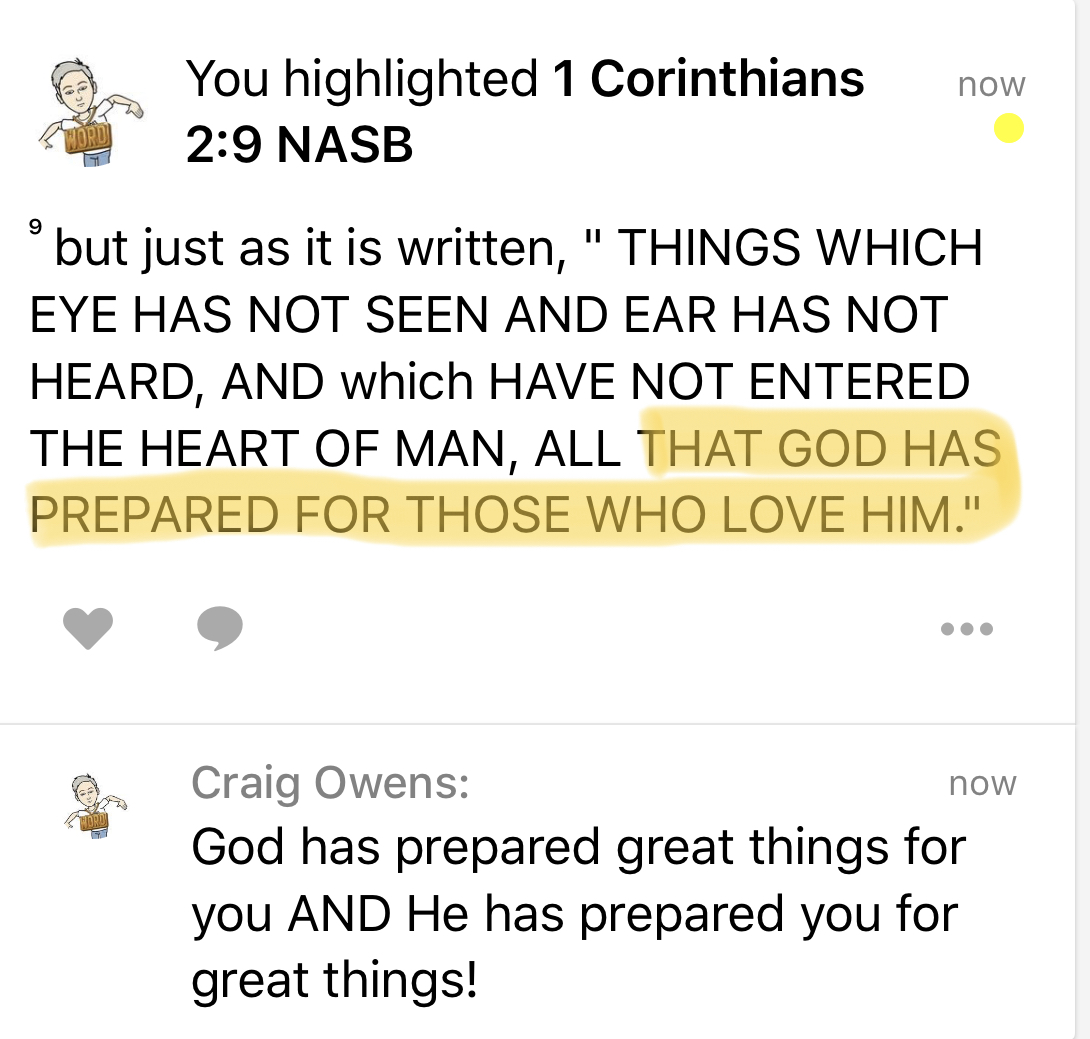
No eye has seen, no ear has heard, and no mind has imagined what God has prepared for those who love Him. (1 Corinthians 2:9 NLT)

So here’s how Scripture teaches us to pray—

I pray that from His glorious, unlimited resources He will empower you with inner strength through His Spirit. Then Christ will make His home in your hearts as you trust in Him. Your roots will grow down into God’s love and keep you strong. And may you have the power to understand, as all God’s people should, how wide, how long, how high, and how deep His love is. May you experience the love of Christ, though it is too great to understand fully. Then you will be made complete with all the fullness of life and power that comes from God. Now all glory to God, who is able, through His mighty power at work within us, to accomplish infinitely more than we might ask or think.(Ephesians 3:16-20 NLT)

God wants to do infinitely more than you can ask or think. He wants to show you new dimensions of His greatness and His love—notice that Paul goes out of his way to list four dimensions (wide, long, high, deep) even though we live in a three-dimensional world.

Here’s the question: are you OUT of your mind or IN your mind? In other words, are you only looking for things that you know can happen, or are you believing God for things that are completely OUT OF YOUR MIND?

Thinking About What You’re Thinking About

When was the last time you thought something new for the first time? Atheist Bertrand Russell said something painful, but true, “Most men would rather die than think. Many do.”

I’ve written before about the most important and most lengthy conversation all of us have every day. It’s the conversation we have with ourselves—it’s called thinking. But for many people, their thinking is stuck in a rut.

I’ve often had conversations with people bucking against a new thought where I have asked them why they believe what they believe. Far too many times they tell me, “That’s just the way I was raised.” Okay, but what do you think about it? “I don’t know. That’s just the way I was raised.”

Two books that have really helped my thinking are As A Man Thinketh (James Allen) and Thinking For A Change (John Maxwell). Allen uses the analogy of our minds as gardens where we need to constantly pull out the weeds and plant the thoughts that will bear the fruit we desire. Maxwell challenges us to look differently at the way we think our thoughts.

The Apostle Paul tells us to take captive every thought and make it obedient to Christ (2 Corinthians 10:5). And then we can begin to change the way we think: Fix your thoughts on what is true, and honorable, and right, and pure, and lovely, and admirable. Think about things that are excellent and worthy of praise (Philippians 4:8).

“Rarely do we find men who willingly engage in hard solid thinking. There is an almost universal quest for easy answers and half-baked solutions. Nothing pains some people more than having to think.” —Martin Luther King, Jr.

If your thinking is ever going to go to a higher level it has to start with this: You have to be willing to think about what you’re thinking about.

In other words, why are you thinking what you’re thinking? Start capturing the thoughts running through your mind and ask them, “Why are you here?” Are you thinking what you’re thinking because you thought it, or because someone else thought it for you?

It is only by capturing the thoughts that are already in your head that you can sort out the healthy thoughts from the unhealthy thoughts.

Sharper Thinking

Yesterday I was challenged to do a lot of thinking. To think about things I’ve not considered before, and to think about things I have considered before but from a different perspective.

Yesterday a fellow pastor convened a Pastor’s Leadership Thinking Lab. The purpose was to use Warren Bullock’s book When The Spirit Speaks as a springboard to talk about the vocal gifts of the Holy Spirit in operation in our church services (see 1 Corinthians 12-14). At the outset, we all reaffirmed our unwavering commitment to our fellowship’s fundamental truths—those were non-negotiable. The challenge was to think about and discuss the practicalities of the how’s in our church services.

It was a bit intimidating being in the room with such smart people. These are guys with way more education and experience than me—guys who have had the privilege of studying and discussing this topic with some of the greatest Pentecostal thinkers of our generation. I felt a little out of place. In fact, during the lunch break, one of my friends commented, “Have you ever felt like that in a roomful of tuxedos you’re the one brown shoe?” My feelings exactly.

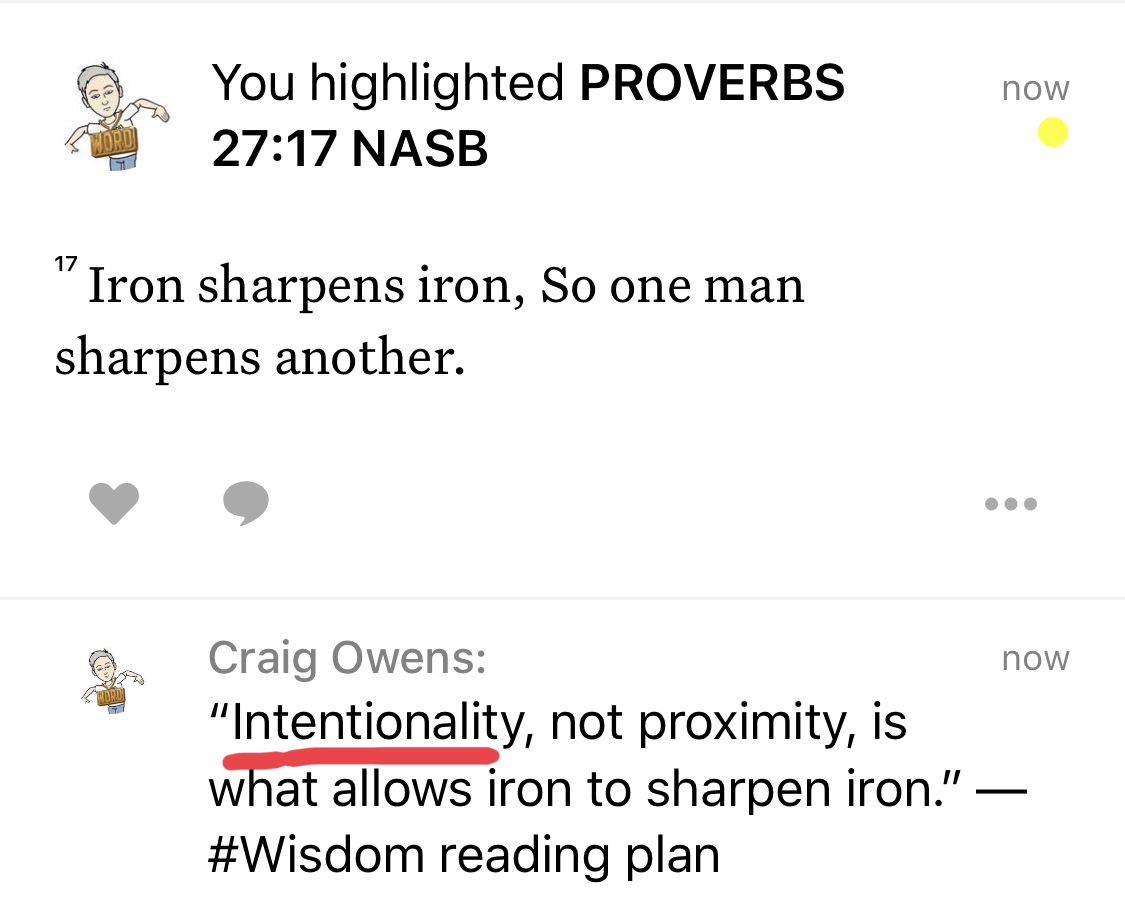
But King Solomon wrote, “As iron sharpens iron, so one man sharpens another” (Proverbs 27:17). The iron of my colleagues definitely sharpened me yesterday.

I also like what John Maxwell said, “Some of my best thinking has been done by others.” In other words, these really smart guys have thought about some things in ways I haven’t; they’ve been exposed to some great thinkers that I haven’t; they’ve experienced some things that I haven’t. But spending the day with them was like getting that education they received, having those conversations with great thinkers they had, and experiencing those things they experienced.

Did I agree with everything that was shared? No.

Was I challenged to think differently? Yes.

F. Scott Fitzgerald wrote, “The truest test of a first-rate mind is the ability to hold two contradictory ideas at the same time, and still retain the ability to function.”

If you really want to sharpen your thinking, get around some people smarter than you. Spend time with people who see things differently than you. But most of all, make sure these folks are one in purpose with you. All of the guys in this Lab shared the same passion to see God glorified and people drawn into a deeper relationship with Jesus. That’s what made yesterday so rewarding for me.

Do you have some “iron” friends in your life that are sharpening your thinking?