Cry Before You Confront

Listen to the podcast of this post by clicking on the player below, and you can also subscribe on AppleSpotify, or Audible.

As a pastor, one of your responsibilities is to point out what may be harmful in someone’s life. We have a word for that: confrontation.

Handled correctly, confrontation can lead to restoration and newfound maturity. Handled incorrectly, and, well, let’s just say it can get very ugly!

I just heard the story of a pastor who felt like he needed to confront one of his board members. I don’t really know this pastor, nor do I know the board member; I don’t know what was said in their meeting, but I have heard about the outcome, and it got ugly.

Samuel was going to be sent by God to confront King Saul about the sin he had committed. Look at this passage:

Then the word of the Lord came to Samuel: “I am grieved that I have made Saul king, because he has turned away from Me and has not carried out My instructions.” Samuel was troubled, and he cried out to the Lord all that night. (1 Samuel 15:10-11)

Did you catch how Samuel responded? He cried out to the Lord all that night.

Perhaps if we, as pastors, cried before we confronted the results might be more healthy.

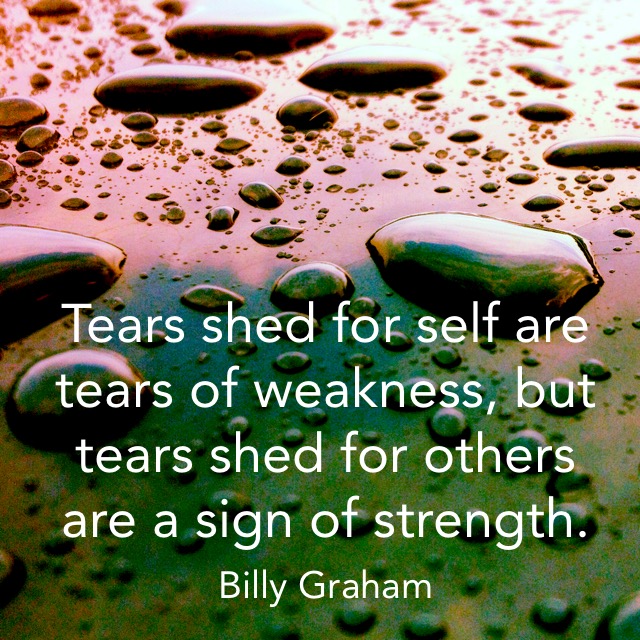
“Tears shed for self are tears of weakness, but tears shed for others are a sign of strength.” —Billy Graham

Nehemiah was another pastoral/prophetic figure that was going to confront the inhabitants of Jerusalem about their sin.

When I heard these things, I sat down and wept. For some days I mourned and fasted and prayed before the God of heaven. Then I said: …I confess the sins we Israelites, including myself and my father’s house, have committed against You. (Nehemiah 1:4-6)

Before Nehemiah confronted the sins of the people, he tearfully took a hard look at himself, and then asked for forgiveness. Jesus shared this same concept with these words:

Why do you look at the speck of sawdust in your brother’s eye and pay no attention to the plank in your own eye? How can you say to your brother, “Let me take the speck out of your eye,” when all the time there is a plank in your own eye? You hypocrite, first take the plank out of your own eye, and then you will see clearly to remove the speck from your brother’s eye. (Matthew 7:3-5)

So before you confront your brother or sister, let the Holy Spirit confront you. Then, if it’s needed, confess your sin and ask God’s forgiveness. Let the Holy Spirit remove things in your life so that you can see clearly how to lovingly confront your brother.

Cry before you confront. Cry over your sin. Cry over the sinful state of your brother or sister. Plead with the Lord for this time of confrontation to lead to restoration and maturity.

►► Would you please prayerfully consider supporting this ministry? My Patreon supporters get behind-the-scenes access to exclusive materials. ◀︎◀︎

AND

It’s a small conjunction that can have enormous impact on your life. Everyone loves it when you can have your cake AND eat it too. Isn’t that way better than having a cake but not getting to eat any of it? For God followers, AND takes on an added power.

Look at this verse:

We prayed to our God AND posted a guard day and night to meet this threat.

Of course Christians would never say, “We posted a guard but didn’t pray to God.”

But far too often Christians live this way: “We prayed to God but didn’t post a guard.”

Sometimes God provides supernaturally, and sometimes God provides through our efforts. In either case, God is still the provider. How sad that we often limit what God can do because we replace AND with but.

How about this instead…

  • Pray to God for healing AND see a doctor.
  • Pray to God for provision AND get a job.
  • Pray to God for a successful marriage AND learn to love your spouse better.
  • Pray to God for your church to grow AND invite your neighbor to a service.
  • Pray to God to protect your kids AND stay involved in their lives.
  • Pray to God to strengthen you against temptation AND get an accountability partner.

Start with prayer, then add AND.

Where will you add AND to your prayers today?

How Noble Do You Want To Be?

Sometimes I find the most thought-provoking phrases buried in the middle of passages in the Bible that seem somewhat obscure. Take this line from the book of Nehemiah, where we read who’s rebuilding which section of the Jerusalem wall…

The next section was repaired by the men of Tekoa, but their nobles would not put their shoulders to the work under their supervisors.

This chapter lists all kinds of people working on the wall: priests (including the high priest) … goldsmiths … perfume-makers … temple servants … mayors … even Shallum’s daughters. Everyone, it seems, was willing to pitch in except these nobles.

Many times in the Old Testament this Hebrew word for nobles is used to describe God Himself. In other words, these nobles thought they were far too important to put their shoulders to the work.

Jesus washed feet. The noblest of us all came to earth to serve even the lowest of the servants.

Which do you think was really the most noble?

How noble do you want to be?

Flash Prayers

Many people have a lot of misconceptions about prayer. Some people think that prayer has to be long, or that it has to include certain “spiritual” phrases, or that you have to address God by one of His Hebrew titles, or that you have to pray in King James English (using words like Thou knowest…).

I’m not knocking any of these things, but neither am I saying any or all of them have to be included.

  • Some prayers recorded in the Bible are very short, and some prayer times last for days or even weeks.
  • Some prayers include very formal language, and some are just the street language of the day.
  • Some prayers address God with a specific title, and some don’t.

Here’s the key thing: they are all very personal. Each prayer reflecting the unique personality and the unique circumstance of the one doing the praying.

Nehemiah was a confidant of King Artaxerxes of Persia. One day the king noticed something he hadn’t seen before: Nehemiah was frowning. The king asked, “What’s up, Nehemiah?” Look what Nehemiah wrote:

Then I prayed to the God of heaven, and I answered the king.

Nehemiah’s prayer was silent and extremely quick. It was a flash prayer.

But here’s what makes this prayer so powerful and effective. Nehemiah started praying for an opportunity to talk to the king about an important issue four months earlier. Nehemiah even took time to fast during his prayer time. His initial prayer to God is very formal sounding, and somewhat long. This prayer was rolling around in his heart and mind for quite awhile.

Then when the opportunity came to talk to the king, Nehemiah could quickly breathe a prayer to God, “Help me!”

I think is exactly what Paul had in mind when he told us to pray without ceasing.

Pray out loud … pray quietly … pray long … pray short … pray formally … pray casually … pray personalized prayers all the time.

I’m working on this.

Good And Angry

When was the last time you got good and angry? Be careful how you answer because I want you to notice that important conjunction AND. So maybe I should ask the question this way: when was the last time you got angry and were still good?

Aristotle correctly pointed out, “Anybody can become angry—that is easy; but to be angry with the right person, and to the right degree, and at the right time, and for the right purpose, and in the right way—that is not within everybody’s power and is not easy.”

Over the past week, I’ve been studying the life and leadership of Nehemiah, an incredible leader who rebuilt the walls of Jerusalem. But when I got to the final chapter of his account, I noticed quite a bit of anger coming from Nehemiah. As a kid, I used to have to really battle against my temper, so this aspect of Nehemiah’s life intrigued me. Can someone be good AND angry?

I think that the deeper I love someone or something, the greater my anger will be towards anyone or anything that violates what I love.

Nehemiah loved God and he was passionate to see God’s holiness magnified. All of his anger is directed at those people or things that violated or detracted from God’s holiness. Look how he got good AND angry

  • Towards Tobiah, who moved his personal belongings into God’s temple, a place reserved exclusively for the worship of God. “I was angry, really angry, and threw everything in the room out into the street, all of Tobiah’s stuff” (v. 8).
  • Towards the people who stopped financially supporting the priests, forcing the priests to leave the temple and work as farmers. “I immediately confronted the leaders and demanded, ‘Why has the Temple of God been neglected?’” (v. 11).
  • Towards those who violated the regulations of the Sabbath Day. “I got angry and said to the leaders of Judah, ‘This evil you are doing is an insult to the Sabbath!’” (v. 17).
  • Towards those tried to get around Nehemiah’s new Sabbath Day regulations. “I spoke sharply to them and said, ‘What are you doing out here, camping around the wall? If you do this again, I will arrest you!’” (v. 21).
  • Towards those who had intermarried with false-god-worshipping people. “I rebuked them and called curses down on them. I beat some of the men and pulled out their hair” (v. 25).
  • Towards Joiada, a priest who married a non-God-fearing woman. “I banished him from my presence” (v. 28).

After each of these incidents, you might expect Nehemiah to regret what he had done and think to himself, “Perhaps I overdid it. Maybe I was too zealous, or maybe I went a little overboard.” But instead, each time Nehemiah was righteously angry he prayed this to God, “Remember me for this, O my God. Remember me with favor because of what I have done” (vv. 14, 22, 29, 31). He was unashamed that he got good AND angry.

The Bible says, “Go ahead and be angry. You do well to be angrybut don’t use your anger as fuel for revenge. And don’t stay angry.”

Can you be good AND angry? Yes! In fact, I think being good helps us be angry with the right person or thing, in the right way, for the right purpose, and for the right length of time. 

(Re)(Un)Learning

Alvin Toffler wrote, “The illiterate of the future are not those who cannot read or write, but those who cannot learn, unlearn, and relearn.” For me, the Sabbath Day—a day God institute as a break from our day-in-day-out routine—is the best day to do this (re)(un)learning.

I took an unusual Sabbath break this weekend. Several of my family members are missionaries, and it is rare that they are all in the United States at the same time. This summer happens to be one of those times, so we took full advantage of catching up and relearning one another.

We all met at my grandparents’ old farmhouse in southern Ohio. Grandpa died in 1984, and Grandma died just a few years ago, but their legacies are alive and well. In no particular order, here are a few things I (re)(un)learned this weekend…

  • Nehemiah was an extraordinary leader that I want to emulate.
  • My daughter is a persistent and naturally-talented horse rider.
  • Every time my extended family gets together I learning something new about their past… and my past.
  • I love my family heritage!
  • It was so cool watching all the boys play the same games in the barns that I used to play as a boy!
  • Sleeping in the same room with Betsy but in a separate bed makes for a lousy night of sleep. The closer I am to my best friend, the better I sleep.
  • Eating meals with 15 people around the table forced me to listen more intently to the one who was talking. Why don’t I do this all the time?
  • One should not play American football, rugby, ultimate Frisbee and soccer (world football) on the same day without a good supply of Motrin handy.
  • Bradford, Ohio, is just as I remembered it as a kid. So is my grandparents’ farm.
  • My puppy only had to get shocked once by the electric fence to learn her lesson. Sometimes it takes me more zaps!
  • I missed my new church family this weekend!
  • Fireside chats are one of the best places to really get to know someone better. And a great place to reveal my own heart more intimately.
  • I need to keep my camera close as there is so much that I want to document and preserve for my kids and grandkids.
  • These kinds of weekends should be more regular in my annual calendar.
  • Sitting on the couch snuggling with Betsy is the best wrap-up to any weekend.

Did you (re)(un)learn anything on your Sabbath? Whether or not you did any (re)(un)learning last week, today is the start of a brand new week. Let’s make it a goal to (re)(un)learn something this week, and use our next Sabbath to reflect on it.