


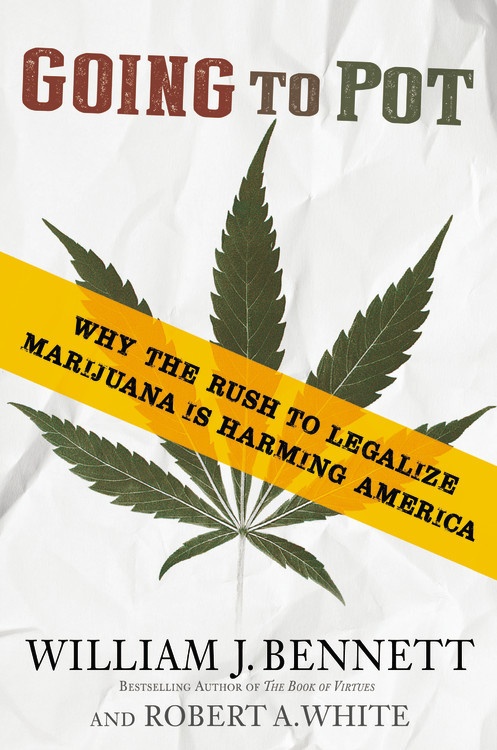
 William Bennett and Robert White have given us an important book, especially during this time when so many are rushing to legalize marijuana in our country. You can read my full book review by clicking here, and below are some of the quotes and statistics I found quite interesting.
“Today’s marijuana THC levels are in the double digits―we’ve gone from about 3 to 5 percent THC in yesteryear’s marijuana to just above 13% THC―but common strains are available that go much higher, into the 20 percents and beyond. The difference between 3 to 5 percent THC and 13 to 30 percent THC is very significant. It is like comparing a 1twelve-ounce glass of beer with a 1twelve-ounce glass of 80 proof vodka.”
“No scientific studies documented the safety or efficacy of marijuana for patients with cancer, HIV, multiple sclerosis, or glaucoma.”
“Marijuana stays in the brain for a long time so that the brain is still experiencing the effects from pot smoking days after the drug use as stopped, in contrast to alcohol use…. Unlike cocaine, which often brings users to their knees, marijuana claims its victims in a slower and more cruel fashion. It robs many of them of their desire to grow and improve, often making heavy users settle for what is left over in life…. Marijuana makes its users lose their purpose and their will, as well as their memory and motivation.” ―Robert Dupont, psychiatrist
“Frequent marijuana smokers can have many of the same respiratory problems experienced by tobacco smokers. … There are 33 cancer-causing chemicals contained in marijuana. … When equal amounts of marijuana and tobacco are smoked, marijuana deposits four times as much tar into the lungs.”
“Teenagers who use marijuana regularly are at greater risk for long-term brain damage and declines in both IQ and cognitive functioning years later.” ―Psychology Today
“Most drug users, over 90 percent of them, including marijuana users, started using drugs in their adolescent years. In fact, if one abstains from substance abuse up to the age of twenty-one, the chances one will ever have a substance abuse problem are next to zero.”
“Marijuana also raises heart rate by 20-100 percent shortly after smoking; this effect can last up to 3 hours. In one study, it was estimated that marijuana users have a 4.8-fold increase in the risk of heart attack in the first hour after smoking the drug.”
“Nationwide, over 70 percent of teens admitted to a substance abuse treatment program claim marijuana as their primary drug of abuse. Neither alcohol, tobacco, nor prescription drugs are responsible for over 70 percent of teen substance abuse problems. It is marijuana that has that dubious distinction.”
“Accidents would increase, healthcare costs would rise and productivity would suffer. Legal alcohol serves as a good example: The $8 billion dollars in tax revenue generated from that widely used drug does little to offset the nearly $200 billion in social costs attributed to its use.” ―Kevin Sabet, a former adviser to President Barack Obama
“In constant dollars, the money spent by Americans on marijuana went up from $21.6 billion in 2000 to $40.8 billion in 2010. That is more than Americans spend each year on pornography, Halloween, and video games combined.”
“Sixty-two percent of the adults who first tried marijuana before they were 15 are likely to go on to use cocaine.”


 Craig T. Owens