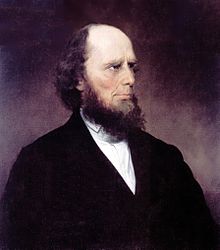
“Brethren, The Fault Is Ours…”

Pastor, these are incredible words spoken by the great Charles Finney nearly 140 years ago! I encourage you to take the time to hear these words with an open heart.

I believe it is a fact generally admitted that there is much less conscience manifested, by men and women, in nearly all the walks of life, than there was forty years ago. There is justly much complaint of this, and there seems to be but little prospect of reformation. The rings and frauds and villainies in high and low places, among all ranks of men, are most alarming, and one is almost compelled to ask: “Can nobody be safely trusted?” Now, what is the cause of this degeneracy? Doubtless there are many causes that contribute more or less directly to it; but I am persuaded that the fault is more in the ministry and public press than in any and all things else. It has been fashionable now for many years to ridicule and decry Puritanism. Ministers have ceased, in a great measure, to probe the consciences of men with the spiritual law of God. So far as my knowledge extends, there has been a great letting down and ignoring the searching claims of God’s law, as revealed in his Word. This law is the only standard of true morality. “By the law is the knowledge of sin.” The law is the quickener of the human conscience. Just in proportion as the spirituality of the law of God is kept out of view will there be manifest a decay of conscience. …The proper guardians of the public conscience have, I fear, very much neglected to expound and insist upon obedience to the moral law.

… The true Gospel is not preached where obedience to the moral law as the only rule of life is not insisted upon. Wherever there is a failure to do this in the instructions of any pulpit it will inevitably be seen that the hearers of such a mutilated Gospel will have very little conscience. …The universal literature of the present day shows conclusively that the moral sense of the people needs toning up, and some of our most fascinating preachers have become the favorites of infidels, skeptics of every grade, Universalists, and the most abandoned characters.

… My beloved brethren in the ministry, is there not a great want in the public inculcations of the pulpit upon this subject? We are set for the defense of the blessed Gospel and for the vindication of God’s holy law. I pray you let us probe the consciences of our hearers, let us thunder forth the law and Gospel of God until our voices reach the capital of this nation, through our representatives in Congress. It is now very common for the secular papers even to publish extracts of sermons. Let us give the reporters of the press such work to do as will make their ears and the ears of their readers tingle. Let our railroad rings, our stock gamblers, our officials of every grade hear from its pulpit, if they come within the sound, such wholesome Puritanical preaching as will arouse them to better thoughts and a better life. Away with this milk-and-water preaching of a love of Christ that has no holiness or moral discrimination in it. Away with preaching a love of God that is not angry with sinners every day. Away with preaching a Christ not crucified for sin.

… Brethren, our preaching will bear its legitimate fruits. If immorality prevails in the land, the fault is ours in a great degree. If there is a decay of conscience, the pulpit is responsible for it. If the public press lacks moral discrimination, the pulpit is responsible for it. If the church is degenerate and worldly, the pulpit is responsible for it. If the world loses its interest in religion, the pulpit is responsible for it. If satan rules in our halls of legislation, the pulpit is responsible for it. If our politics become so corrupt that the very foundations of our government are ready to fall away, the pulpit is responsible for it. Let us not ignore this fact, my dear brethren; but let us lay it to heart, and be thoroughly awake to our responsibility in respect to the morals of this nation. —Charles Finney (December 4, 1873)

Myopia

Myopia is also known as nearsightedness. It occurs when light entering the eye is focused incorrectly, making distant objects appear blurred. Nearsightedness is a type of refractive error of the eye. If you are nearsighted, you have trouble seeing things that are far away.

Myopia is a problem physically and spiritually.

Consider the Apostle Paul. He was in prison, and yet he wrote:

Because of my chains, most of the brothers in the Lord have been encouraged to speak the Word of God more courageously and fearlessly. (Philippians 1:14)

The definition of nearsightedness says that an incorrect refracting of the light makes far object blurry, so we tend to focus only on what’s near to us.

How many of us would have blamed Paul if from his prison cell he cried out, “Why me, O God? What have I done wrong? Please get me out of here!”

This would have been a very myopic view, where Paul was only concerned about what was close; namely, himself and his needs! But Paul allowed the light of God to be properly refracted in his spiritual sight, and he could see the big picture.

As a result of his imprisonment, many other brothers were now encouraged to speak out more boldly than before. 

If you’re going through some trying times, don’t give in to myopia. Lift up your spiritual eyes to your loving Heavenly Father. He can shine the light of His Holy Spirit in a way that just may help you to see what He is accomplishing. Through this you will be encouraged AND be an encouragements to others.

As Billy Graham noted, “Courage is contagious. When a brave man takes a stand, the spines of others are often stiffened.”

Courageous Enough To Interfere

King David was brilliant as a king, and a disaster as a father. One of the things that is very telling is what is not written when his kids mess up. The Bible tells us that David felt strong emotions, but he simply didn’t act on them. In fact, one of the most telling verses of inaction comes when his son Adonijah is trying to put himself on David’s throne—

His father had never interfered with him by asking, “Why do you behave as you do?” (1 Kings 1:6)

It takes courage to interfere with our kids when they are misbehaving.

So why don’t some dads interfere? I can think of a few reasons…

  • They didn’t have a good relationship with their own father. In David’s case, his father Jesse didn’t think too highly of David. In fact, David was the overlooked, almost-forgotten son (1 Samuel 16:8-11).
  • They’re too tired. David was so focused on building up Israel’s defenses, and defeating the bad guys, that he had nothing left emotionally and physically to interact with his kids. We need to make it our priority! John wrote: I have no greater joy than knowing my children all walk in the truth (3 John 4). Now that’s a great priority!
  • Their past sins haunt them. David sinned against Bathsheba (like Amnon did against Tamar); David murdered Uriah (like Adonijah did Amnon). So perhaps he felt like he didn’t have the moral authority to interfere with his sons. But if you read some of the wise sayings in Proverbs 6:20-29 and 7:1-5, they sound like a man who has had experience. Let your hindsight (good or bad) be your kids’ foresight.
  • They think it’s too late. It’s never too late! Never! Apparently, David learned this lesson in time and taught his son Solomon (read Proverbs 1:1 and 4:3-4). As long as there is breath in your lungs, you should be your kids’ dad!

Dads, will you be courageous enough to lovingly interfere with your kids if they are getting off track?

Will you be courageous enough to make some changes in your schedule so that you can invest the time and energy and creativity necessary to raise them up?

Will you be courageous enough to confess your past sins, and not let them hold you back from speaking into your kids’ lives?

Will you be courageous enough to start today?

Dad, you kids need you to be involved! Be courageous enough to step into their lives.

Gutsy Prayer

I am no long my own, but Thine,

Put me to what Thou wilt, rank me with whom Thou wilt.

Put me to doing, put me to suffering.

Let me be employed by Thee or laid aside for Thee,

Exalted for Thee or brought low for Thee.

Let me be full, let me be empty.

Let me have all things, let me have nothing.

I freely and heartily yield all things

To Thy pleasure and disposal.

And now, O glorious and blessed God,

Father, Son, and Holy Spirit,

Thou art mine, and I am Thine. So be it.

And the covenant which I have made on earth,

Let it be ratified in heaven. Amen. (John Wesley’s covenant prayer, 1780)

Wow, that’s a gutsy prayer to pray! I would like to think I can pray this and truly mean it. What about you? Could you really pray this?

Courage

Love this quote from C.S. Lewis—

Courage is not simply one of the virtues, but the form of every virtue at the testing point, which means at the point of highest reality. A chastity or honesty, or mercy, which yields to danger will be chaste or honest or merciful only on conditions. Pilate was merciful till it became risky.

Brave Enough

If God asks me to give $1, I can quickly and easily say, “Yes!”

If God asks me to give $10, I say, “Okay!”

If God asks me to give $100, I say, “Um, well, if You say so.”

If God asks me to give $1000, I say, “I need to pray about this ‘faith promise.’”

If God asks me to give $10,000, I say, “As soon as You bless me, I’ll be able to do this.”

This same principle holds true for anything else:

  • Used clothing? Sure. Brand new stuff? I’m not so sure.
  • Volunteer an hour? Okay! Make a commitment for an hour every week? Let me pray about it.
  • Pray for someone? No problem. Add them to my daily prayer list? Whoa!
  • Support missionaries? Yes! Become a missionary? Well….

It’s easy to obey when we think the stakes are low. But the more “zeroes” that get added to the amount, the higher the stakes seem. Am I brave enough to obey then?

This is what tripped up Saul, Israel’s first king. He was supposed to devote everything from the defeated Amalekites to God. “Devote” means a complete and irrevocable giving to God. When the stakes were low, he obeyed, but when he perceived the stakes being too high, he lost the courage to follow through:

Saul and his men spared Agag’s life and kept the best of the sheep and goats, the cattle, the fat calves, and the lambs—everything, in fact, that appealed to them. They destroyed only what was worthless or of poor quality. (1 Samuel 15:9 NLT)

He captured Agag, king of Amalek, alive. Everyone else was killed under the terms of the holy ban. Saul and the army made an exception for Agag, and for the choice sheep and cattle. They didn’t include them under the terms of the holy ban. But all the rest, which nobody wanted anyway, they destroyed as decreed by the holy ban. (1 Samuel 15:9, The Message)

Ironically, because Saul held on to what he thought was valuable, he lost something invaluable: a close relationship with God. His cowardice led to disobedience, and his disobedience led to his ultimate collapse.

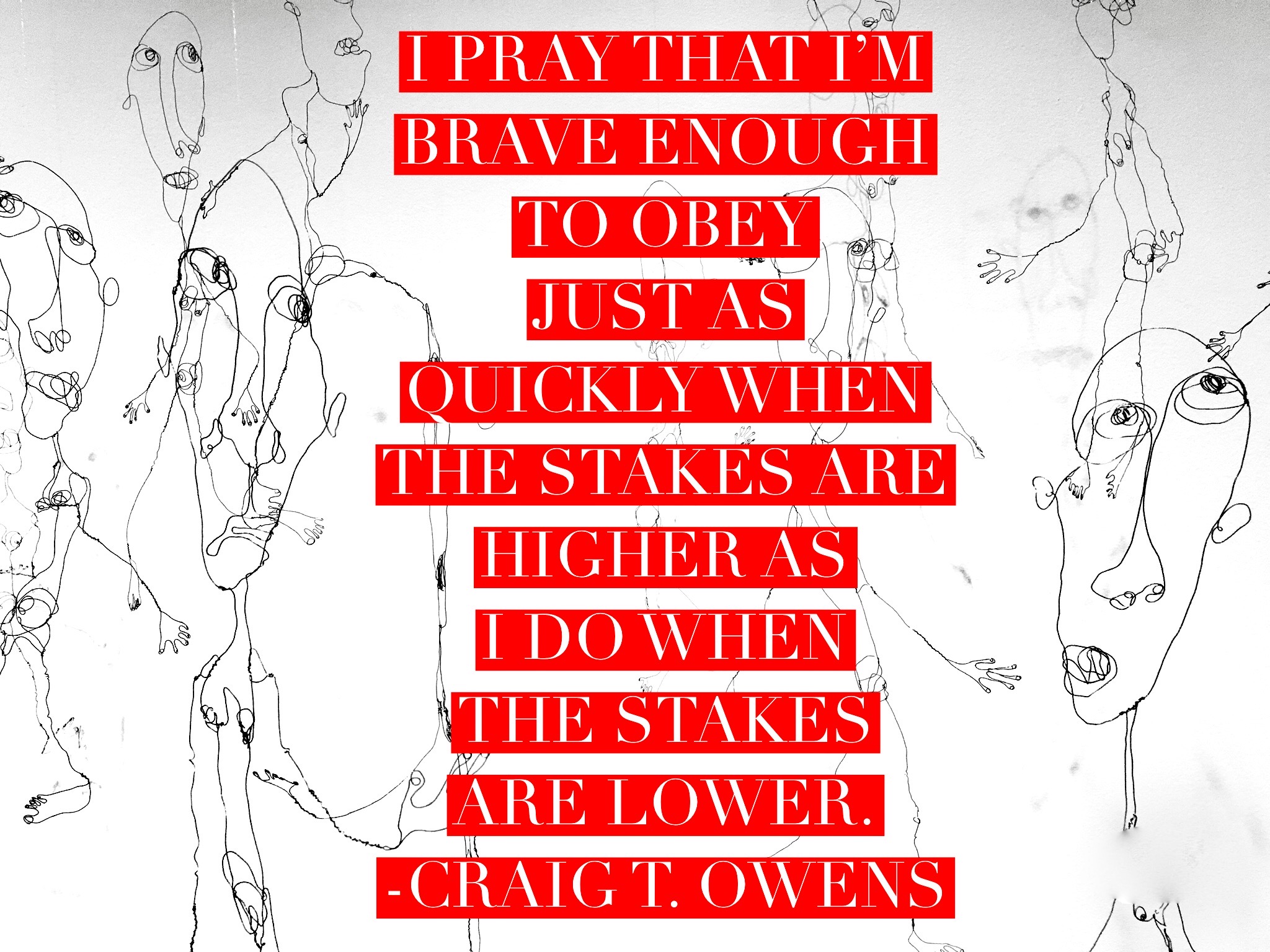
I pray that I’m brave enough to obey just as quickly when the stakes are higher as I do when the stakes are lower.

What about you? Are you brave enough?

The Pits

I recently finished reading two books that both have “the pits” in their title, and they both are solidly based on Scripture. But they couldn’t be more different.

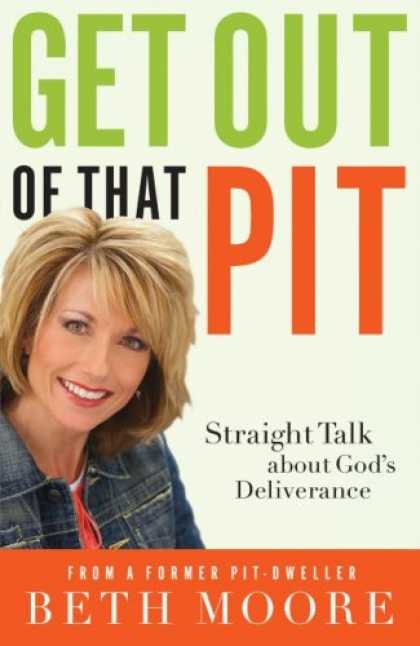
Get Out Of That Pit by Beth Moore is based on three verses in Psalm 40: I waited patiently for the LORD; He turned to me and heard my cry. He lifted me out of the slimy pit, out of the mud and mire; He set my feet on a rock and gave me a firm place to stand. He put a new song in my mouth, a hymn of praise to our God. Many will see and fear and put their trust in the LORD.

Beth’s book is all about getting out of a pit. Those places we’ve slipped into, been shoved into, or keep going back to. Those things that limit our perspective on life. Those hurts that keep us from enjoying the full life Jesus wants to give us. In a word, this book is all about deliverance from a pit.

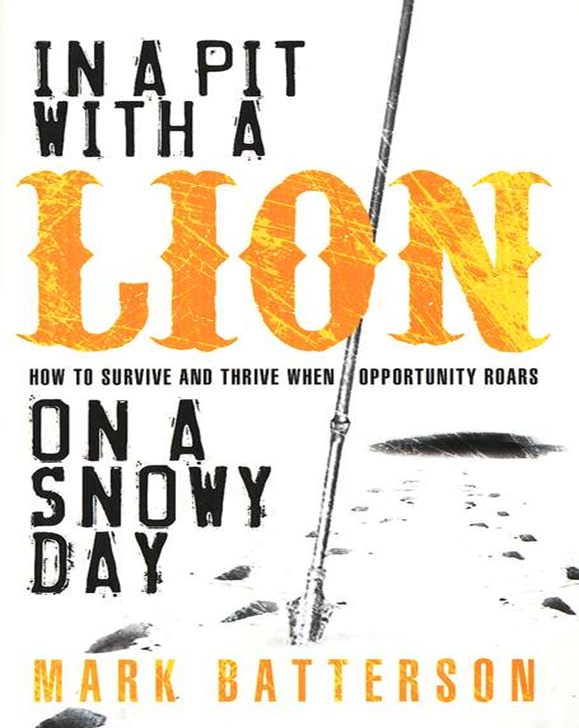
In A Pit With A Lion On A Snowy Day by Mark Batterson is based on two verses in 2 Samuel 23: Benaiah son of Jehoiada was a valiant fighter from Kabzeel, who performed great exploits. He struck down two of Moab’s best men. He also went down into a pit on a snowy day and killed a lion. And he struck down a huge Egyptian. Although the Egyptian had a spear in his hand, Benaiah went against him with a club. He snatched the spear from the Egyptian’s hand and killed him with his own spear.

Mark’s book is all about going into a pit. Benaiah was an initiator. Mark leads us through Benaiah’s life to show us that sometimes problems come as opportunities disguised as Moabite warriors or roaring lions or huge giants. And in order to live the full life God has in mind for us, we have to seize those roaring opportunities. In a word, this book is all about taking the initiative to go into a pit.

The pits can limit your life. Either you can be stuck in one, or you can be afraid to go into one. God wants you to live a victorious life. Whether you are stuck and need deliverance, or you are stuck and need initiative, these books can help awaken in you the great things God wants to do through you.

Both books have discussion questions to go along with each chapter, which makes them excellent for use as either an individual or small group study.

Ready? Go get out of that pit—or dive headlong into one—to live the full life God has for you!

No Cowardly Lions, Please

cowardly-lion2

When Jacob was blessing his sons (Genesis 49) he called Judah a lion’s cub. From that time on the men of Judah were known as skilled and fearsome warriors. Years later The Lion of Judah, Jesus, would come from this noble tribe.

But during the time when the judges ruled Israel, Judah and all of Israel “did evil in the eyes of the Lord” (Judges 13:1), and “all the people did whatever seemed right in their own eyes” (Judges 17:6).

As a result, the mighty lions of Judah became the cowardly lions.

Samson is a well-known judge. He is known for his single-handed exploits against Israel’s enemies. As a result of his victories against them, the Philistines moved into Judah’s territory arrayed for battle.

In response, the mighty lions of Judah muster a force of 3000 warriors. This should look good to the warriors of Judah, since the Philistines came to the battlefield with just 1000 warriors—after all, 3-to-1 seems like good odds.

But instead, the cowardly lions of Judah decided to take all 3000 warriors to confront just one man: Samson. They went to him in the cave where he was staying, not to ask him to join them in battle against the Philistines, but to ask him to surrender to the Philistines.

Samson agreed.

But when the Philistines approached Samson “the Spirit of the Lord came powerfully upon Samson” (Judges 15:14). He picked up a donkey’s jawbone and killed all 1000 Philistines. And when they saw God’s power at work in Samson, the mighty lions of Judah jumped into the fray all around Samson!

Uh, actually, no, they didn’t.

The cowardly lions of Judah were nowhere to be found. When Samson had finished with the Philistines, there was not even one lion of Judah around to give him a drink!

They all ran away.

It’s amazing to see what the Spirit of God does for someone. God’s presence in Samson gave him victory when the odds were 1000-to-1 against him. The lack of God’s presence in the lions of Judah made them cowardly lions even when they had a 3-to-1 advantage and had Samson on their side.

“When you go out to fight your enemies and you face horses and chariots and an army greater than your own, do not be afraid. … For the Lord your God is going with you! He will fight for you against your enemies, and He will give you victory!” (Deuteronomy 20:1, 4)

Don’t try to go to battle on your own. Even if you think you’re a mighty lion, you will end up like the Cowardly Lion if God doesn’t go with you.