Upside (book review)

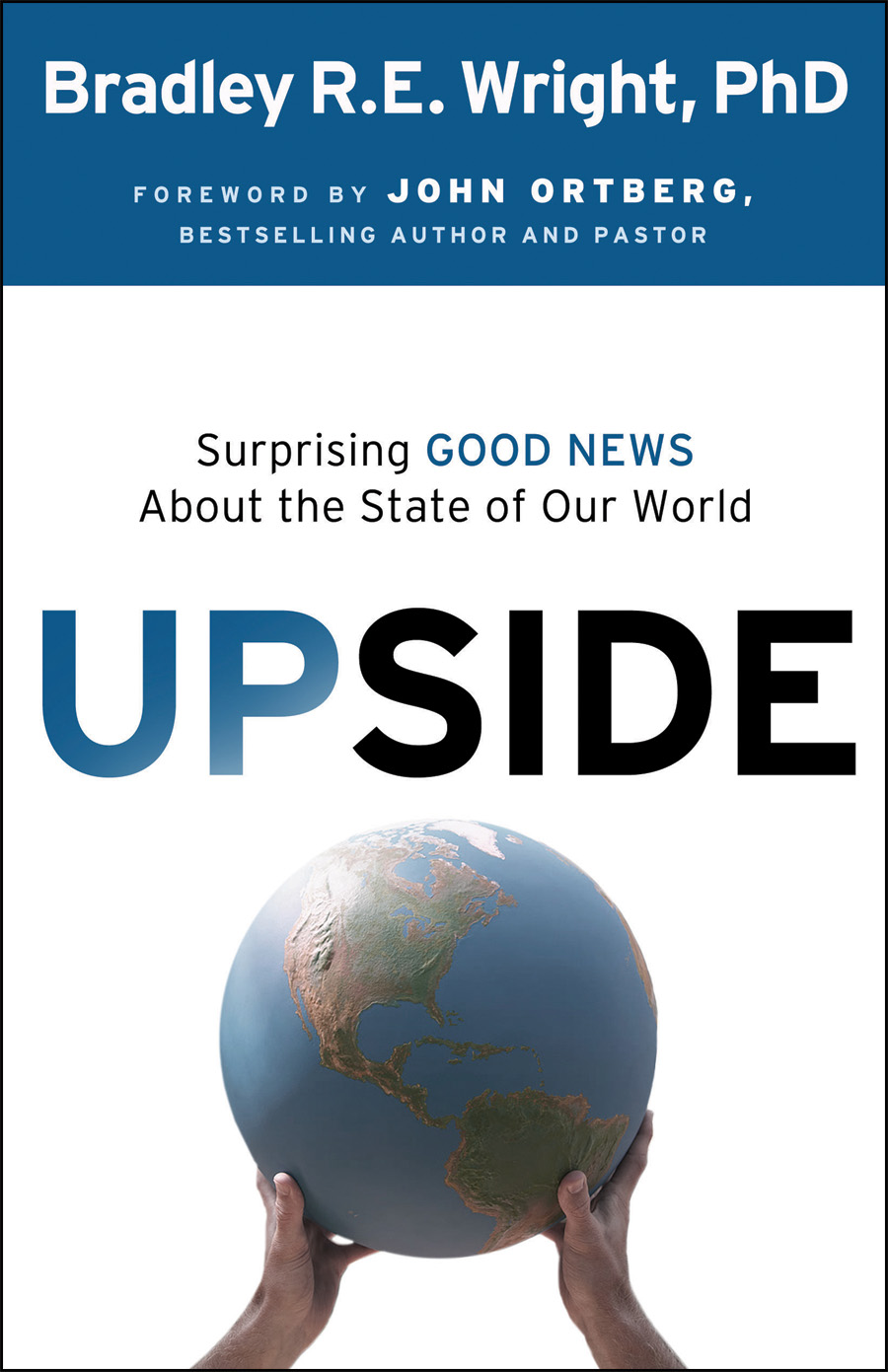
Have you ever heard how a TV news producer decides what the lead story will be? Or how a managing editor decides which stories get the front page of the newspaper? It comes down to this: “If it bleeds, it leads.” Sad, but too often true. With all of this negative news leading, Dr. Bradley R.E. Wright’s book Upside: Surprising Good News About the State of Our World is indeed surprisingly good news!

Dr. Wright notes that sociologist Joel Best “classifies the different types of bad statistics as follows: some numbers are bad to begin with; some numbers get bad as they are passed along; and some numbers are chosen because they are bad.” In other words, there’s just a lot of bad news out there!

But despite all of this negative press, people around the world are surprisingly upbeat. That’s because when a sociologist like Dr. Wright gets a hold of all of these statistics, he can put them into the proper perspective. He looks at the data on a variety of topics:

  • Personal finances
  • Education
  • Health
  • Crime and war
  • Marriage and divorce
  • The environment

“The trouble with this country is that there are too many people going about saying ‘the trouble with this country is….’” —Sinclair Lewis

Do bad things happen? Yes. Are there some issues that still need to be addressed? Absolutely. Is the world ready to collapse all around us? It doesn’t appear so. Christians should have the clearest and keenest worldview because it’s a biblical worldview. Dr. Wright does an excellent job of helping the reader find the perspective that is realistic, yet balanced.

Economist professor Julian Simons summarized it this way—

Almost every economic and social change or trend points in the positive direction, as long as we view the matter over a reasonably long period of time. That is, all aspects of material human welfare are improving in the aggregate.

I am a Bethany House book reviewer.

Enemies Of The Heart (book review)

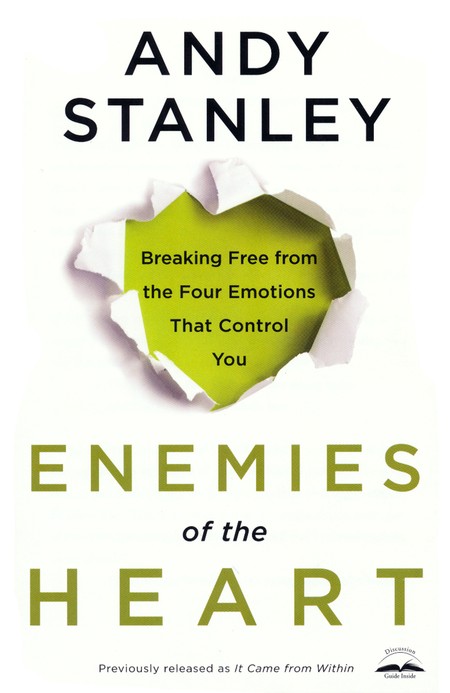
Andy Stanley has a God-given talent to explain things in ways that not only help them “stick,” but in ways that are easily applicable too. In Enemies Of The Heart, Andy helps identify and confront four things that could derail anyone’s life.

Guilt, anger, greed, and jealousy are the four enemies Andy confronts. In a theme that runs throughout the book, Andy describes how each of these can be viewed as a debt-to-debtor relationship. This dynamic is a huge growth impediment to any relationship — whether with God or mankind.

Andy points out:

  • Guilt says, “I owe you.”
  • Anger says, “You owe me.”
  • Greed says, “I owe me.”
  • Jealousy says, “God owes me.”

In the first half of the book, Andy teaches the reader not only how to diagnose these heart problems, but also the danger in allowing these enemies to stay lodged in our hearts. In the second half of the book, Andy shares how to rid our hearts of these enemies, and how to improve the long-term health of our heart.

Since all four of these enemies are relationship killers, and tend to isolate us from other people, the study guide at the back of the book is especially helpful. Because this study guide is designed to be used in discussions with one or more people, there is an instant accountability process built in to rooting out these heart enemies.

Just as our physical heart health affects the rest of our lives, so too does our spiritual/emotional heart health. Don’t wait until it’s too late! This book can help you live a much, much healthier life.

I am a Multnomah book reviewer.

Plugged-In Parenting (book review)

Media saturates our lives. But it’s even more of a factor for the lives of our children. For years I’ve trusted the insights and movie/TV reviews from Focus On The Family’s Bob Waliszewski. Now in Plugged-In Parenting we get to go behind the reviews to learn the whys of the reviews.

In today’s world, we look at our presidents, our prime ministers, our princes and our potentates and we describe them as our leaders, but they’re not. They’re merely our rulers. The leaders are the people who change the minds and stimulate the imaginations of the public, whether children or adults. That means the movie makers, the people who make TV shows, the entertainment people in the business. —Douglas Gresham

Bob lays out some practical, biblically-sound principles that will help parents develop a framework for making sound decisions about media consumption. His approach is not a top-down, because-I-said-so approach, but one that involves even the kids in understanding why these decisions need to be made.

One of the more thought-provoking chapters is about developing a family constitution which gives the guidelines for what types of media are acceptable or unacceptable for your family.

I would recommend this book for every household who wants to ensure that only the highest quality media is being viewed in their homes. In addition, I appreciate the Plugged-In reviews both on their website and on the handy iPhone app.

I am a Tyndale book reviewer.

Why God Won’t Go Away (book review)

Allister McGrath is a genius at pointing out the flaws in the arguments that atheists use. So if you would like to know how to pick apart the theories of the leading atheists of our age, Why God Won’t Go Away: Is The New Atheism Running On Empty is just the book for you.

One of the things I appreciate about Dr. McGrath is his humble attitude. He is an extremely learned man, and could probably not only win a debate, but emotionally crush his debating partner in the process. Instead, you can sense the love and humility underlying all of his arguments. But make no mistake: his love in no way diminishes the sheer force of his intellectual prowess.

Why God Won’t Go Away gives the reader some valuable insights into the “four horsemen” of the New Atheism movement: Richard Dawkins, Christopher Hitchens, Sam Harris and Daniel Dennett. Then Dr. McGrath systematically breaks-down their arguments using reason, science, history and fact. Although he points out the intimidation and ridicule that the New Atheists seem to resort to, Alister McGrath never even hints at a Christian using these tactics.

Another thing I appreciate about this book, is that there is enough information here to help the reader learn how to defend themselves against the arguments of an atheist friend, but the topics aren’t so complicated that it requires an advanced college degree to grasp.

I thoroughly enjoyed reading this book, and I think you will too.

I am a Thomas Nelson book reviewer.

On The Verge (book review)

I’ve only been acquainted with the writings of Alan Hirsch for a short time, but—wow!—do his thoughts resonate with me. On The Verge, which was co-authored with Dave Ferguson, is a thought-provoking, paradigm-challenging look at the potential of the church.

Alan and Dave make it very clear right from the outset that the church in America is at a crucial make-or-break point. They point out that the church in Europe and Australia have already lost their effectiveness in their cultures, and if the church in America doesn’t wake up soon, it will soon head down that same sad path toward irrelevancy.

The good news is that everything the church needs to become the disciple-making, missionally-minded, Christ-centered force it should be is right within it. If churches are willing to realign themselves with the apostolic gene at their core, they are right on the verge of something great!

On The Verge focuses on how churches can imagine, shift, innovate, and then move. Both Alan and Dave are well-suited to inspire their readers to take up this challenge before it’s too late. Alan’s thoughts about the church are so far ahead of the curve, and Dave is not just a church theorist, but he’s successfully doing all of the practices shared in this book.

Pastors and church leaders especially need to read this book. But—as Alan and Dave point out—this is not an issue just for professional clergy. In fact, if the church in America is going to survive and thrive, everyone needs to be involved. This will be a challenging book to read, but well worth your time.

I received a free copy of this book for review.

Why Great Men Fall (book review)

Dr. Wayde Goodall addresses a subject that I wish didn’t have to be addressed in Why Great Men Fall. Unfortunately, we’ve all seen it; perhaps you’ve even experienced it firsthand with someone close to you. How tragic it is when we see spiritual, business or political leaders lose their influence in the wake of a devastating fall.

Dr. Goodall pulls no punches as he identifies the things that seem to trip men up time and time again. He looks squarely at the root causes – not just the symptoms – and challenges men to do the same. We’re all susceptible to sin and failure. The Bible warns us: “So, if you think you are standing firm, be careful that you don’t fall!” (1 Corinthians 10:12).

These words from J.C. Ryle are a sober reminder:

“Great falls seldom happen to a saint, without a previous course of secret backsliding. The church and the world are sometimes shocked by the sudden misconduct of some great professor of religion. Believers are discouraged and stumbled by it. The enemies of God rejoice and blaspheme. But if the truth could be known, the explanation of such cases would generally be found to have been private departure from God. People fall in private, long before they fall in public. The tree falls with a great crash, but the secret decay which accounts for it, is often not discovered until it is down on the ground.”

Why Great Men Fall is not a long book, nor does Dr. Goodall present complicated arguments. It’s a straightforward, easy-to-understand diagnosis of the most common things which trip up great men. I cannot encourage you strongly enough to not only read this book, but to read it with a friend who will hold you accountable.

Guys, your family, your church, and your community need you to STAND STRONG!

Smith Wigglesworth On Faith (book review)

He may have a funny-sounding name, but—wow—can this man ever preach!

Smith Wigglesworth didn’t sit down to write a book, he just preached this book. In fact, Smith didn’t even read other books; he only read the Bible. So to read a Smith Wigglesworth book is really to “listen” to his power-packed sermons.

From 1900 to 1940, Smith traveled around the United States, speaking at various locations. His sermons are a heavy dose of Scripture, accented with frequent interpretations of a message in tongues from the Holy Spirit. So Smith Wigglesworth On Faith is a collection of faith-building sermons preached over a four decade time span.

If you want to have your faith (re)ignited, you can’t go wrong by listening (I mean: reading) these sermons. Highly, highly recommended!

Radical Together (book review)

In Radical Together, David Platt follows up on his book Radical by focusing on how followers of Jesus need to rethink the purpose of the church.

Throughout the book, David continually challenges the age-old paradigms of “church,” and he calls on Christians to return to a more biblical approach to living out their faith. Some of my favorite wake-up calls come in these quotes:

“So we decided to stop planning, creating and managing outreach programs and to start unleashing people to maximize the ministry opportunities God had already planned and created for them.”

“Be careful not to let programs in the church keep you from engaging people in the world with the Gospel.”

“Discussions in the church more often revolve around what we want than what [God] wills. Almost unknowingly, the church becomes a means of self-entertainment and a monument to self-sufficiency.”

And he also addresses pastors specifically in the way they lead their churches. One quote from David really caused me to pause—

“The Bible is not in a church leader’s hands so he or she can give people answers to every question they have and guidance for every situation they face. Instead, the Bible is in a church leader’s hands to transform people into the image of Christ and to get people in touch with the Holy Spirit of God, who will not only give them counsel for every situation they face but will also walk with them through those situations. And when church leaders use God’s Word for this purpose, then church members develop a healthy dependence on God’s Spirit and a healthy admiration of God’s glory.”

Although Radical Together was really written as a sequel to Radical, I didn’t read the first book. With that being said, I didn’t feel like I was only getting part of the story, as Radical Together clearly stands alone.

If you are tired of same-old-same-old church, Radical Together just might be the wake-up call that you need.

I am a Multnomah book reviewer.

Be The People (book review)

If Carol M. Swain’s book, Be The People, sounds like the opening words of the Constitution of the United States of America, it was fully intended that way.

Be The People is a clarion call for American citizens to return to our roots. And Dr. Swain makes no attempt to hide the fact that our country’s roots are firmly grounded in biblical truth. The first section of the book is three chapters long and is called “Broken Vows: Forsaking What We Once Knew.” In language that is sometimes scholarly, sometimes biblical, but always straightforward, Dr. Swain systematically lays out where we’ve come from, and how we’ve abandoned God’s ways to get to this point in our country’s history.

The second section — which makes up the remainder of the chapters — lays out what we can do to reclaim our Judeo-Christian heritage. Leaving nothing to the imagination, Dr. Swain lists several action points at the end of each chapter. She also includes the Ten Commandments, the Declaration of Independence, the Bill of Rights, and the Constitution at the back of the book. There are no excuses for her readers not to be fully informed of the stark divide between our Founding Fathers’ original intent, and the beliefs and practices of those currently in political power.

Parts of this book surprised me; parts disgusted me; still other parts gave me a greater appreciation for our heritage. But the entirety of this book called me to action. After reading Be The People I feel more prepared to defend what I believe about our great country, and more motivated to get involved.

If you are upset with the current highly-politicized, Scripture-eschewing, heritage-denying atmosphere among the current office-holders in the USA, Be The People is just the book for you.

I am a Thomas Nelson book reviewer.

Home And Away (book review)

I just finished reading Home And Away, by David & Nancy French, and I have tears in my eyes. I readily admit that I’m a “patriotic crier” whenever the red, white and blue is involved, and this book hit me right in that patriotic soft spot.

A real quick summary of the book goes like this: David & Nancy French have an ideal life in America (family, home, career, etc.), but David feels compelled to serve his country in the armed forces in Iraq. So David enlists in the reserves and is stationed away in Iraq for a year, and Nancy tries to adjust to life home without her husband. The book alternates chapters, with both Nancy and David writing about the war from their perspective.

But what was invaluable to me was the insight into the emotional life of this couple. Both of them explain so clearly all of the feelings that are swirling around inside of them. You can feel the frustration as they try to explain their feelings to others, who don’t quite seem to get it. Even David has trouble grasping all that Nancy is experiencing, as Nancy tries to come to grips with what David is going through. In the end, I have a much greater appreciation for both our soldiers away in harm’s way, and their families who attempt to carry on at home without them.

If you want to know how to better support and pray for our armed forces and their families, I highly recommend Home And Away to you.

I am a Hachette Group book reviewer.