I stumbled on a great typo last night. “Staff in the lobby were wondering around…”
Wandering around is an aimless waste of time.
Wondering around, though, that sounds useful.
Wondering why this product is the way it is, wondering how you can make the lobby more welcoming, wondering if your best customers are happily sharing your ideas with others… So many things worth wondering about, so few people actually taking the time to do it.
Wondering around is the act of inquiring with generous spirit.
I love wondering around:
Wondering about Christ’s love for me. (There’s a great Christmas carol about this. You can read the lyrics here.)
Wondering about what I’m doing that reflects God’s love to others.
Wondering how I could be so blessed with a fantastic wife, great kids, a vibrant church, health, and on and on.
Wondering about these blessings—and so many more!—every day as I work on my 365/720/1095 challenge.
Seth was exactly right: wandering around is a waste, but wondering around is a great way to live.
On Sunday we had our annual business meeting at Calvary Assembly of God. The actual business part was minimal. The more exciting things included hearing how God had blessed us last year, and looking forward to the greater things we can do for Him this year.
I shared a story from Genesis 26 about Isaac. This story just keeps rolling around in my mind.
Initially, God blessed Isaac just because he was Abraham’s son. God said, “Abraham obeyed me. He did everything I asked him to do, so I blessed him.” Then God challenged Isaac: “I am willing to bless you with even more if you, too, will follow Me.”
It’s interesting to note what Isaac did first. Hereopened all of the old wells his father had dug, and hegave them the same name Abraham had given them…
…he honored the heritage of his father.
Honoring those who have gone before us is so important. But it’s not enough.
If Isaac was going to experience more of God’s blessings, he couldn’t be satisfied with just drinking from the old wells. Don’t get me wrong: it was good of him to reopen those wells…
…but if that’s all he did, he would have just maintained the status quo.
Isaac had to dig new wells. It didn’t start so well. The first two wells he tried to dig on his own led to quarrels with his neighbors…
…the enemy doesn’t fight against those who maintain the status quo.
…the enemy only quarrels with us when we try to dig new wells.
Isaac kept at it, and his third attempt was successful. Here’s the payoff:
…we can honor our heritage by reopening the old wells and drinking from them.
…AND we can continue to dig new wells so that we can minister to more people.
…blessed to have talented and Spirit-led leaders around me.
…blessed to lead worship with gifted and passionate worship leaders.
…blessed that God meets with us every single time we gather together.
…blessed that our congregation responds so enthusiastically to the Word of God week after week.
…blessed by the prayerful dedication of our spiritual forerunners.
…blessed that our congregation wants to move forward into new territory.
…blessed by the unity among our church family.
If you haven’t got the point yet: I’m one blessed pastor! I can hardly wait to see what God is going to do next. It’s going to be absolutely incredible!
Last night my two young nephews were staying at our house. After dinner (and ice cream!) my youngest nephew decided he would rather go back home to sleep in his own bed. As I was driving him back toward his house, we had a fascinating conversation.
Fascinating for me because of the sincere simplicity of his young mind. He sees the world so innocently, and yet so sincerely as well. It reminded me of… me.
When I was a kid, my Grandfather offered me my choice of a dollar bill or a single penny. Without any hesitation, I chose the penny. “Why do you want just one penny,” my Grandfather asked, “Don’t you know that a dollar is worth 100 pennies?”
“Yes,” I replied in all my 3-year-old wisdom, “But you can’t put a dollar in a gumball machine.”
I robbed myself of a greater blessing because of my innocent simplicity. I saw onlythe immediate gain and not the greater blessing. I might have to go through an extra step to exchange the dollar for 100 pennies, but wouldn’t the effort be worth it?
Here’s what C.S. Lewis said:
“If there lurks in most modern minds the notion that to desire our own good and earnestly hope for the enjoyment of it is a bad thing, I submit that this notion has crept in from Kant and the Stoics and is no part of the Christian faith. Indeed, if we consider the unblushing promises of reward and the staggering nature of the rewards promised in the Gospels, it would seem that our Lord finds our desires, not too strong, but too weak. We are half-hearted creatures, fooling about with drink and sex and ambition when infinite joy is offered us, like an ignorant child who wants to go on making mud pies in a slum because he cannot imagine what is meant by the offer of a holiday at the sea. We are far too easily pleased.”
Are you too easily pleased? Can you believe God for greater blessings? You might have to give up the immediate gain, but won’t it be worth it to trade mud pies in a slum for a holiday at the sea? Don’t settle for a single penny, when there are immeasurable treasures waiting for you!
Days set aside for giving thanks to God have been observed throughout the history of our great nation. But in 1863 in the midst of Civil War, President Abraham Lincoln designated an annual Thanksgiving Day. Lest we not forget, our first and greatest thanks should be to God from Whom all blessings flow. A portion of President Lincoln’s proclamation reads:
“No human counsel hath devised nor hath any mortal hand worked out these great things. They are the gracious gifts of the Most High God, who, while dealing with us in anger for our sins, hath nevertheless remembered mercy. It has seemed to me fit and proper that they should be solemnly, reverently and gratefully acknowledged as with one heart and one voice by the whole American People. I do therefore invite my fellow citizens in every part of the United States, and also those who are at sea and those who are sojourning in foreign lands, to set apart and observe the last Thursday of November next, as a day of Thanksgiving and Praise to our beneficent Father who dwelleth in the Heavens.
You can read the full text of President Lincoln’s proclamation here, or for those of you who would rather listen to the proclamation, enjoy the video version.
Make today “a day of Thanksgiving and Praise to our beneficent Father.”
On Saturday night I was in the hospital with a family as their loved one took his final breath. It’s not the first time I’ve been in a room with someone as their life here ends. And I’m certain it won’t be the last time. I feel blessed to be able to do this.
Before you think I sound morbid, hear me out on this.
I feel blessed to have had some valuable training for this. Long before I became a pastor (a “doctor” of the spirit) I was studying to be a medical doctor (a doctor of the body). I’m so grateful that I received enough training to be prepared for these settings.
I feel blessed to be there for the grieving family. When the emotions are so raw and the pain so deep, I’m grateful that God places me in a position to truly be a minister to hurting people.
I feel blessed to be reminded of the shortness and preciousness of life. It reminds me that life is fragile and short. It reminds me to hug more often, express love more frequently, and not take any time with my loved ones for granted.
Being in the hospital room as someone passes from this life is not an easy thing. But I wouldn’t trade the blessing of being a pastor for anything.
My folks came to our home for dinner after our Sunday church service. It’s always great to have them around.
Aside from the good fellowship and great food, I noticed something else: there were a lot of dishes to be cleaned. Not only was the dishwasher filled and run twice, but there were other dishes that had to be washed by hand. At first, I began to grumble about all of the extra work to do, but then I thought, “Dirty dishes are a good thing.”
Lots of dirty dishes means that lots of people graced our home.
Lots of dirty laundry means that my kids are running around and enjoying life.
Lots of trips to the grocery store means that friends and family are coming over to hang out with us.
Lots of studying means that I have lots of opportunities to invest in others.
There are so many things that I could choose to grumble about, but instead, I’m choosing to focus on the blessings. I’d much rather have dishes to clean, clothes to wash, errands to run, and hours to study than the alternative, wouldn’t you?
Look on the bright side this week: turn those grumbling opportunities into opportunities to give thanks.
It seems like we never have enough. Enough time. Enough money. Enough food. Enough friends.
As weird as it sounds—the cure to have enough is to give what you have away.
Imagine a drought … famine … despair. Lakes drying up and wells running dry. The dairy cows aren’t producing as much milk as usual, and the beef cows don’t have as much meat on them as they used to. The wheat fields aren’t growing as abundantly, and the corn is dry and mealy. Men don’t work as much, their wives don’t visit as much, and the kids don’t play as much.
Now, what if you found out you were going to be fortunate enough to host a VIP at your home? How do you prepare a decent meal? How do you think this VIP is going to react to the meager meal set before him? What if someone came from a distance away and brought you 20 loaves of freshly-baked bread?
Do you know how Elisha responded in these settings? He said, “Give it to the people to eat” (2 Kings 4).
Elisha shows up at his guests’ home and says, “Put the large pot on the stove and make some stew.” The large pot?!? Don’t you know we’re in a famine? Don’t you realize that we don’t have very much to spare?
“Put the large pot on the stove and make some stew, then serve it to the people to eat,” Elisha said. He didn’t ask for the food to be prepared for himself, but for others. And not just a little stew either—he said make stew in the large pot. It’s interesting to me, too, that the householders had all the ingredients for a stew, but they were trying to stretch it out and make it last longer. They were hoarding what they had.
Then a friend arrives from a distant land bringing Elisha 20 loaves of bread.
Do you know how Elisha responded to this gift? “Give it to the people to eat.” Give it to the people?!? There are over 100 people here and we only have 20 loaves! That seems a bit cruel to just whet people’s appetites with so little; why don’t we just keep it for ourselves.
But Elisha said, “Give it to the people to eat. Not only will they all eat, but there will be leftovers too.”
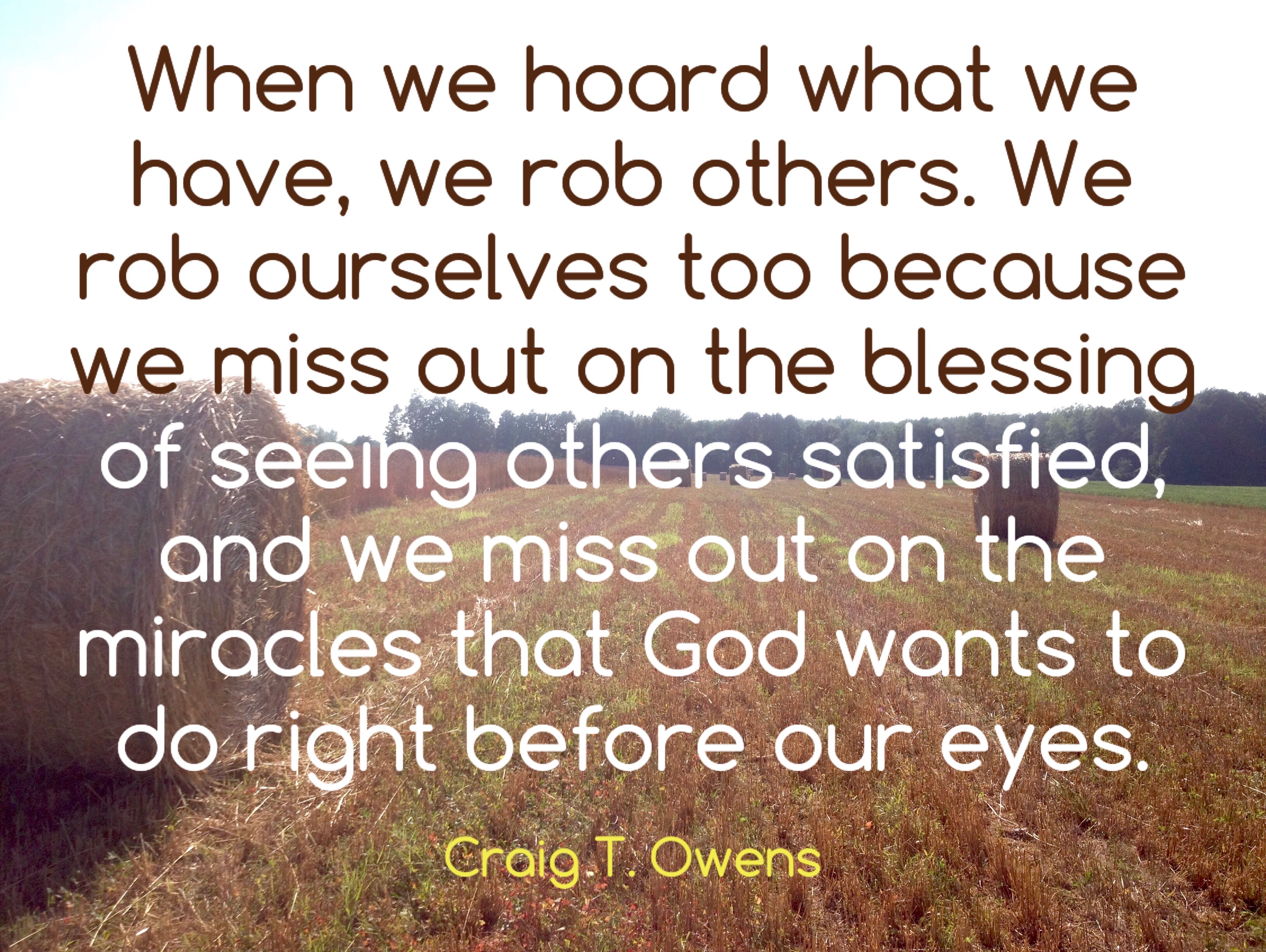
When we hoard what we have, we rob others. We rob ourselves too because we miss out on the blessing of seeing others satisfied, and we miss out on the miracles that God wants to do right before our eyes.
“Why does God bless us with abundance? So we can have enough to live on and then use the rest for all manner of good works that alleviate spiritual and physical misery. Enough for us; abundance for others.” —John Piper
So, when you think about it, don’t you really have enough time to help someone in need?
Don’t you really have enough money to alleviate someone’s suffering?
Don’t you really have enough food to satisfy someone’s hunger?
Don’t you really have enough love to make a new friend?
Don’t rob yourself by hoarding. Don’t buy into the scarcity mindset that looks away from others.The more you give away, the more you will have. Try it, it works!
Listen to the podcast of this post by clicking on the player below, and you can also subscribe on Apple, Spotify, or Audible.
I sort of remember the days of full-service gas stations. My Dad would drive in and say, “Fill ’er up!” and the gas station attendant would jump into action. Filling up the gas tank, cleaning the windshield, checking the oil level, and even checking the air pressure in the tires.
But, alas, those days of full service seem to be long gone, replaced by highly-efficient, less-personal self-serve stations. And I’m not necessarily talking just about gasoline stations either.
All of our lives seem to have become more efficient and less personal. We are a more do-it-yourself, leverage-technology kind of society today. And I wonder if the result is that many people aren’t getting filled up like they used to.
There is a well-known Bible story in 2 Kings 4. A widow is facing what would amount to foreclosure today. Except this foreclosure was on her sons. Her husband, a God-fearing man, had died and left her with debts she could not pay. The practice in that society was for her sons to be “sold” to pay off the debts. These boys would have to work all day long for someone else, and whatever money they would have earned for their labors would go to the creditors.
In her desperation, the widow turned to the prophet Elisha. He asked her if she had anything of value in her house, and she replied, “Just a little oil. But not enough to pay off my debts.” The counsel Elisha gave her is applicable for our self-serve society today—
Elisha said, “Go around and ask all your neighbors for empty jars. Don’t ask for just a few” (v. 3).
Elisha asked the woman and her family to humble themselves—ask all your neighbors. Sometimes this is one of our biggest hindrances: pride which keeps us from admitting we have a need. And this was no small task because she had to ask ALL her neighbors to, “Fill ’er up!”
Elisha asked them to be persistent—don’t ask for just a few. Not just a jar here and there, but ask for every available jar to, “Fill ’er up!”
The principles in this story shouldn’t just apply to times of desperation in our lives. Because maybe if we worked on being around our neighbors and asking what needs they have, and sharing our needs as well, maybe we wouldn’t get into such desperate situations.
In the story in 2 Kings, the oil stopped flowing only after every available jar had been filled. If I want God to continue to pour His oil of blessing into my life, He has to have room in which to pour. That means that I need to be pouring into others’ lives as often as I can. Listen to the blessings when we, “Fill ’er up!”—
I want you to know how delighted I am to have Stephanas, Fortunatus, and Achaicus here with me. They partially make up for your absence! They’ve refreshed me by keeping me in touch with you. (1 Corinthians 16:17-18, The Message paraphrase)
In addition to our own encouragement, we were especially delighted to see how happy Titus was, because his spirit has been refreshed by all of you. (2 Corinthians 7:13)
God bless Onesiphorus and his family! Many’s the time I’ve been refreshed in that house. And he wasn’t embarrassed a bit that I was in jail. The first thing he did when he got to Rome was look me up. May God on the Last Day treat him as well as he treated me. (2 Timothy 1:16-18, The Message paraphrase)
Your love has given me much joy and comfort, my brother, for your kindness has often refreshed the hearts of God’s people. (Philemon 7 NLT)
Get around other “full” people and let them fill you up.
Seek out “empty” people and pour abundantly into them.
The more you pour out into others, the more room there is for God to pour into you.
God is always pleased when our lifestyle is one of “Fill ’er up!”
In 2 Kings 3 the combined armies of Judah, Israel and Edom set out to attack the country of Moab. To try to take Moab by surprise the armies marched for seven days through the desert.
But there’s a problem with deserts: no water! And when you have three combined armies with all of their soldiers and horses and cattle, no small amount of water is needed. So on the verge of battle, this massive army is unable to fight because they are parched. To find a solution to this problem, the prophet Elisha is consulted, and he gives some very unusual counsel—
Make this valley full of ditches. For this is what the LORD says: You will see neither wind nor rain, yet this valley will be filled with water, and you, your cattle and your other animals will drink (verses 16-17).
Dig ditches in the desert? Yeah, right, sounds like a great strategy… NOT! But—
In the morning—it was at the hour of morning sacrifice—the water had arrived, water pouring in from the west, from Edom, a flash flood filling the valley with water (v. 20, The Message).
The story goes on to tell us that when the Moabites looked out into the desert the water looked to them like blood. They assumed that the armies had a disagreement between themselves during the night and their partnership dissolved into civil war. The Moabites rushed out to the battlefield—thinking they would now have an easy victory—only to walk right into the newly-invigorated and still-unified armies!
Many times the way God provides for us is contingent upon the level of our faith-filled obedience. Imagine this scenario: The army captains instruct their men, “Start digging ditches! Dig lots of them because we have lots of men and livestock to water.” The obedient soldiers jump to their work and begin digging. Out in the hot desert sun, digging through sifting sands, imagine how cynical the soldiers could have become.
“This is stupid! We’re in a desert, for crying out loud! There’s no water anywhere and not a cloud in the sky as far as the eye can see. I’m already parched and now I’m breaking my back digging ditches?!? I don’t think so! This is pointless: I quit!”
But catch this—God could only send as much water as they were willing to dig ditches. If they didn’t have the ditches ready when the water started flowing in, none of the men nor livestock could have contained the water to be able to quench their thirst. The floodwaters would have been useless to them!
Many times I think God is calling us to dig ditches so He can provide for us. What do you need to do to be ready for the flood of blessing He wants to send to you? What blessing would be wasted if you didn’t already have ditches ready? What ditches do you need to dig? Maybe you need to…
Get certified
Finish your degree
Make that phone call
Setup that meeting
Paint that room
Train those teachers
Some of those “ditches” may seem pointless now—as pointless as digging water ditches in the desert!—but when God pours out His blessing, won’t you be glad that your ditches are ready? What ditches do you need to start digging today?



 I read this on Seth Godin’s blog this morning: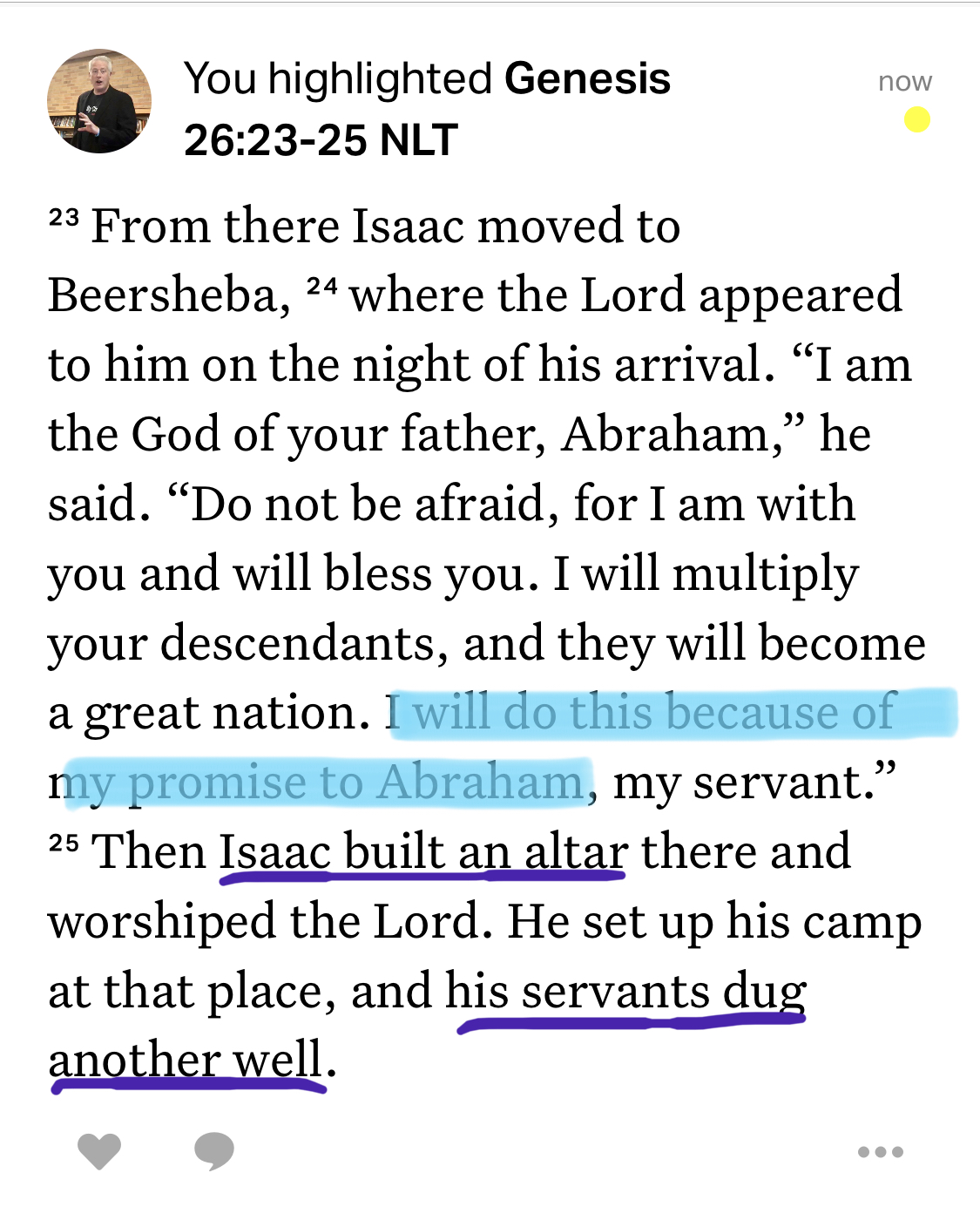







 Craig T. Owens