Don’t Get Left Behind

This post is especially for the men (but, ladies, feel free to read along too).

No, I’m not talking here about the series of Left Behind books that tell a story about people who may miss out on the rapture of the Church. I’m talking about you leaving the protection of your friends and being exposed to a serious defeat.

Most times when I am counseling men who have given in to a temptation, or those who are battling the same old perplexing problems, I find a common theme. It’s not something new—it’s been around a long, long time.

Take this for example:

In the spring of the year, when kings normally go out to war, David sent Joab and the Israelite army to fight the Ammonites.

You probably know the rest of this sad story: David cannot contain his lust for Bathsheba (another man’s wife) so he seduces her, sleeps with her, gets her pregnant, and then kills her husband to try to cover it up. But look where it all started: David was alone. When he normally would have been with his brothers-in-arms, he stayed behind.

I’m a big believer in accountability, so I’ve written before about a brother who makes sure I stay on the straight-and-narrow. What about you? Are you trying to stay pure all by yourself? Are you battling temptations on your own?

Two people are better off than one, for they can help each other succeed. If one person falls, the other can reach out and help. But someone who falls alone is in real trouble. Likewise, two people lying close together can keep each other warm. But how can one be warm alone? A person standing alone can be attacked and defeated, but two can stand back-to-back and conquer. (Ecclesiastes 4:9-12)

Don’t try to go into battle all by yourself. If David—a man after God’s own heart—couldn’t win on his own, what makes you think you can?

Do You Read The Bible Or Does The Bible Read You?

I’ve been studying the lives of the kings of Judah. The last God-fearing king before the fall of Jerusalem was a man named Josiah. He became king as an 8-year-old and really began looking for God as a teenager. Apparently, during all of this time, the book of the Law (the first five books of our current Bible) was hidden away and forgotten. As Josiah started seeking God, he gave orders that the temple in Jerusalem be repaired. During the clean-up work, the workers rediscovered the book of the Law and brought it to the palace. They began to read the Law to Josiah…

When the king heard the words of the Law, he tore his robes.

Tearing of the robes is a sign of deep mourning. The words of Scripture cut Josiah like a dagger to the heart because he knew he and his people weren’t living according to God’s standards. He started telling everyone the Scriptural standards that they needed to honor, and had the words of the Law read aloud for everyone to hear. Then in the presence of everyone, Josiah reaffirmed his commitment to be a man who lived by the words of God’s Word.

This got me thinking:

  • Do I have an emotional response when I read the Bible? Or is it just a mental exercise? Or worse yet, just a meaningless daily habit?
  • Am I truly sorry when I read in the Bible where I’ve fallen short of what God desires? Or do I make excuses?
  • Do I ask the Holy Spirit to help me live out what I’ve read in the Word? Or do I convince myself that those parts don’t pertain to me?
  • Do I share with others what’s been revealed to me? Or do I keep it to myself?
  • Am I willing to be accountable to others about the changes I need to make? Or am I trying to be a lone ranger saint?

Do I just read the Bible? Or do I allow the Bible to read me?

Chazown (book review)

I’m a huge Craig Groeschel fan, and Chazown didn’t do anything to diminish my respect and admiration for what Craig has to say. Chazown may be a funny-looking word (it’s pronounced khaw-zone, by the way), but it is vitally important to a successful life.

Right at the beginning of the book, Craig defines the importance of Chazown this way:

Where there is no Chazown—no dream, no revelation, no vision, no sense of our created purpose—we perish.
Where there is no vision that you were created to have a growing, lifelong, and personal relationship with your Creator, your inner being withers and dies.
Where there is no vision that you have been placed on earth to matter deeply to people, and reveal God’s love and power to them, you live in loneliness and your relationships perish.
Where there is no vision for a godly family, you have a 50 percent chance of ending up divorced.
Where there is no vision that your body is the temple of God’s Spirit—property on loan from Him—your physical health slips away. Your exuberance fades.
Where there is no vision for a financially wise lifestyle, you can live in the richest country on earth and still be drowning in debt.
Where there is no vision for meaningful work, people live for five o’clock. They really just exist. Their goal is to survive—to pay bills, stay married, keep the kids out of jail….
But you and I were made for so much more.

Chazown is easy to read (most of the chapters are very short), and the “You Are The Author” exercises throughout the book make the message of chazown applicable to your life. And Craig’s transparency about his own struggles and successes makes the message of chazown real to your life.

A key component in making your chazown work for you is accountability. The back of this book contains study guides for small groups, and there are plenty of team resources available on the chazown website.

This book is especially timely at the beginning of a New Year when so many are making resolutions. Chazown can help you make meaningful life changes that make a real difference.

I am a Multnomah book reviewer.

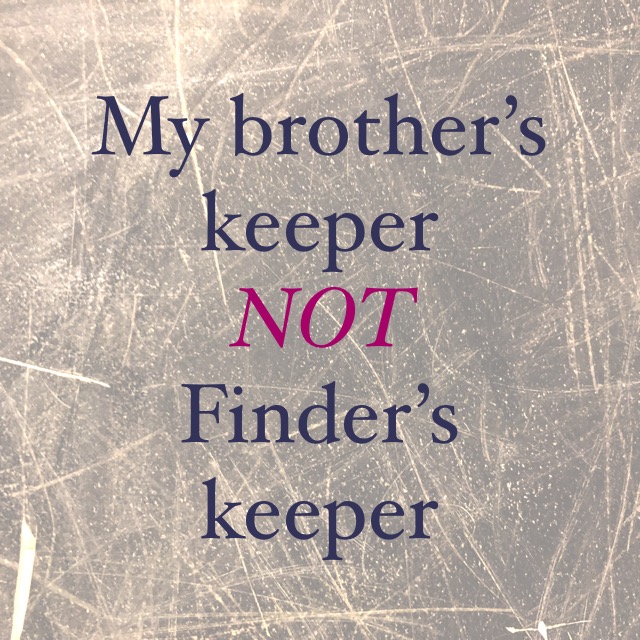
My Brother’s Keeper…

…is not Finder’s Keeper.

Society has it backward: On the playground, on the worksite, and sadly even in the church, we tend to play by the opposite:

  • I found it, so I get to keep it!
  • Hey, I’m not my brother’s keeper!

Look at what God says:

If you see your neighbor’s ox or sheep or goat wandering away, don’t ignore your responsibility. Take it back to its owner. If its owner does not live nearby or you don’t know who the owner is, take it to your place and keep it until the owner comes looking for it. Then you must return it.

My brother’s property is my responsibility. Notice that even if I don’t know who the owner is, I’m still supposed to safeguard his property until I can return it to him.

Finding something that isn’t mine makes me responsible to care for it. I am my brother’s keeper; it’s not simply finder’s keeper.

What if my mindset changed to, This is yours, but I’m going to take care of it like it’s mine until I can return it to you?

What if my values became focused on…

  • Mutual accountability?
  • Shared responsibility?
  • Genuine community?

I must be the change I wish for our society. I need to care for anothers’ property as much as I care for my own.

Would you join me in changing your community away from Finder’s Keeper and toward Brother’s Keeper?

Rules Of Engagement (book review)

In whatever criteria you want to measure him, Chad Hennings is a man’s man: accomplished wrestler, US Air Force fighter pilot, Outland Trophy winner, and Super Bowl champion with the Dallas Cowboys. So when Chad sets out to write a book for men, Rules Of Engagement, you know it’s going to be right on target.

And it is.

Chad doesn’t pull any punches. He calls men out on the games we tend to play to hide our insecurities or our shortcomings. Using his military background, the book is divided into two main sections: basic training and active duty.

In basic training, you will learn how to become a well-rounded man. Chad covers the emotional, spiritual, mental, and physical regimens that will prepare men for the battles we fight every day. In this section, I especially appreciated the insights on character and vision, the foundations for a successful life. Chad writes, “Character and vision go hand in hand because a man’s vision comes directly from his character.”

In the active duty, section, you will learn how to put all of this training and hard work into practice. Chad covers the areas of family, accountability with another strong man (your wingman), money, and community involvement.

This book would be excellent for a man to read by himself. But I think it would take on even more effectiveness if two or three men read the book together and then enlisted each other as their wingmen. Accountability is a key factor in making all of this stick.

I am a FaithWords book reviewer.

Living Life In The Zone (book review)

I’m frequently asked to recommend books for men for their devotional time, small group, or accountability groups, and I usually answer the same way: “I don’t know. Who’s in your group? Where are they now spiritually? What do they want to accomplish?”

But now, Living Life In The Zone by Kyle Rote, Jr. and Dr. Joe Pettigrew just may have given me my new standard answer. This book is applicable for almost any guy that is seeking a more energizing, more satisfying relationship with Jesus Christ.

Here’s what I like about this book—

  • Short chapters. Guys are busy, so just give us what we need and let’s get on with our day.
  • A “game plan” in each chapter that gives me the Scripture backing for each daily thought. I can read just the Scriptures listed here, or I can dig deeper.
  • Real-life “playmakers” help me see how this principle is being lived out in someone else’s life.
  • Discussion-stimulating questions. Guys don’t need questions that can be answered yes/no, but we need to have a reason to talk more.

This book is designed to take men on a 40-day journey. I suppose it could be done in 40 consecutive days, but I also see this book being used as a 40-week guide for men meeting together for accountability and spiritual growth.

For men who like to read and study, there is enough here for them to really dig into. For men who don’t particularly like to read, the short chapters will be appealing enough to engage their heart, mind, and soul.

I highly recommend this book to men seeking a deeper walk with God.

I am a Book Sneeze reviewer.

Do You Really Want To Be Accountable?

I have a great friend. He is the brother I never had, but he is more than any brother I could have ever hoped for. We are brothers like David and Jonathan were brothers in the Bible. We are covenant brothers (we’ve coined the shorthand CovBro).

What is accountability? The dictionary simply says it means “to give an account or to give an answer.” It doesn’t say “to give an excuse or to give the rationale.”

Accountability means there is only black and white. No gray. Either I did what I was supposed to do. Or I didn’t. King Solomon said it this way:

Young people, it’s wonderful to be young! Enjoy every minute of it. Do everything you want to do; take it all in. But remember that you must give an account to God for everything you do.

Before it’s time to give an account to God, wouldn’t you like someone else to hold you accountable? I would!

In this everything’s-relevant, I’m-not-responsible-for-my-own-actions world, finding someone who will actually hold you to a rigid “Yes, I did it” or “No, I didn’t do it” standard is rare. But my CovBro is one who holds me accountable.

When we meet each month, he asks me the hard questions:

  • How are your business dealings?
  • Are you spending enough time with God?
  • Are you doing what God has called you to do?
  • What’s happening in your marriage? Your relationship with your kids? Your church?

He gets my internet usage report from X3 Watch. He is the iron that sharpens my iron. He accepts no wishy-washy answers nor any flimsy excuses. I do the same for him. And we’re both better off for it.

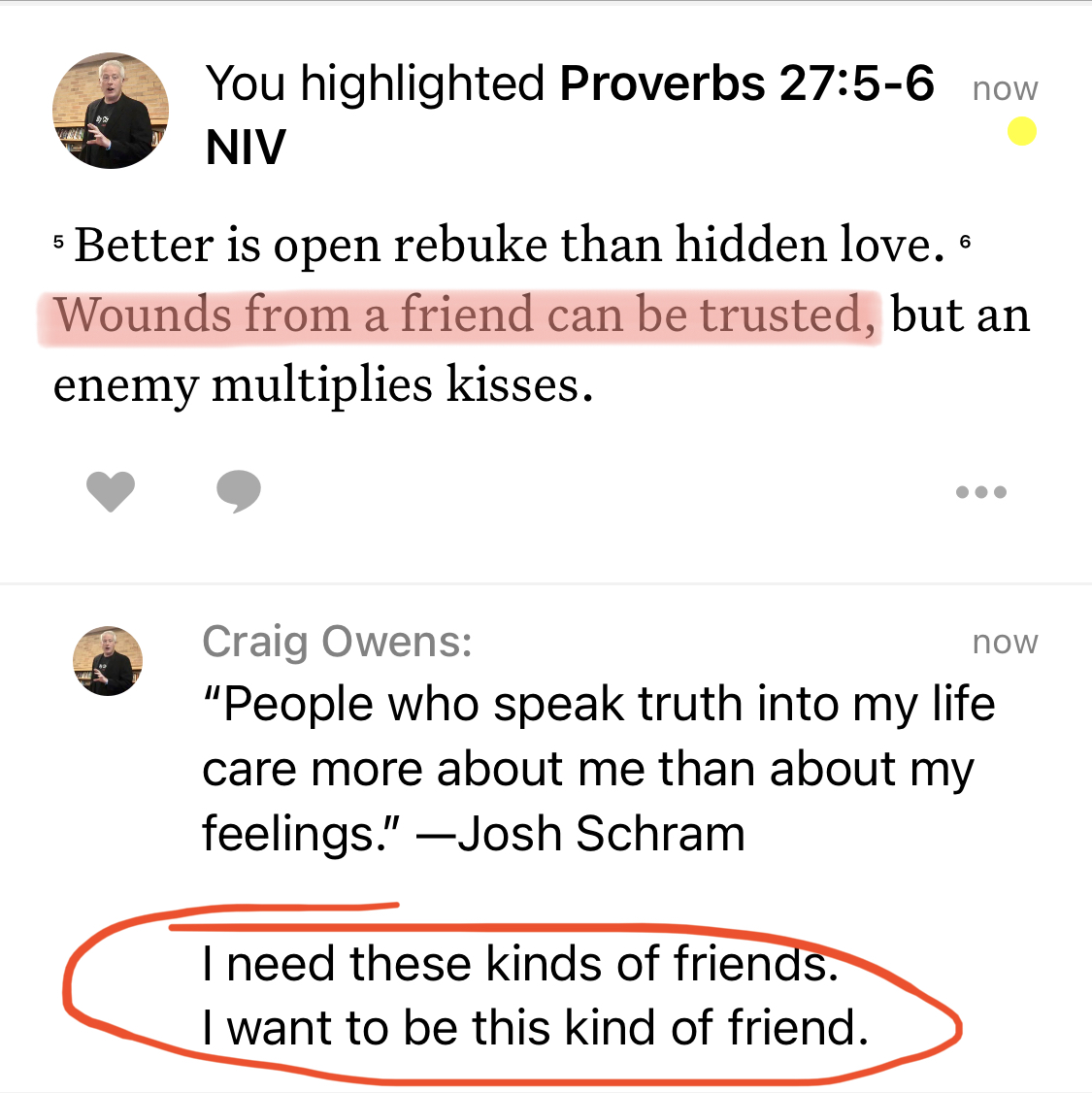
Do you really want to be accountable? Then find someone that loves you too much to let you get away with anything less than your very best. Someone who will hold you to God’s standards. Someone who will sharpen your iron. It can be painful. But the results are so worth it!

Derailed (book review)

Derailed

As I read Dr. Tim Irwin’s latest book, Derailed, I thought about a quote from John Maxwell: “A wise man learns from his mistakes. A wiser man learns from others’ mistakes. The wisest man learns from others’ successes.”

The subtitle of this book is “Five lessons learned from catastrophic failures of leadership.” In this, we learn from others’ mistakes. But then Dr. Irwin goes on to show us successes that we can learn from as well. Combining the insight from successful—or should I say “non-derailed” leaders—with his own discernment, Dr. Irwin shows us how to stay on the rails.

When I first noticed that the examples in the book were all high-profile CEOs, I thought, “What could I learn from them? After all, I’m not the CEO of a Fortune 500 company.” But Dr. Irwin does an excellent job of bringing the four qualities of character—authenticity, self-management, humility, and courage—down to a pedestrian level where even we non-CEO-types can benefit from his wisdom.

Although the principles in Derailed can benefit anyone in leadership, or aspiring to a leadership position, this book still might not be for everyone. The six case studies in the book are all derailed CEOs, and unless you have a penchant for the business world, you might not find them very enjoyable reading. However, for those of you who enjoy business history, there is much to gain from a careful reading of Derailed.

I am a Thomas Nelson book reviewer.

Deadly Viper Character Assassins

The dictionary defines an assassin as “one who murders by surprise attack.” No assassin worth his/her salt sends you an announcement to say, “I’ll be stopping by your office tomorrow morning to kill you. If that’s not a convenient time for you, please let me know.” Of course not! Assassins never tell you that they’re coming.

Theodore Roosevelt said, “Character, in the long run, is the decisive factor in the life of an individual and of nations alike.”

So a “character assassin” is something that sneaks up and takes out the essential factor that could have made us successful and effective in life. This is why Deadly Viper Character Assassins is such a vital resource.

Here are the two pulls in my life:

Be self-controlled and alert. Your enemy the devil prowls around like a roaring lion looking for someone to devour [assassinate]. (1 Peter 5:8)

You, therefore, must be perfect [growing into complete maturity of godliness in mind and character, having reached the proper height of virtue and integrity], as your heavenly Father is perfect. (Matthew 5:48)

If I keep our character intact, I’ve developed a foundation that will sustain me for the long haul. In my experience, here’s what I’ve done to keep developing my character:

  1. Be more concerned about my character than my popularity.
  2. Regularly look myself in the mirror of God’s Word to see chinks in my armor.
  3. Make myself accountable to godly friends.

Don’t wait until the assassin has already taken a shot at your character, but begin to protect yourself now. Continue to grow in the character Jesus Christ exhibited for us.

Esse Quam Videri

Guest Author: Dick Brogden

Dr. Warren Newberry is the head of my PhD Program in Intercultural Studies at the Assembly of God Theological Seminary. He has the Latin phrase Esse Quam Videri on his office wall. It means “To be rather than to seem.”

The phrase is first found in Cicero’s essay On Friendship. Aeschylus used a similar phrase in Seven Against Thebes, at which the scout says of the priest, “His resolve is not to seem the best but in fact to be the best.” Plato quoted this line in Republic (361b). It is also the State motto of North Carolina.

Coming back to America for the summer (studies and some meetings) has reinforced this precept. America on the surface seems whole and healthy. As a family, we have enjoyed McDonald’s, Lake Michigan, vibrant worship services, and incredible public libraries, among many other wonderful things. Last week however I took a trip on a Greyhound bus. Every American should be so lucky.

Greyhound bus stations in Middle America are fascinating places “to be.” There was a nervous young Amish couple. There was an African American street preaching pair: The woman had her Bible out, loudly laughing, scolding, and reading Scripture to all who did or did not want to listen. Her companion was a monster of a man, tattoo-covered, gold tooth glinting in the neon light. He did not speak often, but when he did you were afraid to not pay attention. Hippies, druggies, bums, out-of-work mechanics and returning U.S. Marines. Thin and fat. Old and young. Black, brown, yellow, and white. It was a living mosaic reminding me of what America is, not just what America seems.

It makes me reflect on the dichotomy between who I am and who I seem to be. In God’s mysterious grace, opportunities for higher profile ministry and service are coming our way. In front of pulpits, cameras, microphones, interviewers, and even in front of you through newsletters and emails we can seem to be a certain way.

In The Prince, Niccolò Machiavelli twists this phrase to Videri Quam Esse (to seem rather than to be) with respect to how a ruler ought to act. This is such a danger for missionaries… for me… for you.

I write to ask for prayer and for accountability. I want to ask you to pray for the judgment of God on my life. I want to ask that all falsehood and pretension is exposed and removed. I want to ask that there is no hypocrisy or pride left in me. I ask this fearfully, but it is my desire to walk humbly before God, before you, and before Muslims in Sudan. I long to be—not just seem to be—a lowly follower of Christ.

Dick Brogden and his family have served as missionaries in numerous Arabic nations for over 20 years.