Love Is… (part 1)

Love is… worksheet 1The greatest definition of love in the history of mankind is given to us in 1 Corinthians 13. This is the “gold standard” to which all of us should strive to pattern our lives.

But notice that right at the beginning, Paul says, “Love IS” (verse 4). Not love feels good or even love does; but love is. Love is not love because it makes us feel good. Love is not love because we did something nice. Love is love because it measures up to this standard in 1 Corinthians.

Here are the first five attributes of love.

Love is patient

  • Patient love doesn’t lose heart, but stays hopeful.
  • It endures patiently and bravely in enduring misfortune and disappointment.
  • “It can endure evil, injury, and provocation, without being filled with resentment, indignation, or revenge.” —Matthew Henry

Love is kind

  • It is pleasant and courteous.
  • It both seizes opportunities and makes opportunities to show kindness.
  • …as far as it depends on you, live at peace with everyone. (Romans 12:18)

Love is catching others doing something good

  • The biblical phrase is love is not envious, but I want to turn the positive into a negative. Far too often we Christians are known more for what we against, not what we’re for. So the positive way of saying this: we rejoice when others succeed. Or, we catch them doing something good.

Love is complementing others

  • Again, we turn the negative love does not boast into a positive, and say love complements others.
  • Agape raises the value of the object of its love.

Love is others-focused

  • Again, turning the negative love is not proud into a positive.
  • Do nothing out of selfish ambition or vain conceit, but in humility consider others better than yourselves. (Philippians 2:3)

Here’s where the real test comes in: How will you apply these attributes of love to someone in your life? More specifically: to someone you think is “unloveable”?

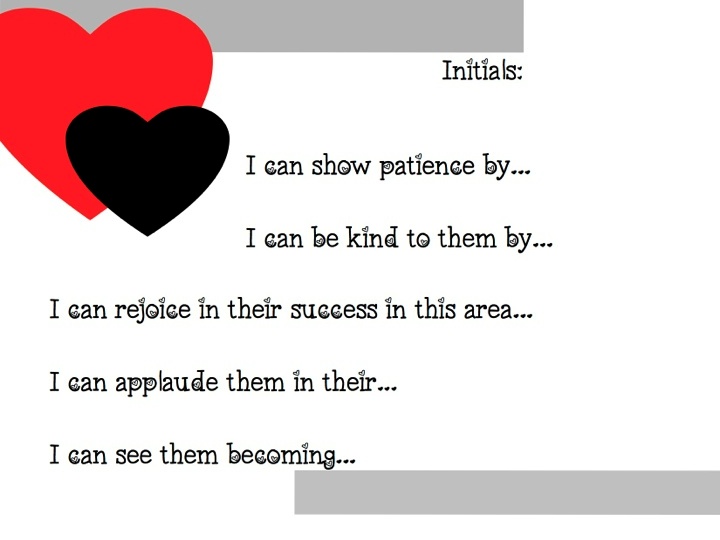
I know you have someone in your life that you think is unloveable. With that person’s face clearly in mind, how will you fill in the blanks:

  1. I can show patience by…
  2. I can be kind to them by…
  3. I can rejoice in their success in this area…
  4. I can applaud them in their…
  5. I can see them becoming…

If you would like a downloadable PDF of this worksheet, click here –> Love is… worksheet 1

If you missed any of the messages in our Loving the Unlovable series, you can check them all our here.

Thursdays With Oswald—My Part And God’s Part

This is a weekly series with things I’m reading and pondering from Oswald Chambers. You can read the original seed thought here, or type “Thursdays With Oswald” in the search box to read more entries.

My Part And God’s Part 

     Beware of the tendency of trying to do what God alone can do, and of blaming God for not doing what we alone can do. We try to save ourselves, but God only can do that; and we try to sanctify ourselves, but only God can do that. …

     The love of God is the great mainspring, and by our voluntary choice we can have that love shed abroad in our hearts, then unless hindered by disobedience, it will go on to develop into the perfect love described in 1 Corinthians 13

     We have, then, to make the voluntary choice of receiving the Holy Spirit Who will shed abroad in our hearts the love of God [Romans 5:5], and when we have that wonderful love in our hearts, the sovereign preference for Jesus Christ, our love for others will be relative to this central love. 

From Biblical Psychology

I cannot save myself from an eternity apart from God.

I cannot make myself love someone.

I cannot force myself to give up a sinful habit.

But I can decide to let the Holy Spirit flood my heart with God’s love. And when this happens, I can give up anything that’s holding me back from enjoying an eternity in God’s presence.

My part: allow the Holy Spirit to bring God’s love into my heart, and then obey what God’s Word tells me to do.

God’s part: everything else.

Maturing Love

Psst… I’m mostly speaking to the guys with this one (but you ladies can listen in too).

So I’m hoping you figured out before now that today is Valentine’s Day, right? Allow me to let you in on a little secret: this day may be a no-big-deal day for you, but it is a HUGE deal for the ladies in your life! So the most loving thing you can do is make today a big deal to you too!

Maybe you’ve already figured that part out, and you are trying to make today a special day. But let me ask you a question: Does this Valentine’s Day look just like last year’s? I sure hope not, because our love should be growing up.

Smack-dab in the middle of his great treatise on love, the apostle Paul says this about grown-up love:

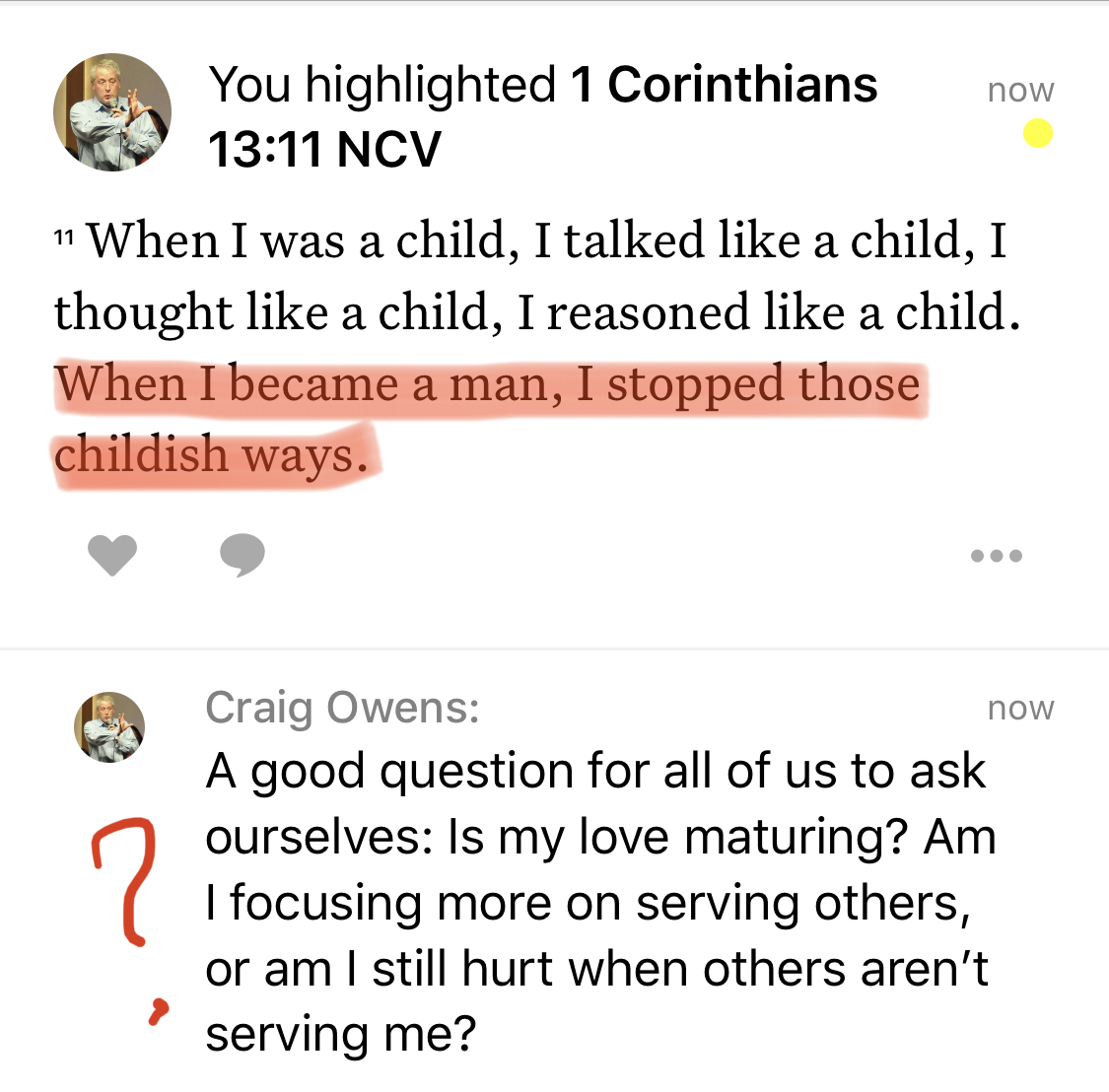
When I was a child, I talked like a child, I thought like a child, I reasoned like a child. When I became a man, I put childish ways behind me.

Quite simply this means: your love is supposed to be maturing. You’re supposed to be getting better at expressing your love … more creative in your date night planning … more intuitive in your gift giving

So how are you doing? Is your love growing up?

Full Tank

The other day a friend of mine wrote on Facebook that he was shopping with his daughter. He half-jokingly added, “I think that is her love language!” I say half-jokingly because I think the time with Daddy was speaking volumes to his daughter.

Spending time shopping with Dad was filling her love tank!

Have you ever felt like one of your relationships was in a rut? Or maybe even in a rut with ends in it (also known as a grave!)? Do you ever feel like the other person just doesn’t get you? Have you ever been frustrated that the other person doesn’t understand all that you are doing for him/her?

My guess is that you are speaking different love languages.

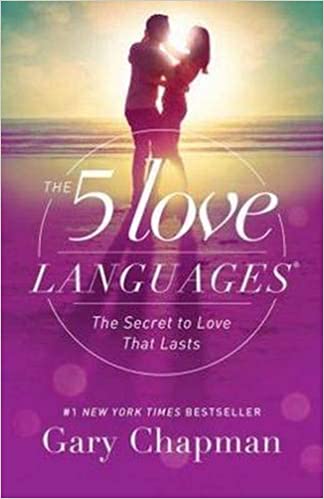
Dr. Gary Chapman wrote an amazing book called The Five Love Languages. In his book, he lays out five “languages” that we use to communicate our love to one another:

  • Words of affirmation
  • Quality time
  • Gifts
  • Acts of service
  • Physical touch

When you and I communicate, we naturally communicate in a way that is most comfortable to us. We communicate in our primary love language. But if the other person in the relationship has a different love language, no matter how much you love them, you are simply not getting through effectively. You are leaving the other person with a near-empty love tank.

I would suggest you start by taking a brief love language assessment (download the free PDF here → 5 Love Languages assessment) to determine YOUR OWN love language first. This is the language you will feel most comfortable using. Second, you need to learn the love languages of OTHERS CLOSE TO YOU so you can change your love dialect.

In the great love chapter in the Bible, the apostle Paul says this, “When I was a child, I spoke and thought and reasoned as a child. But when I grew up, I put away childish things” (v. 11, New Living Translation). Our love—and the way we express it to others—should always be growing up. If you are trying to communicate your love to someone special in the same ways (the same “languages”) you’ve always used, there’s a good chance your love is being viewed as childish.

As you mature in your expressions of love — as you speak the other person’s love language — you will begin to fill their love tank. Guess what happens next? Out of a full love tank, the other person is motivated to begin to speak your love language, to fill your tank. It can become so much fun to love with a full tank! Because when the other person’s love tank is full, almost any love language will work for them—wow, what a blast!

For married couples, YouVersion has an excellent reading plan that teaches specifically how the love languages operate in the context of your marriage.

UPDATE… my friend Greg Heeres and I host a leadership podcast on YouTube. Recently, we discussed the value of leaders learning and speaking the love languages of their teammates.