


Listen to the podcast of this post by clicking on the player below, and you can also subscribe on Apple, Spotify, or Audible.
 This is part 4 in our series “Is that in the Bible?”
Statement #4—Name it and claim it. Is that in the Bible? No!
But in fairness, even the proponents of this belief don’t usually say it this way. Instead they quote words from Jesus like: “I will do whatever you ask in My name” (John 14:13) or “Ask whatever you wish, and it will be given you” (John 15:7).
They really want this to be true, I think, because in their minds happy, prosperous Christians make God look good. On the other hand, struggling Christians make God look bad. There is a whole branch of theology called theodicy which literally means: “a defense of God’s goodness and omnipotence in view of the existence of evil.”
This is nothing new. Religious people have always tried to have pat answers. In the oldest book of the Bible, Job’s friends were convinced that suffering results from sin and blessing results from righteousness. And yet according to God, Job was a righteous man (Job 1:1, 8, 20-21).
At the advent of Jesus, the chief priests and scribes want the Messiah to be heroic so they modified a prophecy to make Bethlehem sound more impressive (compare Micah 5:2 with Matthew 2:6).
So it follows that this name-it-claim-it group wants God to look good because His people look good, dress well, drive nice cars, live in big homes, fly private jets, and never get sick.
But Jesus Himself told His followers to, “Sell your possessions and give to the poor” (Luke 12:33). And He said, “Blessed are you when people insult you, persecute you and falsely say all kinds of evil against you because of Me” (Matthew 5:11). And Jesus also said, “In this world you will have trouble” (John 16:33).
This is not to say that God opposes wealth: He gave wealth to His leaders, Job was doubly-wealthy after his trial, and wealthy people funded the ministry of Jesus and the early church. But this isn’t the same as pursuing—or even demanding—wealth, or of making the erroneous connection that poor people are somehow out of favor with God.
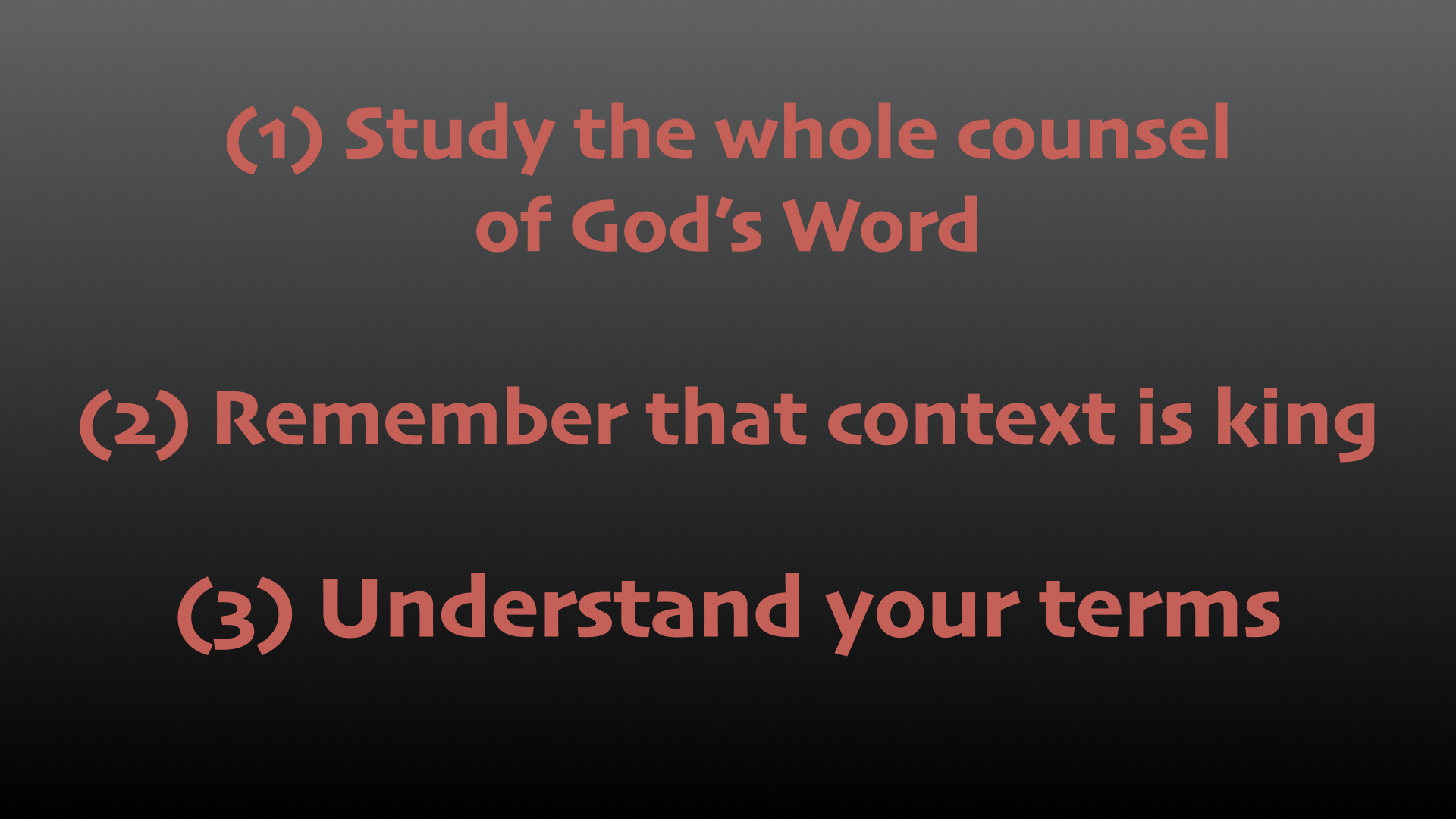 How do we avoid these errors? Here are three thoughts:
(1) Study the whole counsel of God’s Word.
Don’t just read your favorite passages, or the ones that make you feel good, but read all of the Bible. Jesus frequently had to correct the religious leaders’ beliefs by sending them back to the Scripture (Matthew 21:15-16; Mark 12:18-27; Luke 6:3). Jesus called the Holy Spirit the Spirit of truth (John 16:12-15). The Holy Spirit that inspired the Bible is the same Holy Spirit in a Christian that can illuminate the Bible as you read it.
(2) Remember that context is king.
The word “eisegesis” means to read something into the Word. But that is like creating your own beliefs and then going to the Bible to find phrases that support what you already believe. On the other hand “exegesis” is to read the Bible and have it speak to us by the Holy Spirit.
Two of the phrases from Jesus that the name-it-and-claim-it folks use (John 14:13 and John 15:7) turn out to mean something entirely different than, “God will give me all of the things I demand from Him” when they are read within the context of the things Jesus was teaching at that time (see John 14:9-14 and 15:1-8).
(3) Understand your terms.
If something is biblical, that is something the Bible says yes to. Unbiblical things the Bible says no to. But non-biblical are those the Bible doesn’t explicitly address. We have to be very careful of trying to make non-biblical things sound biblical or it may lead to some unbiblical attitudes and actions.
This is exactly what the Pharisees did by giving their non-biblical traditions the weight of biblical statements, and then looking down on others in a very unbiblical way.
God is sovereign. We do not tell Him what to do. We do not demand Him to respond to our needs. We trust Him and and we abide in Him. Then in the abiding, asking and understanding and fruitfulness are as natural as a flower sprouting from a branch that is attached to the vine. We don’t name things and claim things for our personal comfort, but we desire solely for God’s glory to be seen—whether in wealth or poverty, health or sickness, peaceful times or tribulation.
Evaluating all biblical sounding statements by those three items—studying the whole counsel of God’s Word, understanding the context, and knowing our terms—will guide us from going astray.
If you’ve missed any of the messages in our series Is That In The Bible?, you can get a list of all of the messages by clicking here.
►► Would you please prayerfully consider supporting this ministry? My Patreon supporters get behind-the-scenes access to exclusive materials. ◀︎◀︎



 Craig T. Owens