Character Over Reputation

Matthew HenryHere are some of the quotes I shared this morning…

The circumstances amid which you live determine your reputation …
   the truth you believe determines your character.…
Reputation is what you are supposed to be;
   character is what you are.…
Reputation is the photograph;
   character is the face.…
Reputation comes over one from without;
   character grows up from within.…
Reputation is what you have when you come to a new community;
   character is what you have when you go away.
Your reputation is made in a moment;
   your character is built in a lifetime.…
Your reputation is learned in an hour;
   your character does not come to light for a year.…
Reputation grows like a mushroom;
   character lasts like eternity.…
Reputation makes you rich or makes you poor;
   character makes you happy or makes you miserable.…
Reputation is what men say about you on your tombstone;
   character is what the angels say about you before the throne of God. —William Hersey Davis

“Men may go toward Heaven, yet come short; and they may go to Hell with a good reputation.” —Matthew Henry

“If I take care of my character, my reputation will take care of itself.” —D.L. Moody
Love Is… (part 2)

Love is… worksheet 2We are taking a practical look at the incredible definition of love in 1 Corinthians 13. We’re doing this in the context of learning how to love the “unloveable”—or maybe I should say, loving those who are the most resistant to real love. If we can show them love, how much more will the love of Jesus be seen!

All of these verbs are present tense verbs. That means they aren’t exhausted in the past, and they aren’t waiting for future conditions to improve—they are in operation NOW.

Far too many people know Christians more by what we’re against than by what we’re for. So where the biblical text say “love does not” or “love isn’t,” I’ve changed it into the positive “love is.”

You can read about the first five attributes love love by clicking here.

The next five attributes are:

Love is graceful

  • The root word means something that should be covered up, or something we’re ashamed of. Because our words and actions are graceful, they are things we wouldn’t have to defend, or explain, or apologize for later. They are words and actions that wouldn’t embarrass us.
  • Agape will do nothing that misbecomes it.” —Matthew Henry

Love knows our relationship > my rights

  • True love “does not demand its own way” (New Living Translation) nor does it “insist on its own rights” (Amplified Bible). Instead it always seeks ways that the relationship can be repaired or enhanced, even if that means giving up something I consider to be “my right.”
  • NOTE: I’m not saying that you become a doormat. This is not a license for someone to abuse you, but it is a call for us to balance our responses. Romans 12:18 says as far as it depends on you, live at peace with everyone.
  • Here are some great balancing verses. Balance Proverbs 26:4-5 (here is a video where I expand on this idea), and then balance Philippians 2:3-4.

Love is even-tempered

  • The Amplified Bible says it well: love is not touchy or fretful or resentful.
  • This Greek word means not getting stirred up or exasperated. So we need to lighten up!
  • There are some places where we’ve become too sensitive, too touchy, too short-fused. The fire of hurt has replaced the fire of love. So Matthew Henry advises us: “Where the fire of love is kept in, the flames of wrath will not easily kindle, nor long keep burning.”

Love is forgiving

  • The New International Version says love keeps no record of wrongs.
  • This Greek phrase speaks of an accountant tallying up the hurts (where there is an overdrawn account), seeing there is a debt to be paid back, and then appointing himself as the bill collector. True love cancels those IOUs.
  • We don’t forgive others because they deserve forgiveness, but we forgive others because we received forgiveness from God that we did not deserve!
  • For if you forgive people their trespasses [their reckless and willful sins, leaving them, letting them go, and giving up resentment], your heavenly Father will also forgive you. (Matthew 6:14 AMP)

Love is God-honoring

  • Agape loves what God loves and hates what God hates.
  • Agape loves when people find God’s truth, and hates anything that blocks that pursuit.
  • Agape loves the sinner and hates the sin.
  • “The sins of others are the grief of an agape spirit [not] its sport or delight; they will touch it to the quick….” —Matthew Henry

Here’s where the real test comes in: How will you apply these attributes of love to someone in your life? More specifically: to someone you think is “unloveable”?

I know you have someone in your life that you think is unloveable. With that person’s face clearly in mind, how will you fill in the blanks:

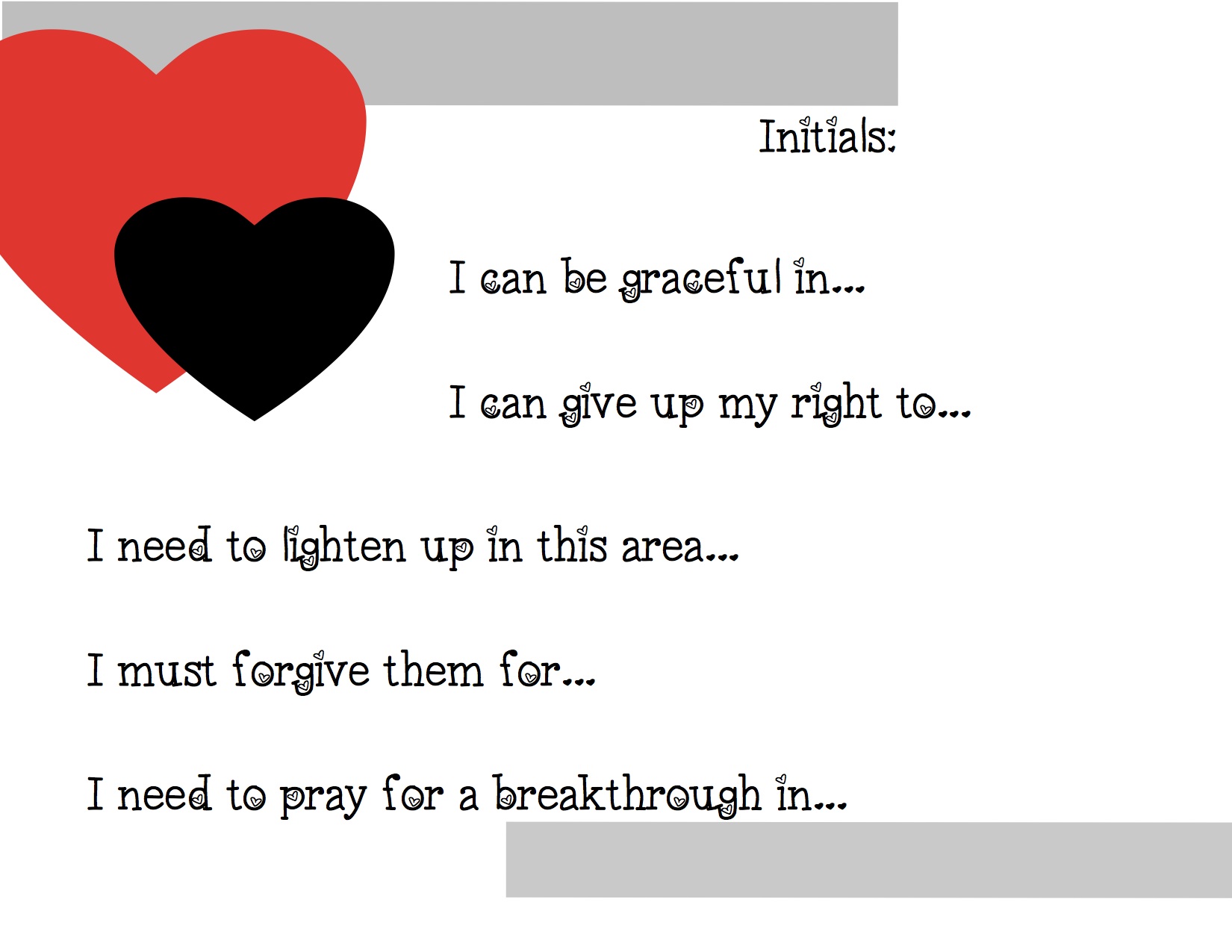
  1. I can be graceful in…
  2. I can give up my right to…
  3. I need to lighten up in this area…
  4. I must forgive them for…
  5. I need to pray for a breakthrough in…

If you would like a downloadable PDF of this worksheet, click here –> Love is… worksheet 2

If you missed any of the messages in our Loving the Unlovable series, you can check them all our here.

Love Is… (part 1)

Love is… worksheet 1The greatest definition of love in the history of mankind is given to us in 1 Corinthians 13. This is the “gold standard” to which all of us should strive to pattern our lives.

But notice that right at the beginning, Paul says, “Love IS” (verse 4). Not love feels good or even love does; but love is. Love is not love because it makes us feel good. Love is not love because we did something nice. Love is love because it measures up to this standard in 1 Corinthians.

Here are the first five attributes of love.

Love is patient

  • Patient love doesn’t lose heart, but stays hopeful.
  • It endures patiently and bravely in enduring misfortune and disappointment.
  • “It can endure evil, injury, and provocation, without being filled with resentment, indignation, or revenge.” —Matthew Henry

Love is kind

  • It is pleasant and courteous.
  • It both seizes opportunities and makes opportunities to show kindness.
  • …as far as it depends on you, live at peace with everyone. (Romans 12:18)

Love is catching others doing something good

  • The biblical phrase is love is not envious, but I want to turn the positive into a negative. Far too often we Christians are known more for what we against, not what we’re for. So the positive way of saying this: we rejoice when others succeed. Or, we catch them doing something good.

Love is complementing others

  • Again, we turn the negative love does not boast into a positive, and say love complements others.
  • Agape raises the value of the object of its love.

Love is others-focused

  • Again, turning the negative love is not proud into a positive.
  • Do nothing out of selfish ambition or vain conceit, but in humility consider others better than yourselves. (Philippians 2:3)

Here’s where the real test comes in: How will you apply these attributes of love to someone in your life? More specifically: to someone you think is “unloveable”?

I know you have someone in your life that you think is unloveable. With that person’s face clearly in mind, how will you fill in the blanks:

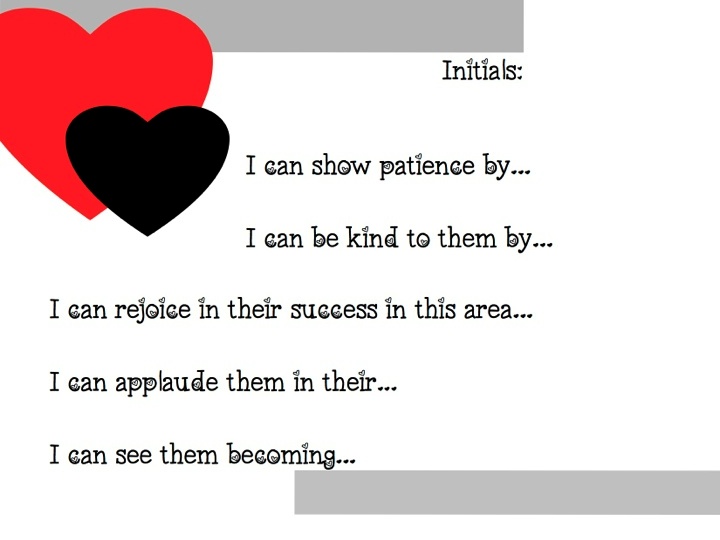
  1. I can show patience by…
  2. I can be kind to them by…
  3. I can rejoice in their success in this area…
  4. I can applaud them in their…
  5. I can see them becoming…

If you would like a downloadable PDF of this worksheet, click here –> Love is… worksheet 1

If you missed any of the messages in our Loving the Unlovable series, you can check them all our here.

We Were Robbed!

Yesterday morning I walked into the church and noticed the office door was open. “Hmm,” I thought to myself, “I am sure that I closed that door before I left yesterday.”

Then I walked around the corner and noticed my office door standing open. “I know I closed that door,” I said. The hair on the back of my neck stood up, and I could feel all my muscles starting to tense. I walked into my office and saw the mess. I looked more closely at my office door and saw it had been jimmied open. So too had the office door.

Someone broke into the church. We had been robbed!

I made an inventory through the church, called the sheriff, and called our Board members. What else was there to do? I returned to my office, sat down in my chair, and looked around my office. Two thoughts overwhelmed me:

1.  All of the things that were taken were replaceable. I am grateful that the things that have sentimental value to me were left untouched.

2.  The words from Matthew Henry’s journal on the day he was robbed immediately came to mind:

“Let me be thankful first, because I was never robbed before; second, because, although they took my purse, they did not take my life; third, because, although they took my all, it was not much; and fourth, because it was I who was robbed, not I that robbed.”

So sitting in my office waiting for the sheriff deputy to arrive I prayed. I thanked God for His protection, and I prayed for the desperate individual who broke in. Clearly, this is someone who is at their wit’s end. Our thief is someone who needs my prayers, not my scorn.

I still feel violated. I still had a sick feeling in my stomach all day (and even now as I recall the events of yesterday). But I also remain grateful to God for His protection, and I’m continuing to pray for our thief that in His desperation He will meet this same loving God.

Sharper

Yesterday was one of those days that I was in “receive” mode. As a pastor, I usually spend more days in the “dispense” mode: teaching, counseling, advising. But yesterday I was blessed to sit back and soak in some great counsel. And I’m sharper for it.

It’s too bad that many people never take the time to allow others to advise them. Or, if they do go through the motions of “listening” to advice, they never put that counsel into action.

I met with a seasoned pastor yesterday morning. He asked me several questions to assess where I was personally and professionally, and then he gave me some invaluable insight. He’s one of those “been-there-done-that” guys who has learned the lessons of history well, and he was gracious to share with me.

Last night I invited my Impact teaching team over to my house. After sharing dinner together I listened as they weighed in on our upcoming series in our youth services. Since they are closer in age to our students, their insight into the teenage mind was so keen. They were able to help me better understand the challenges and culture of middle and high school students. And I’m sharper for it.

A few thoughts from some other wise counselors:

“A wise man will hear, and will increase learning; and a man of understanding shall attain unto wise counsels.” —Proverbs 1:5 (KJV)

“Those who will not be counseled, cannot be helped. More souls are ruined by pride than by any other sin whatever.” —Matthew Henry

“Without good direction, people lose their way; the more wise counsel you follow, the better your chances.” —Proverbs 11:14 (The Message)

“Plans fail for lack of counsel, but with many advisers they succeed.” —Proverbs 15:22 (NIV)

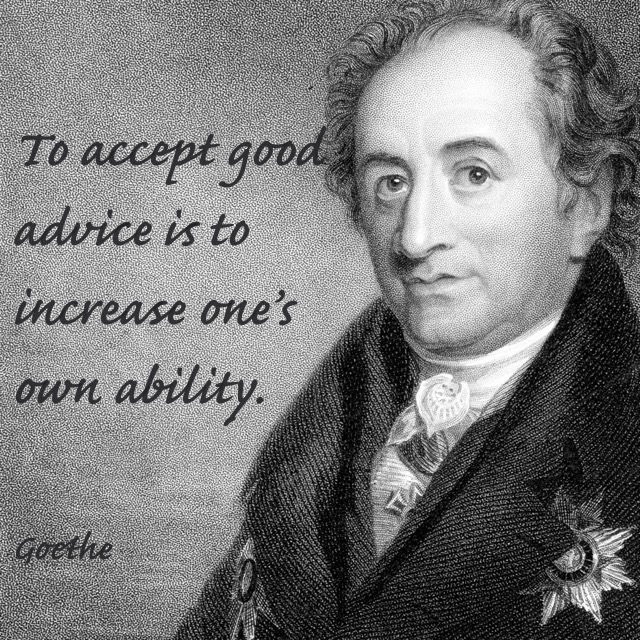
“To accept good advice is to increase one’s own ability.” —Goethe

Are you getting sharper? Are you listening to good advice?