Democracy, Immoral Laws, And A Christian’s Responsibility

We know the law is good if one uses it properly. (1 Timothy 1:8)

Whether laws are labeled spiritual or civil, the IF in that verse is very important. Law is intended to restrain unbecoming or immoral activities. Laws are aimed at lawbreakers. But in order for any law to carry weight, it has to be backed up by something more solid than a man’s opinion of what is “right” or “wrong.”

According to Scripture, a law must…

  • …be supported by sound doctrine (1 Timothy 1:10). What defines “sound doctrine” is the word of God, not man-made opinion. Jesus said about the Pharisees, “They worship Me in vain; their teachings are but rules taught by men” (Matthew 15:9). The New Living Translation renders this verse: “Their worship is a farce, for they teach man-made ideas as the commands of God.”
  • …conform to the gospel (1 Timothy 1:11). Literally this means filtered through Scripture. Any law that does not have its foundation set on a biblical principle is, by definition, an immoral, man-made law.

So what is the Christian’s role in the legislative process? I see four responsibilities for Christians:

1. Pray for our elected officials that they would have a God-fearing, biblically-sound perspective in their legislative activities (see 1 Timothy 2:1-2).

2. Stay informed on the law-making activities on both the local, state, and national levels (see Acts 17:11; 1 Chronicles 12:32).

3. Speak out against unbiblical, immoral laws (see Esther 4; 1 Peter 2:17).

4. Disobey immoral laws. The Bible commands us to “give to Caesar what is Caesar’s, and to God what is God’s” (Luke 20:25). We must never give to Caesar what is God’s (see Acts 5:29)!

I love Martin Luther King Jr’s Letter From Birmingham Jail where he addresses Christian pastors about the rightness of peacefully disobeying immoral laws. If you haven’t read this masterpiece, please take time to do so. In this letter, Dr. King wrote:

Over the last few years I have consistently preached that nonviolence demands that the means we use must be as pure as the ends we seek. So I have tried to make it clear that it is wrong to use immoral means to attain moral ends. But now I must affirm that it is just as wrong, or even more, to use moral means to preserve immoral ends.

Christian, you have a responsibility. Pray, be informed, respectfully speak out against immoral laws, and then peacefully disobey when it is necessary.

Respecting Elected Officials

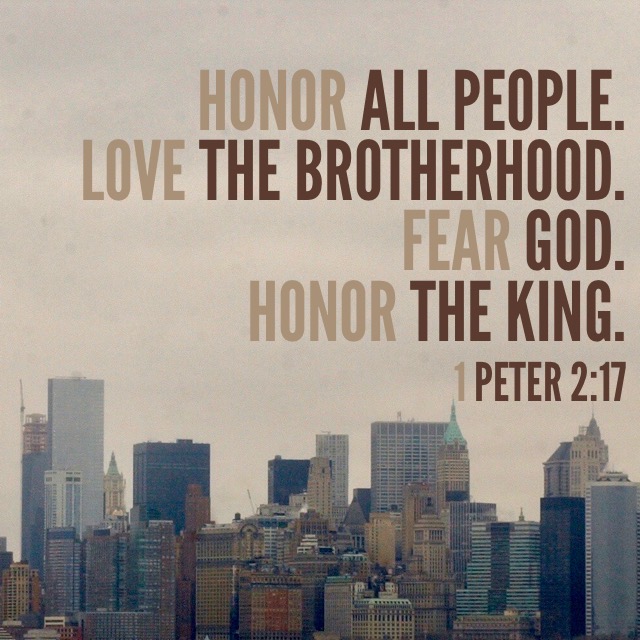
During our prayer time yesterday, I was contemplating the Apostle Peter’s instruction to, “Fear God, and respect the king” (1 Peter 2:17).

  • How do I respect the king (or the other elected officials in my city, state, and country)?
  • Does respect mean saying “yes” to every law that’s passed?
  • Can I be respectful and still disagree with those in elected office? How?

During our hour of prayer at the church last night, I was really wrestling with how I as a Christian should show respect to those in authority in our governments. Here are the nine things the Holy Spirit showed me.

I can show respect to those in authority by:

  1. Not forgetting that God placed them in their office (Daniel 4:25).
  2. Praying for them regularly (1 Timothy 2:1-2).
  3. Obeying all laws that aren’t immoral (Luke 20:25; Acts 5:29).
  4. Disobeying laws that are immoral (Esther 4:16; Acts 4:19).
  5. Holding them to biblical standards (Proverbs 8:15).
  6. Insisting they uphold the United States Constitution (Ecclesiastes 8:2).
  7. Reminding them that God’s wisdom is the ultimate standard (Proverbs 8:22-23).
  8. Requiring them to honor their promises, unless those promises conflict with God’s Word or the Constitution (Esther 1:13; 8:8).
  9. Speak to and about them without complaining or arguing (Philippians 2:14-15).

(Check out all of the above passages by clicking here.)

I’m working on living these out. What do you think?

Thursdays With Oswald—God’s “Oughts”

Two of my favorite authors are C.S. Lewis and Oswald Chambers. Lewis helps me to see biblical truths in a way I’ve not seen them before. Chambers helps me live out those biblical truths differently than I’ve been living them before.

I’m working my way through the complete works of Oswald Chambers (or maybe I should say, his writings are working their way through me!), so I thought I’d share with you, my dear reader, what’s challenging me.

We’ll see how this goes, but on Thursdays, I’ll share with you something I’ve been reading and thinking about from the writings of Oswald Chambers. Sometimes I may just let the teacher speak for himself, and sometimes I may offer a thought or two of my own. As always, you are welcome to weigh in with your thoughts as well. I’m excited to share these lessons with you.

God’s “Oughts”

      Strictly speaking, there is no disobedience possible to an imperative law, the only alternative being destruction. In this sense the moral law is not imperative, because it can be disobeyed and immediate destruction does not follow. And yet the moral law never alters, however much men disobey it; it can be violated, but it never alters. Remember, at the back of all human morality stands God.

      The Ten Commandments were not given with any consideration for human ability or inability to keep them; they are the revelation of God’s demands made of men and women who had declared that if God would make His law known, they would keep it. …

      If the “Oughts” of the Old Testament were difficult to obey, Our Lord’s teaching is unfathomably more difficult. Remember, the commandments were given irrespective of human ability or inability to keep them; then when Jesus Christ came, instead of doing what we all too glibly say He did—put something easier before men, He made it a hundredfold more difficult, because He goes behind the law to the disposition.

      The purity God demands is impossible unless we can be re-made from within, and that is what Jesus Christ undertakes to do through the Atonement. … It is not a question of applying Jesus Christ’s principles to our actual life first of all, but of applying them to our relationship to Himself, then as we keep our souls open in relation to Him our conscience will decide how we are to act out of that relationship.

From Biblical Ethics

A growing relationship with Jesus = Greater sensitivity to my conscience and the Holy Spirit = Correct disposition to obey God’s laws.

What Are Rules For?

Listen to the podcast of this post by clicking on the player below, and you can also subscribe on AppleSpotify, or Audible. 

David is on the run from Saul. He leaves town so quickly that he didn’t have time to kiss his wife goodbye. He didn’t even have enough time to grab a weapon, a change of clothes, companions, or food. So he stops by Ahimelech’s house to see if this priest has any food.

Remember this old nursery rhyme?

Old Mother Hubbard
Went to the cupboard,
To give the poor dog a bone:
When she came there,
The cupboard was bare,
And so the poor dog had none.

That’s just about what happened here. Ahimelech said, “The only bread I have is the holy showbread.” This consecrated bread was 12 loaves laid out each Sabbath in God’s presence. When this bread was replaced each week, it became food for the priests. Ahimelech recognized he had a moral obligation to save David’s life which superseded the ceremonial rules.

Jesus used this incident as an example when the Pharisees accused Him of breaking the law concerning the Sabbath day. Jesus and His followers had been walking through a wheat field, plucking some pieces of grain on which they could munch. The rule-keeping Pharisees said this amounted to work, and a violation of Sabbath rules.

I think sometimes we get so caught up in keeping the rules (or following tradition, or preserving decorum) that we forget the meaning behind the rule. Or, more accurately, we forget God’s design behind the rule.

Every rule God gives is to keep us in a place where we can experience His presence. Rules are not life, but they are boundaries that keep us on the path to life.

Ahimelech kept David alive with showbread. Jesus and His disciples sustained themselves with wheat kernels. Jesus healed the sick on the Sabbath to bring life and wholeness.

Following rules just to follow rules misses the point. What is the point? Following God’s rules to find God’s heart is THE point.

So let me ask you: Do you get the point?

You may also want to check out series on God’s rules called The Love In The Law, or the post called Rules Are Overbearing—Love Never Is.

►► Would you please prayerfully consider supporting this ministry? My Patreon supporters get behind-the-scenes access to exclusive materials. ◀︎◀︎