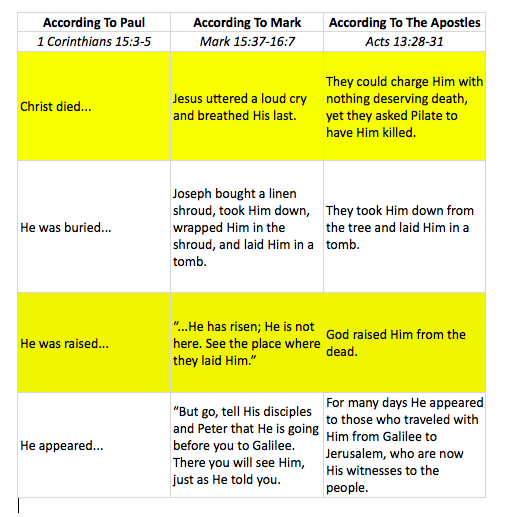
 Did Jesus Rise From The Dead? is an excellent apologetic for both the biblical skeptic and the biblical student. You can read my full book review by clicking here. Below are seven noteworthy quotes and one infographic from this fascinating book.
“One of the most noteworthy facts about the early Christian belief in Jesus’ resurrection was that it flourished in the very city where Jesus had been publicly crucified. So long as the inhabitants of Jerusalem thought that Jesus’ corpse lay in the tomb, few would have been prepared to believe such silliness as the claim that God had raised Jesus from the dead.”
“We have the extraordinary number of at least five independent sources for Jesus’ burial, some of which are extremely early. The Gospels describe Joseph as a rich man, a member of the Jewish Sanhedrin. As a member of the Jewish Sanhedrin that condemned Jesus, Joseph of Arimathea is unlikely to be a Christian invention. The Sanhedrin was a sort of Jewish high court made up of seventy of the leading men of Judaism, which presided in Jerusalem. There was an understandable hostility among early Christians toward the Jewish Sanhe-drists, for Christians blamed the Sanhedrists for engineering a judicial murder of Jesus at the hands of the Romans. … Therefore, Jesus’ burial by Joseph is very probably historical, since it would be almost inexplicable why Christians would invent a story about a Jewish Sanhedrist who gives Jesus a proper burial.”
“Matthew is clearly working with an independent source, for he includes the story of the guard at the tomb, which is not derived from Mark and is unique to his Gospel; moreover, his comment that the rumor that the disciples had stolen Jesus’ body, ‘And this story has been spread among the Jews to this day,’ (Matthew 28:15) shows that the guard is not Matthew’s own creation, but was part of prior tradition. Luke also has an independent source, for he tells the story, not found in Mark, of two disciples’ inspecting the tomb to verify the women’s report that the tomb was vacant. This story cannot be regarded as Luke’s own creation, since the incident is independently reported in John’s Gospel. And, again, given John’s independence of the other three Gospels, we have yet another independent report of the empty tomb.”
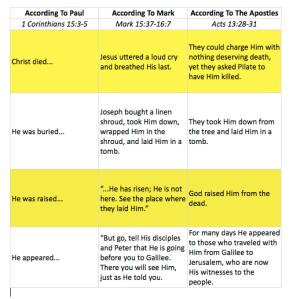
(click image for a larger view)
“To appreciate how restrained Mark’s narrative is, we need only read the account in the second-century apocryphal Gospel of Peter. It describes Jesus’ triumphant exit from the tomb as a gigantic figure whose head reaches above the clouds, supported by giant angels, followed by a talking cross, heralded by a voice from heaven, and all witnessed by a Roman guard, the Jewish leaders, and a multitude of spectators! This is how real legends look: They’re richly decorated with theological and apologetical motifs. By contrast, Mark’s account is stark in its simplicity.”
“Think about that: ‘His disciples came by night and stole Him away’ [Matthew 28:13]. The Jewish authorities did not deny the fact that Jesus’ tomb was empty; instead they entangled themselves in a hopeless series of absurdities, trying to explain it away. In other words, the Jewish claim that the disciples stole the body presupposes that the body was, in fact, missing. Therefore, we have evidence from the very adversaries of the early Christian movement for the fact of the empty tomb.”
“All the followers of those first century messianic movements were fanatically committed to the cause…. But in no case right across the century before Jesus and the century after Him do we hear of any Jewish group saying that their executed leader had been raised from the dead, and he really was the Messiah after all.” —N.T. Wright
“A supernatural explanation of the empty tomb, the resurrection appearances, and the origin of the Christian faith is not contrived given the context of Jesus’ own unparalleled life, ministry, and personal claims.”




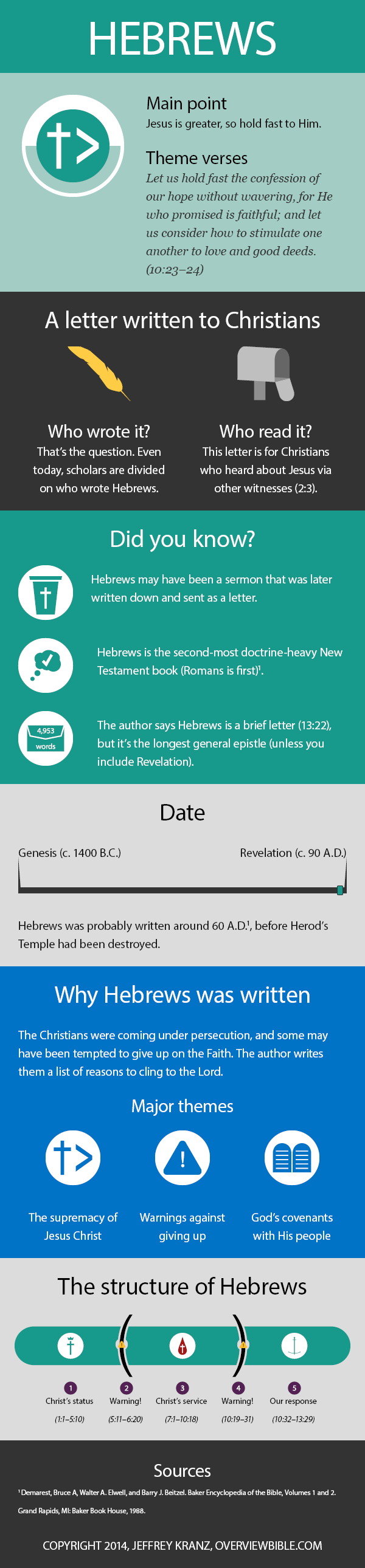 The Overview Bible Project has another book study released on Hebrews. Read this and then please subscribe to have the latest studies sent right to your email. I love these!



 Craig T. Owens