The Christian Atheist (book review)

Every time I read a Craig Groeschel book, I know I’m going to read words that cut right across all of my excuses for not changing. And I was not disappointed to find this pattern continued with his latest book The Christian Atheist.

If the title sounds like an oxymoron (you can read the definition of this funny-sounding word here), that’s because it is. Or is it? The subtitle of the book gives the right-on-target definition of a Christian atheist: believing in God but living as if He doesn’t exist.

So every chapter is titled, “When you believe in God, but…

  • …you don’t really know Him.”
  • …you are ashamed of your past.”
  • …you aren’t sure He loves you.”
  • …you don’t think you can change.”
  • …you don’t share your faith.”
  • and many more!

It reminds me of what James wrote in his letter to the church, where he called them out for being Christian atheists: “You believe in God? Good for you! Even the demons believe in Him. But you’re not living like you believe in Him.”

Brennan Manning wrote,

“The greatest single cause of atheism in the world today are Christians who acknowledge Jesus with their lips and walk out the door and deny Him by their lifestyle. That is what an unbelieving world simply finds unbelievable.”

But Craig doesn’t just identify the symptoms, he gives his readers the prescriptions too. In easy-to-apply concepts, Craig tells those who believe in God how they can make the changes that won’t deny God by their atheistic lifestyle.

I highly recommend this book to you.

I am a Zondervan book reviewer.
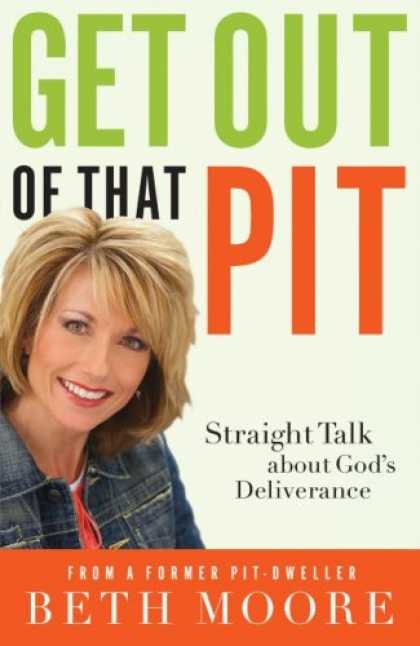
The Pits

I recently finished reading two books that both have “the pits” in their title, and they both are solidly based on Scripture. But they couldn’t be more different.

Get Out Of That Pit by Beth Moore is based on three verses in Psalm 40: I waited patiently for the LORD; He turned to me and heard my cry. He lifted me out of the slimy pit, out of the mud and mire; He set my feet on a rock and gave me a firm place to stand. He put a new song in my mouth, a hymn of praise to our God. Many will see and fear and put their trust in the LORD.

Beth’s book is all about getting out of a pit. Those places we’ve slipped into, been shoved into, or keep going back to. Those things that limit our perspective on life. Those hurts that keep us from enjoying the full life Jesus wants to give us. In a word, this book is all about deliverance from a pit.

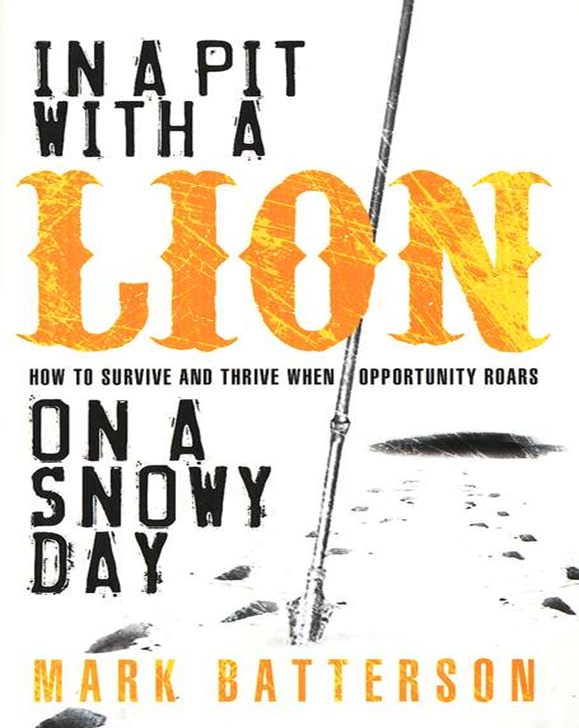
In A Pit With A Lion On A Snowy Day by Mark Batterson is based on two verses in 2 Samuel 23: Benaiah son of Jehoiada was a valiant fighter from Kabzeel, who performed great exploits. He struck down two of Moab’s best men. He also went down into a pit on a snowy day and killed a lion. And he struck down a huge Egyptian. Although the Egyptian had a spear in his hand, Benaiah went against him with a club. He snatched the spear from the Egyptian’s hand and killed him with his own spear.

Mark’s book is all about going into a pit. Benaiah was an initiator. Mark leads us through Benaiah’s life to show us that sometimes problems come as opportunities disguised as Moabite warriors or roaring lions or huge giants. And in order to live the full life God has in mind for us, we have to seize those roaring opportunities. In a word, this book is all about taking the initiative to go into a pit.

The pits can limit your life. Either you can be stuck in one, or you can be afraid to go into one. God wants you to live a victorious life. Whether you are stuck and need deliverance, or you are stuck and need initiative, these books can help awaken in you the great things God wants to do through you.

Both books have discussion questions to go along with each chapter, which makes them excellent for use as either an individual or small group study.

Ready? Go get out of that pit—or dive headlong into one—to live the full life God has for you!

Rules Of Engagement (book review)

In whatever criteria you want to measure him, Chad Hennings is a man’s man: accomplished wrestler, US Air Force fighter pilot, Outland Trophy winner, and Super Bowl champion with the Dallas Cowboys. So when Chad sets out to write a book for men, Rules Of Engagement, you know it’s going to be right on target.

And it is.

Chad doesn’t pull any punches. He calls men out on the games we tend to play to hide our insecurities or our shortcomings. Using his military background, the book is divided into two main sections: basic training and active duty.

In basic training, you will learn how to become a well-rounded man. Chad covers the emotional, spiritual, mental, and physical regimens that will prepare men for the battles we fight every day. In this section, I especially appreciated the insights on character and vision, the foundations for a successful life. Chad writes, “Character and vision go hand in hand because a man’s vision comes directly from his character.”

In the active duty, section, you will learn how to put all of this training and hard work into practice. Chad covers the areas of family, accountability with another strong man (your wingman), money, and community involvement.

This book would be excellent for a man to read by himself. But I think it would take on even more effectiveness if two or three men read the book together and then enlisted each other as their wingmen. Accountability is a key factor in making all of this stick.

I am a FaithWords book reviewer.

Classic Wisdom For The Professional Life (book review)


Bryan Curtis has compiled a collection of quotes that are targeted for the business professional. In Classic Wisdom for the Professional Life, you will find sage wisdom from a variety of different perspectives.

Winston Churchill once said, Every uneducated man should read a book of quotes.” I love reading the wisdom of people who have been-there-done-that, and this book is full of those kinds of people. I enjoy letting their hindsight educate me and become my foresight. Normally I speed-read my way through books, but I found myself going rather slowly through this book, trying to absorb the wisdom in each of the quotes.

My only frustration with this book is that the quotes are not grouped together in any apparent categories. I would have liked a section on planning, a section on overcoming failure, a section on people skills, etc. So I just took the quotes most meaningful to me and retyped them in my computer into the categories where I would have grouped them. Other than that, there is much wisdom to be found in these pages.

I am a book reviewer for Thomas Nelson.

Plan B (book review)

I was immediately intrigued by the title of Pete Wilson’s book Plan B because it’s a phrase we use so much in my family. In fact, we sometimes take it farther than that: many times we’re talking about Plan F or even Plan Q!

Yet at the same time, I found myself asking, “Does God have a Plan B for my life?” As I read Pete’s book I discovered the answer to my question is a resounding and loving, “No!” God only has a Plan A, nothing takes Him by surprise. I, however, often get taken by surprise: that’s where Plan B comes in. And that’s where Pete’s book is so beneficial.

This book is not about scrambling to come up with an alternate plan, but learning how to rest assured in God’s Plan A for my life.

I’m pretty sure that all of us have been disappointed at some point. We thought things were heading in the right direction, but then everything seemed to be going sideways. Our first inclination is to try to come up with a Plan B to deal with our ‘crisis’. But Pete Wilson’s Plan B is a reminder that God’s Plan A still prevails, that we can still place our hope in God. I love this quote from the book:

“There is an undeniable relationship between crisis and hope. Between waiting hopefully and being transformed. Between Plan B and the glory of God.”

A practical and timely book to help you successfully navigate through the tough spots, to not collapse in crisis, but to be buoyed by hope.

I am a Thomas Nelson book reviewer.

A Century Turns (book review)

Some people may turn away from William Bennett’s book A Century Turns because they claim not to like history. But I have two reasons why this book is definitely worth your time: (1) Those who don’t learn the lessons of history are doomed to repeat them, and (2) This book doesn’t read like a history book.

Bill Bennett has a great talent to give us lessons from history in almost novel-like form. This narrative traces the changing tides of the United States and her relationship with her allies from the election of President George H. W. Bush through the election of President Barak Obama.

Mr. Bennett was in a unique position to see these unfolding events from the front row. In fact, in reading his book I could help but think about how Forrest Gump seemed to always show up at such pivotal and momentous times of history. So too does Bill Bennett. He has served in a variety of positions in Washington, D.C. that placed him in the right place at the right time to give his readers the “inside scoop.”

But beyond a retelling of history, Mr. Bennett captures the mood of the country through these times. He shows us just how quickly public opinion can turn. But most importantly he shows us that this great country is still made up of a government of the people, by the people, and for the people. And that is the most important history lesson of all.

I am a Thomas Nelson book reviewer.

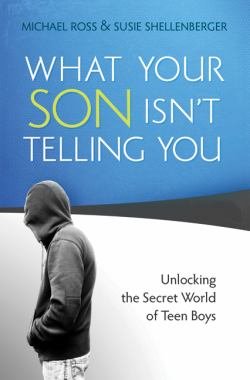
What Your Son Isn’t Telling You (book review)

Here’s a shocker (maybe you should sit down for this one): Boys are different from girls. Gasp! I know any parent who has both a son and a daughter is saying, “Duh!” Here’s the problem though: since girls are typically more verbal, it’s easier to know what’s on their minds. Not so much with boys.

That’s why I so enjoyed What Your Son Isn’t Telling You by Michael Ross and Susie Shellenberger. It’s not what your son is saying, it’s what he isn’t saying that becomes frustrating. Michael and Susie do a great job of demystifying a boy’s brain. From the physiological makeup of the male brain, to the typical coping mechanisms of guys, to the deepest fears and greatest desires that our sons have, this book helps arm Moms and Dads for better communication with their son.

The book is laced with email communications from guys from pre-teen to early-college ages. These first-person insights give real validity to what the authors are teaching. I also appreciated the very easy-to-apply communication tips to help open the door from “isn’t saying” to “saying.”

Although I am blessed to have a great wife who is actively involved with our two sons, I took note of the authors’ advice for single Moms. I was really pleased to see the special attention for a Mom that has to raise a son on her own.

Any parents with sons will appreciate this timely and practical book. I highly recommend it.

I am a Bethany House book reviewer.

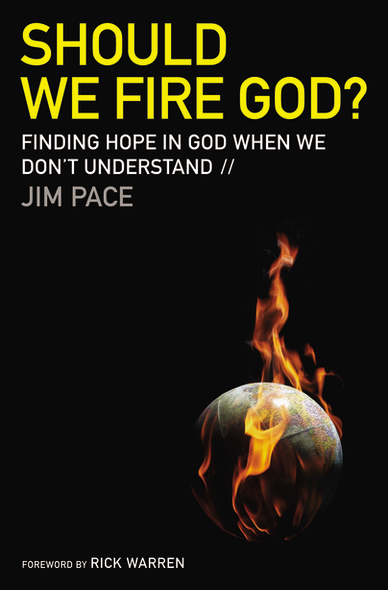
Should We Fire God? (book review)

Probably like me, the first thing that caught your eye was the title. Jim Pace didn’t entitle his book Should We Fire God? just to be provocative. It’s a legitimate question. In fact, it’s a question that so many have wrestled with for centuries: How can God allow bad things to happen?

It’s one thing when we in America are asking this question about the genocide in Darfur, or the earthquake in Haiti, or a famine in the Middle East. But what about when it hits so much closer to home?

Jim Price was pastoring at Virginia Tech University, when on April 16, 2007, a lone gunman opened fire on the campus killing over 30 people, including himself. Immediately Jim was forced face-to-face with this age-old question: How could this happen?

Some thought, “If God couldn’t keep us safe, perhaps He’s not up to the job. Should we fire God?

Carefully, honestly, loving, Jim addresses this question. For him, this is not some theoretic exercise. It’s personal. The emotion comes through raw and real. After weighing all the evidence and considering all of the possibilities, Jim reaches the conclusion that…. Well, you’ll have to read Should We Fire God? for yourself and come up with your own conclusion.

If you’ve ever faced heartache, if you’ve ever wondered how God could allow something tragic to happen, if you’ve ever wrestled with the thought of firing God, you will find some great thinking material in this book.

I am a FaithWords book reviewer.

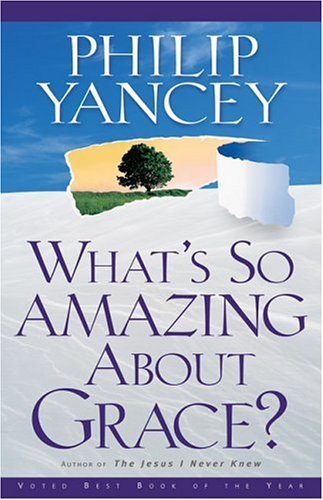
What’s So Amazing About Grace (book review)

Philip Yancey calls grace “the last best word,” and I quite agree. What’s So Amazing About Grace is a challenging read because it is so painful. The truth of our almost daily practice of ungrace is confronting and convicting.

Throughout this book I wanted to say, “I’m glad I don’t behave that way.” And then I’d get a quick glance of myself in the mirror and realize how easily I slip into the same ungraceful behavior I despise. I so desperately want to be a grace-filled man.

Here are just a few of the passages that I’m meditating on, and trying to apply to my life:

  • “I yearn for the church to become a nourishing culture of grace.”
  • “Sociologists have a theory of the looking-glass self: you become what the most important person in your life (wife, father, boss, etc.) thinks you are. How would my life change if I truly believed the Bible’s astounding words about God’s love for me, if I looked in the mirror and saw what God sees?”
  • “I really only love God as much as I love the person I love the least.” (Dorothy Day)
  • “In a brilliant stroke Jesus replaces the two assumed categories, righteous and guilty, with two different categories: sinners who admit and sinners who deny.”
  • “Grace substitutes a full, childlike and delighted acceptance of our Need, a joy in total dependence. We become ‘jolly beggars.’” (C.S. Lewis)
  • “Having spent time around ‘sinners’ and also around purported ‘saints,’ I have a hunch why Jesus spent so much time with the former group: I think He preferred their company. Because the sinners were honest about themselves and had not pretense, Jesus could deal with them. In contrast, the saints put on airs, judged Him, and sought to catch Him in a moral trap. In the end it was the saints, not the sinners, who arrested Jesus.”

If you are challenged about living grace-filled in an increasingly grace-less society, you will find ample help in reading this book.

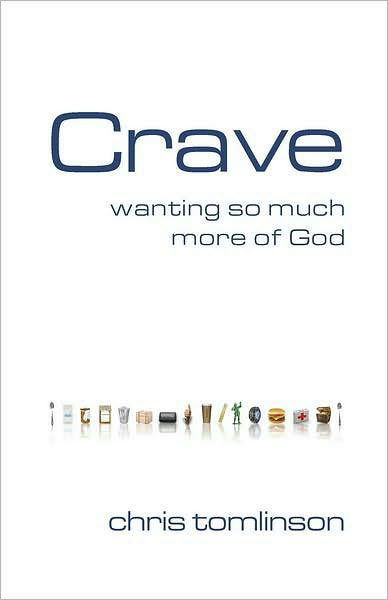
Crave (book review)


Chris Tomlinson’s first book is a winner! Sometimes when I read books from guys who have Been There Done That, I get the feeling that they’ve somehow arrived and I’m still so lacking. Crave reads like Chris’s personal journal. He’s a BTDT guy, but he humbly paints the picture of someone still on the journey for more of God (which is also, aptly, the subtitle of his work).

The fifteen chapters all point to the same overarching theme: how can I get more of God? Chris opens up his heart and lets us peek inside to see what his journey has looked like, and what it still looks like. Never did I have the feeling that he was telling me what I should do, but more like he was saying to me,

“Here’s where I struggled; here’s where I blew it; here’s where I overcame; here’s what I’m still learning. Learn from my successes and failures, and let’s go after more of God together.”

Many times I gauge a book by how many passages I highlight, but I couldn’t do that with Crave. Too much of it rang true to me. If I were to highlight the heart-tugging passages, pages and pages would have become saturated with orange ink. Instead of the pages soaking up ink, I let my spirit soak up the truthfulness, applicability and timeliness of Chris’s words.

If you’re craving more of God, if you want a more satisfying relationship with Christ, even if you feel like your relationship with God has parked on a plateau, Crave can help you rekindle your pursuit of intimacy with your Creator.

I am a Harvest House book reviewer.