


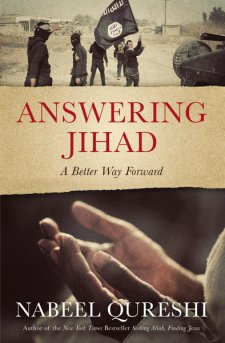
 Militant Islam … Jihad … Religion of peace … ISIS … Islamic terrorism. These phrases dominate the news stories and the water-cooler conversations, but do we really know what they mean? Nabeel Qureshi does. He was born to devout Muslim parents, trained in the Quran, and ready to follow in his parents’ footsteps. But along the way, Nabeel became a Christian. Knowing both the Muslim and Christian angles of these topics, Dr. Qureshi can capably help us Westerners in Answering Jihad.
(By the way, if you haven’t read Nabeel’s account of how he became a Christian, you really should read Seeking Allah, Finding Jesus.)
Answering Jihad is presented to us in the form of answers to 18 of the most-asked questions about how jihad is really perceived in the Muslim community. As he did in his biography, Nabeel presents this information in a way Western minds can grasp. He introduces key points of history that surround Muhammed, explains Islamic terms, and quotes relevant passages from the Quran and other Muslim scholars. I think you will find, as I did, so much more clarity than the sound bytes thrown around on news sources and on social media.
Nabeel concludes his book by telling us that there is a better way forward than the “either-or” extremes that are usually proposed. He explains it this way—
“If we avoid the truth about jihad, we leave the door open for innocent people to be killed in attacks like Paris and San Bernardino. If we lack compassion, we close the door to innocent people who need refuge from places like Syria and Somalia. … Even though Muslims are often raised with the teaching that ‘Islam is the religion of peace,’ when they study the texts for themselves, they are faced with the reality that Mohammed and the Quran call for jihad. They will stand at the crossroads for only so long before they choose what path they will take—apostasy, apathy, or radicalization. As Muslims make that choice, it would benefit the whole world if they did not make it alone, or worse, with radical recruiters. We need to show compassion for Muslims and befriend them.”
Well said! And with the information in Answering Jihad, you can be ready to befriend your Muslim neighbors on their journey.
I am a Zondervan book reviewer.


 Craig T. Owens