
Links & Quotes

link quote

Some interesting reading from this weekend…

Assemblies of God missionaries were addressing the issue of sex slaves and sex trafficking as far back as 1917.

Chilly Chilton challenges us to view worship as serving: Serving Up Some Worship!

This infuriates me … a Planned Parenthood staffer recommends abusive sex to a 15-year-old! And guess what? Our tax dollars are paying for this garbage.

More medical evidence that stress is bad for your heart.

“It will take an infinite number of ages for God to be done glorifying the wealth of His grace to us—which is to say He will never be done. And our joy will increase forever and ever. Boredom is absolutely excluded in the presence of an infinitely glorious God.” —John Piper

Don’t just study; study well. Here are some important questions to ask yourself.

The Overview Bible Project has a cool look at the Psalms.

How can we ever hope that our kids will become moral, ethical, committed people when we can’t keep our word, can’t keep our pants on, and can’t seem to hold our tongue or liquor? To all three groups of leaders, I simply say: We don’t expect you to be perfect, but we do expect you to embody integrity.” Read more from Tim Elmore’s post The Only Way To Turn Students Into Ethical Leaders.

“As Christians we are called upon to exhibit the character of God, and this means the simultaneous exhibition of His holiness and His love.” —Francis Schaeffer
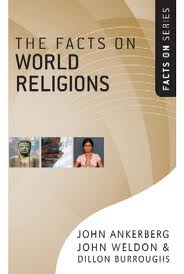
The Facts On World Religions (book review)

The Fact On World ReligionsAs a Christian, I have always taken seriously the admonition of the Apostle Peter to, “Always be prepared to give an answer to anyone who asks you the reason for the hope you have. Do this with gentleness and respect” (1 Peter 3:15). Not being able to answer is unacceptable, and so I want to diligently study. The Facts On World Religions by John Ankerberg, John Weldon & Dillion Burroughs is just the book to help me in this pursuit.

The Facts On is a well-researched, well-footnoted, helpful guide to learn the basic information on four of the world’s predominate religions: Christianity, Islam, Hinduism, and Buddhism. For all four religions the authors give a broad overview in the categories of:

  • What are this religion’s central beliefs?
  • How did this religion originate?
  • Is the founder of this religion who he claimed to be?
  • Are this religion’s scriptures reliable?

Having each religion covered in the same four categories make a side-by-side comparison much easier. Although this book is not an in-depth study, every chapter is heavily notated to make it easy to find additional study materials on each religion. The last section of the book is a summation of the findings and addresses the questions: Is all religion good? Is only one religion fully true? Are Christians intolerant to say Christ is the only way? What are the consequences for believing the way these religions teach?

All in all this book is a very handy guide for any student who wants to be prepared to give an answer.

Check out this video from Greg Koukl on why Christians should defend their faith…