And David knew that the Lord had established him as king over Israel and that his kingdom had been highly exalted for the sake of His people Israel.
“David knew” reminds me of a line from Jesus’ life: Jesus knew that the Father had put all things under His power (John 13:3).
David and Jesus both knew that their positions of leadership were God-granted. And with that knowledge, they both wanted to further expand God’s Kingdom.
They didn’t keep the power for themselves; they didn’t lord it over others; they didn’t hoard the blessings; they didn’t use their leadership for personal gain; they used their God-granted authority to serve others.
They were confidently humble leaders.
If you are in a position of leadership, it’s not for you nor is it because of you. Leadership is from God, through you, to benefit others and to expand His Kingdom.
What do you know about leadership … and what are you doing with it?
Betsy and I went to school conferences and discovered that our youngest son has been staying after school—by his own choice—to help his teacher tidy up the classroom. Are you kidding me?! This is the first I had heard of this. Wow, am I one proud Dad!
I’m not sure if he knows this verse or not, but Brandon is living out what Jesus said:
Don’t do your good deeds publicly, to be admired by others, for you will lose the reward from your Father in heaven.
He’s serving just because he wants to serve. I didn’t know about it, but his Heavenly Father did. Thank you, Brandon, for giving me this wonderful example of servant leadership!
Listen to the podcast of this post by clicking on the player below, and you can also subscribe on Apple, Spotify, or Audible.
As King Solomon’s son Rehoboam was ascending the throne, he received some wise counsel:
If you will be a servant to these people and serve them and give them a favorable answer, they will always be your servants.
I also like the way The Message paraphrases this same verse:
If you will be a servant to this people, be considerate of their needs and respond with compassion, work things out with them, they’ll end up doing anything for you.
In other words: the more you serve, the better you will lead. Unfortunately, Rehoboam chose to reject this counsel, and his leadership disintegrated.
If you will be a servant [position] and serve [attitude] they will serve you.
This Hebrew word for serve is used quite a bit in the Old Testament. Interestingly, the first five times it is used are all in the agricultural sense: farming the land, tending to the plants, working, waiting, and ultimately harvesting. Leadership is never developed quickly. Servant leaders must be in it for the long haul.
But among you it will be different. Whoever wants to be a leader among you must be your servant, and whoever wants to be first among you must be the slave of everyone else.
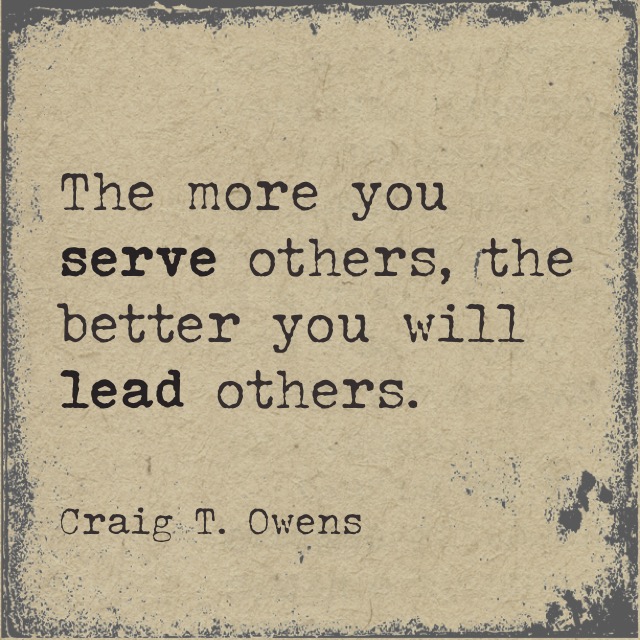
Bottom line: The more you serve others, the better you will lead others.
Listen to the podcast of this post by clicking on the player below, and you can also subscribe on Apple, Spotify, or Audible.
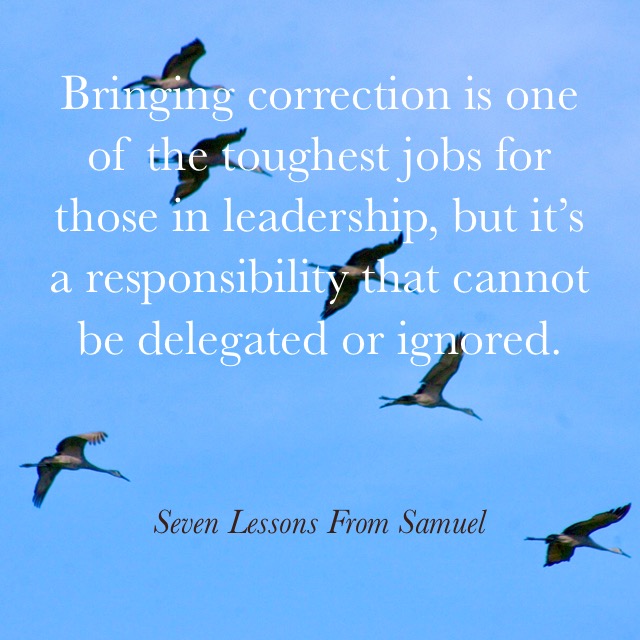
Bringing correction is one of the toughest jobs for those in leadership, but it’s a responsibility that cannot be delegated or ignored. In order for correction to be effective, it must not be too light or too heavy. Unfortunately, many of us have experienced far too many ineffective forms of leadership correction.
I read a great example of how to properly correct in the life of Samuel. In 1 Samuel 12, the people had gotten off track, and Samuel lovingly and effectively brought them back into line. Here’s what his example teaches us on how to correct followers:
1. Shared history (v. 2). Samuel reminded them of what had happened in their history, and even what they had experienced together. “Newbie” leaders need to be cautious about bringing correction that violates an organization’s established culture.
2. Integrity (v. 3). Samuel’s words and lifestyle lined up. That doesn’t mean he never made a mistake, but it does mean that he was willing to acknowledge and repair his mistakes. Nothing is worse than a leader who says, “Do as I say, not as I do!”
3. Common ground (vv. 6-11). A leader needs to get everyone on the same page. Find something somewhere on which everyone can agree, and then move forward from there.
4. Just say it (vv. 12-13). Don’t beat around the bush; don’t try to bring correction through a parable; don’t soften the blow. Just say it: “This is where I believe you made a mistake.” Far too many leaders talk too much and leave their followers saying, “Huh?” If you are going to bring correction, make sure your followers know exactly what it is you are correcting.
5. Give the remedy (vv. 14-15, 20-21). Samuel pointed out the error, and he just as clearly told them how to get back on track. The remedy should be as clear and simple as possible.
6. Remove the fear (vv. 20, 22). Don’t let the corrected follower be afraid of you! Fear will never re-establish trust. Samuel couldn’t have been more clear on this. He literally said to the Israelites, “Do not be afraid.”
7. Demonstrate servant leadership (v. 23). At the close of the meeting, Samuel said he would do two things: “I will continue to pray for you, and I will continue to teach you.” In telling them this, Samuel was really saying, “Let’s walk through this together.”
If you lead your family, your church, your company, or your team, you are going to have to bring correction at some point. When you need to do this, take some time to review this list and bring correction the way Samuel did: lovingly and effectively.
P.S. You can also check out this post where the apostle Paul gives us another example of how to handle correction properly.
Over the past couple of days I’ve been thinking a lot about something: What does it mean to serve? Or more specifically, what does God say about how we should serve?
The typical image that comes to mind when someone says “servant” is a person of lower status—someone who is at the lower end of the organizational chart, someone who is expected to do more with less, someone who doesn’t have many opportunities for advancement (or even a day off), or maybe someone who is expected to be tuned into everyone else’s needs but seldom has his own needs met.
Is being a servant the same thing as being a doormat?
He now showed them the full extent of His love…. Jesus knew that the Father had put all things under His power, and that He had come from God and was returning to God; so He got up from the meal, took off His outer clothing, and wrapped a towel around His waist. After that, He poured water into a basin and began to wash His disciples’ feet, drying them with the towel that was wrapped around Him.
Jesus was the most important person in the room: Jesus KNEW that the Father had put all things under His power. He was also the most love-filled person in the room. What did He do with all of His love and power? He served others.
When He finished, John writes that He returned to His place, and asked His disciples a question, “Do you understand what I just did?” Then in the only instance of Scripture where Jesus Himself said this, “I have set you an example that you should do as I have done.”
Servants are people who use the power they have to lovingly serve others.
Servants don’t serve because someone else forces them to serve. Servants serve because the love of God empowers them to serve.
Do you love your spouse enough to serve him/her? Do you love your family enough to serve them? Do you love your coworkers enough to serve them? The greater the love we have for others, the greater the empowerment to serve. Love empowers us for service.



 …and what are you doing with it?