Links & Quotes

link quote

Some great reading & watching from this weekend…

What it means to fight like a man.

[INFOGRAPHIC] The most popular Book of all time.

“Christians are priests, but how priests if they offer no sacrifice? Christians are lights, but how are they lights unless they shine for others? Christians are sent into the world, even as Christ was sent into the world, but how are they sent unless they are sent to pray? Christians are meant not only to be blessed themselves, but in them shall all the nations of the earth be blessed, but how if you refuse to pray?” —Charles Spurgeon

“Reason does not know that salvation must come down from above; we want to work up from below so that the satisfaction is rendered by us.” —Martin Luther

“No matter the society or culture, the city or town, God has never lacked the power to work through available people to glorify His name.” —Jim Cymbala

Chilly Chilton has a very timely message: My Take On Mark Driscoll & Acts 29.

[FREE EBOOK] I love the graphics and Bible study tools from The Overview Bible Project. Check out the free ebook they are offering on the apostles.

[VIDEO] John Maxwell says, “You cannot be full of yourself and focused on others.” Check out his video on humility.

12 Noteworthy Quotes From “There Is A God”

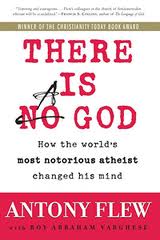
There Is A GodAs I said in my book review of Anthony Flew’s There Is A God, the real value of this book is in the arguments which contributed to Flew’s shift from atheism to theism. You can read my full book review by clicking here.

Frankly, it’s hard to share a lot of the quotes because the context of the full argument would be lacking, but I’ve been sharing a few of them over several posts. To wrap up this series, here are several other noteworthy quotes from this thought-provoking book.

“I would have liked to convince my father that I had found what he had been looking for, the ineffable something he had longed for all his life. I would have liked to persuade him that the search for God does not have to be in vain. But it was hopeless. He had known too many blind Christians, bleak moralists who sucked the joy from life and persuaded their opponents; he would never have been able to see the truth they were hiding.” —Katherine Tait, daughter of Bertrand Russell 

“Nothing can penetrate the loneliness of the human heart except the highest intensity of the sort of love the religious teachers have preached.” —Bertrand Russell

“In sum, to the Being who he considered to be the explanation of the world and its broad form, Aristotle ascribed the following attributes: immutability, immateriality, omnipotence, omniscience, oneness or indivisibility, perfect goodness and necessary existence. There is an impressive correspondence between this set of attributes and those traditionally ascribed to God within the Judaeo-Christian tradition. It is one that fully justifies us in viewing Aristotle as having had the same Divine Being in mind as the cause of the world that is the object of worship of these two religions.” —David Conway

“There can never be any real opposition between religion and science; for the one is the complement of the other. … Religion and natural science are fighting the joint battle in an incessant, never relaxing crusade against skepticism and against dogmatism, against unbelief and superstition … and therefore ‘On to God!’” —Max Planck

“God is a mathematician of a very high order and He used advanced mathematics in constructing the universe.” —Paul A.M. Dirac 

“Reason tells me of the extreme difficulty or rather impossibility of conceiving this immense and wonderful universe, including man with his capability of looking far backwards and far into the futurity, as a result of blind chance or necessity. When thus reflecting I feel compelled to look to a First Cause having an intelligent mind in some degree analogous to that of mine; and I deserve to be called a Theist.” —Charles Darwin

“Science can proceed only if the scientist adopts an essentially theological worldview. … Even the most atheistic scientist accepts as an act of faith the existence of a lawlike order in nature that is at least in part comprehensible to us.” —Paul Davies, Templeton Prize winner 

“It is crazy to postulate a trillion (casually unconnected) universes to explain the features of one universe, when postulating one entity (God) will do the job.” —Richard Swinburne

“The problem of how meaningful or semantic information can emerge spontaneously from a collection of mindless molecules subject to blind and purposeless forces percents a deep conceptual challenge.” —Paul Davies 

“One feature of life, though, remains certain: Life could not have evolved without a genetic mechanism—one able to store, replicate, and transmit to its progeny information that can change with time. … Precisely how the first genetic machinery involved also persists as an unresolved issue.” —Antonia Lazcano

“The world is rational. The order of the world reflects the order of the supreme mind governing it.” —Kurt Gödel

“The reality of rationality cannot be evaded with any appeal to natural selection. Natural selection presupposes the existence of physical entities that interact according to specific laws and of a code that manages the processes of life. And to talk of natural selection is to assume that there is some logic to what is happening in nature (adaptation) and that we are capable of understanding this logic.” —Roy Abraham Varghese

  • You can read some direct quotes from Anthony Flew by clicking here.
  • Some Albert Einstein quotes can be found by clicking here.
  • A fascinating mathematical explanation from Gerald Schroeder is found by clicking here.

5 Quotes From Anthony Flew In “There Is A God”

There Is A GodAs I said in my book review of Anthony Flew’s There Is A God, the real value of this book is in the arguments which contributed to Flew’s shift from atheism to theism. You can read my full book review by clicking here.

Frankly, it’s hard to share a lot of the quotes because the context of the full argument would be lacking, but I’m going to attempt to share some of them in multiple posts. To start with, below are some of the direct quotes from Anthony Flew.

“I have said in some of my later atheist writings that I reached the conclusion about the nonexistence of God much too quickly, much too easily, and for what later seemed to me the wrong reasons. I reconsidered this negative conclusion at length and often, but for nearly seventy years thereafter I never found the grounds sufficient to warrant any fundamental reversal. One of those early reasons for my conversion to atheism was the problem of evil.” 

“The presumption of atheism can be justified by the inescapable demand for grounds. To believe there is a God, we have to have good grounds for the belief. But if no such grounds are provided, there exists no sufficient reason for believing in God, and the only reasonable position is to be a negative atheist or an agnostic (by negative atheist, I meant ‘a-theist,’ parallel to such words as atypical and amoral). … This argument garnered many and varied responses. Writing as an agnostic, the English philosopher Anthony Kenny maintained that there may be a presumption for agnosticism, but not for positive or negative atheism. He suggested that it takes more effort to show that you know something than that you do not (this includes even the claim that the concept of God is not coherent). But he said this does not let agnostics off the hook; a candidate for an examination may be able to justify the claim that he or she does not know the answer to one of the questions, but this does not enable the person to pass the examination. … By far, the heaviest challenge to the argument came from America. The modal logician Alvin Plantinga introduced the idea that theism is a properly basic belief. He asserted that belief in God is similar to belief in other basic truths, such as belief in other minds or perception (seeing a tree) or memory (belief in the past). In all these instances, you trust your cognitive faculties, although you cannot prove the truth of the belief in question. Similarly, people take certain propositions (e.g., the existence of the world) as basic and others as derivative from these basic propositions. Believers, it is argued, take the existence of God as a basic proposition.”

“If there is an infinite series of books about geometry that owe their pattern to copying from earlier books, we still do not have an adequate answer as to why the book is the way it is (e.g., it is about geometry) or why there is a book at all. The entire series needs an explanation.” 

“Science qua science cannot furnish an argument for God’s existence. But the three items of evidence we have considered in this volume—the laws of nature, life with its teleological organization, and the existence of the universe—can only be explained in the light of an Intelligence that explains both its own existence and that of the world.”

“My discovery of the Divine has been a pilgrimage of reason and not of faith.”

Check back soon for some additional quotes from this thought-provoking book.

Gaining Reason By Becoming Mad

An excerpt from Kahlil Gibran’s The Madman

Once there ruled in the distant city of Wirani a king who was both mighty and wise. And he was feared for his might and loved for his wisdom.

Now, in the heart of that city was a well, whose water was cool and crystalline, from which all the inhabitants drank, even the king and his courtiers; for there was no other well.

One night when all were asleep, a witch entered the city, and poured seven drops of strange liquid into the well, and said, “From this hour he who drinks this water shall become mad.”

Next morning all the inhabitants, save the king and his lord chamberlain, drank from the well and became mad, even as the witch had foretold.

And during that day the people in the narrow streets and in the market places did naught but whisper to one another, “The king is mad. Our king and his lord chamberlain have lost their reason. Surely we cannot be ruled by a mad king. We must dethrone him.”

That evening the king ordered a golden goblet to be filled from the well. And when it was brought to him he drank deeply, and gave it to his lord chamberlain to drink.

And there was great rejoicing in that distant city of Wirani, because its king and its lord chamberlain had regained their reason.

When I was in high school some of my peers from my “Christian” school were behaving in ways I thought un-Christlike. So I challenged them on their behavior. Their response was something like, “Quit being like John the Baptist—quit being so holier-than-thou. Why can’t you just go along with us?”

In other words, they were mad (in regard to biblical behavior) and they wanted me to drink from the same cup to ‘regain their reason.’

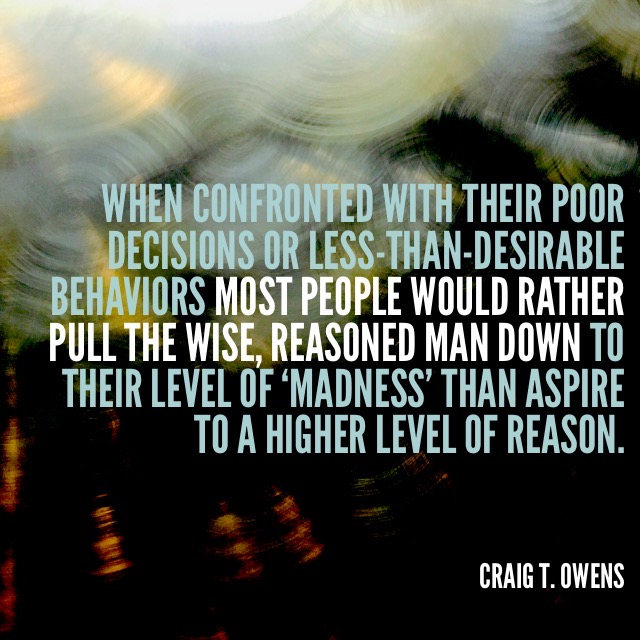
When confronted with their poor decisions or less-than-desirable behaviors most people would rather pull the wise, reasoned man down to their level of ‘madness’ than aspire to a higher level of ‘reason.’

Check out Erwin McManus’ thoughts on this, “When we live below a standard, it is simply human nature to redefine the standard as unreasonable and establish standards that our patterns are already accomplishing. We keep lowering the bar until we clear it.”

Instead, why don’t you raise your standard today? Don’t partake of the madness of others just to be accepted by them—you set the standard for decency, holiness, nobleness, self-sacrifice, self-control, and temperance!

Live right,
speak the truth,
despise exploitation,
refuse bribes,
reject violence,
avoid evil amusements.
This is how you raise your standard of living!
A safe and stable way to live.
A nourishing, satisfying way to live.
(Isaiah 33:15-16, Message)