
Call It To Mind And Speak It Out

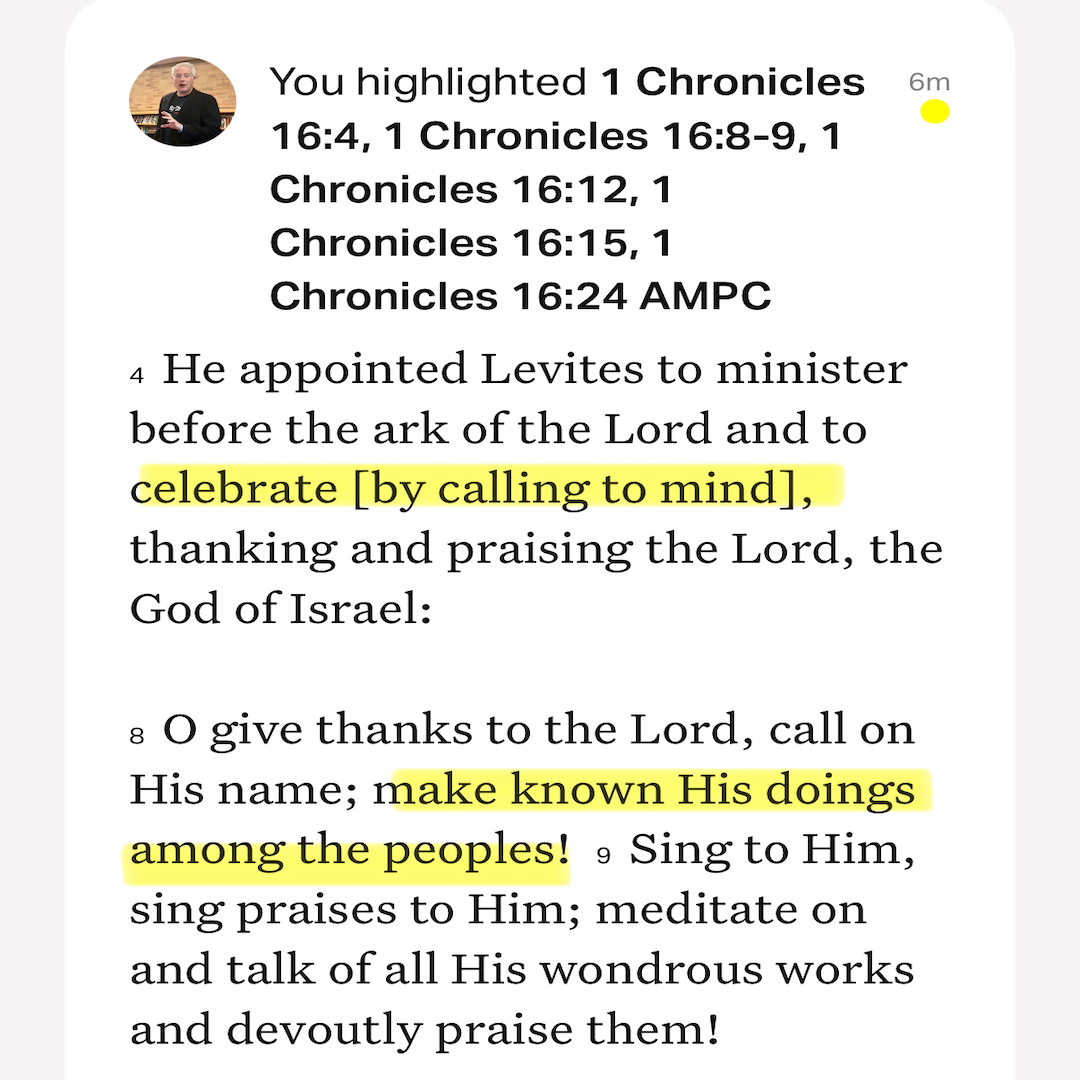
[King David] appointed Levites to minister before the ark of the Lord and to celebrate by calling to mind, thanking and praising the Lord, the God of Israel: … O give thanks to the Lord, call on His name; make known His doings among the peoples! Sing to Him, sing praises to Him; meditate on and talk of all His wondrous works and devoutly praise them! … Earnestly remember the marvelous deeds which He has done, His miracles, and the judgments He uttered as in Egypt. … Be mindful of His covenant forever, the promise which He commanded and established to a thousand generations. … Declare His glory among the nations, His marvelous works among all peoples. (1 Chronicles 16:4, 8-9, 12, 15, 24 AMPC) 

Calling to mind … meditate … earnestly remember … be mindful. All these things lead to both worship and proclamation. 

Recalling to mind all that God has done for us in the past, all that He is for us now, and all that He will do in the future gives us a song of praise. This praise is to be proclaimed among all people—both fellow worshipers and those who don’t know God as their Savior yet. 

The more we meditate on Who God is, the more we praise Him; the more we praise Him, the more compelling our testimony to the nations becomes. 

I blogged about forgetfulness leading to ingratitude in my post Forgetfulness Can Be Fatal. And I also blogged about how calling God’s goodness to mind empowers us in our spiritual battles in the post Grateful Remembering Fortifies Us Against Temptation. 

Biblical Mindfulness

Listen to the podcast of this post by clicking on the player below, and you can also subscribe on Apple or Spotify.

I have always been mindful of Your unfailing love…. (Psalm 26:3).

The dictionary defines “mindful” as simply being aware. Unfortunately, many psychologists today have constricted this term to mean simply being aware of the present moment, especially one’s own emotions in the present moment. 

In the New Living Translation, this verse has David saying to God, “I am always aware of Your unfailing love.” God’s unfailing love is an eternal attribute of God, and David says he is perpetually contemplating this attribute. But notice how David applies mindfulness not just to his present moment, but to his past and future as well. In fact, David invites God to examine his heart and mind to verify that David is always properly mindful of God’s love.

Notice the past, present, and future tenses David uses—

Past (v. 1):

  • I have led a blameless life 
  • I have trusted in the Lord without wavering 

Present (vv. 3, 7, 11):

  • Your love is ever before me 
  • I walk continually in Your truth
  • I proclaim aloud your praise
  • I lead a blameless life

Future (v. 12):

  • In the great assembly I will praise the Lord

Notice that between David’s claim that he has led a blameless life and that he is still leading a blameless life, we read his request for God to, “Test me, O Lord, and try me, examine my heart and my mind.” David was perpetually mindful of God’s awareness of both his thoughts and his lifestyle.

Being mindful of God’s love means looking back in gratitude to recall God’s past provision, looking around in worship to see God’s ongoing involvement, and looking ahead in hope to anticipate God’s unending grace. 

Unlike modern-day psychology which tells us mindfulness is a narrowing of our thoughts, biblical mindfulness is an expanding of our thoughts. Biblical mindfulness sees God’s past work and His future grace, and brings those to bear on our present circumstances. 

12 Quotes From “Love Like That”

Dr. Les Parrott dives into the loving life of Jesus and takes us with him to discover the five was Jesus loved. Check out my full book review by clicking here, and then enjoy some of the quotes I especially liked. 

“The great hindrance to true enjoyment is our willingness to settle for pitiful pleasures.” 

“What keeps us from being mindful? I can answer this question with one word: agendas. … Every one of us has the capacity to set aside our self-interest, temporarily. We have the ability at any time to press the pause button on what we want. … That’s the moment we become mindful.” 

“Loving like Jesus is not efficient. It takes time away from our own agenda-driven pace.” 

“Jesus was shockingly accessible to anyone who felt undesirable or unwanted—lepers, Gentiles, tax collectors, the poor and persecuted, pagans and sinners. He wasn’t like other ‘holy men’ in Judea. His fellow rabbis operated on the principles of exclusion and isolation.” 

“If you want to love like Jesus, you can’t limit your love to people who deserve it.” 

“God is happy to give unconditional acceptance and unmerited grace to all who will receive it.” 

“We can’t give grace to others when we are aren’t receiving it ourselves. When we’re busy earning acceptance from God, we start to think everyone else should earn it too. Judgmentalism creeps in. Self-righteousness appears. … When we aren’t cognizant of God’s unconditional acceptance in our own lives, we can’t give it to others.” 

“If you want to love like Jesus, you can’t shy away from what you know is right and true. You can’t remain silent just to go unnoticed. Loving like Jesus is not for the chickenhearted. It requires a fierce commitment to being authentic. It requires a bold commitment to being a truth-teller. … No one accused Jesus of being a pushover—or winsome.” 

“Self-giving is selfishness in reverse. It is not concerned with benefits, and it expects nothing in return. … It comes down to motive. You can be a giver and still expect something in return. … True self-giving is offering the best of who you are to others, and it comes with no strings attached.” 

“The long and short of it is that we love like Jesus when we allow Jesus to love through us. It’s not about our effort. We are not trying to imitate Jesus. It’s an inside job. It’s about being a channel for His love.” 

“Loving like Jesus isn’t achieved as much as it is received.” 

“The word intuition comes from the Latin word intueri, which is roughly translated as meaning ‘to contemplate.’ You see, our intuition stems from what we are considering, what we are sensitive to or attuned to do. … So, if you want to hear from God, you’ve got to slow down enough to clear your head and be attuned to His Spirit. That’s when the sacred gift of God’s whisper is heard—when you become accustomed to His voice.” 

I’ll be sharing more quotes from Love Like That soon, so stay tuned! Updatenew quotes are posted here.