I get so tired of people calling themselves “a self-made man.” There is no such thing! It is equally as distasteful when pastors pat themselves on the back talking about “the ministry I have built.”
Here are important words to remember—
“Wherever we go in ministry and mission, we either benefit from the labor of others or we contribute to the future benefit of those that will follow. If we see fruit, we can be assured that it is not solely due to our dedication or vision but because others went ahead of us and did the hard work. Often prayer accomplishes this hard work. Regularly those on the ground preceding us did this hard work.” (Dick Brogden)
And this—
What, after all, is Apollos? And what is Paul? Only servants, through whom you came to believe—as the Lord has assigned to each his task. I planted the seed, Apollos watered it, but God has been making it grow. So neither the one who plants nor the one who waters is anything, but only God, who makes things grow. The one who plants and the one who waters have one purpose, and they will each be rewarded according to their own labor. For we are co-workers in God’s service; you are God’s field, God’s building. (1 Corinthians 3:5-9)
What do you think?
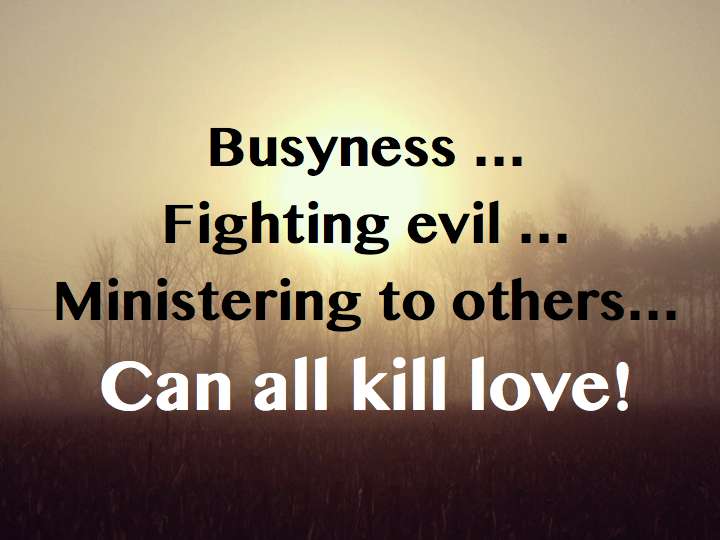
It’s possible to be so busy doing good things that we forget why we are doing those good things. Worse than that: our busyness can actually kill what’s most important.
When Jesus addressed the church at Ephesus (Revelation 2:1-7), He addressed a problem we in the West face today as well. Jesus said, “You are hard workers. You keep pressing on despite the obstacles. You are ministering to others, you’re making sure no wolves in sheep’s clothing infiltrate the church, and you even stand strong under persecution for your faith.”
But then Jesus drops a hard word on them: “Yet I have this against you: You have forsaken your first love.”
The Ephesians were fighting the good fight. Yet this intense work and ministry detracted from what is most important: Love for God. The New Living Translation says verse four this way: You don’t love Me or each other as you did at first.
Ministering to others is not love. It can only come from the overflow of love. But if the love is not kept full, there’s nothing there to overflow, and we’re only “doing our duty.”
So Jesus challenges the Ephesians (and us) with these two steps: Remember and Repent.
The verb tense for remember is the present tense. That means it’s something we need to do now. I cannot tell my wife “I love you” nine times on Monday morning and expect that I’m covered for the next 10 days. In the same way, we cannot tell Jesus we love Him on Sunday morning, and then go off to do our own thing for the rest of the week. That choice will not allow us to overflow with love; in fact, it will be just the opposite: we’ll be running on empty, just doing our duty.
We must keep our love up-to-date. Remember often how much God loves you, and express your love to Him. And if you find something in your life that is more of a focus that Christ, repent. Turn from that and turn back to your first love.
This is a weekly series with things I’m reading and pondering from Oswald Chambers. You can read the original seed thought here, or type “Thursdays With Oswald” in the search box to read more entries.
Are You A Saint?
The New Testament idea of a saint is not a cloistered sentiment gathering around the head of an individual like a halo of glory, but a holy character reacting on life in deeds of holiness.
From Christian Disciplines
Artists usually depict saints the same way they depicted Jesus: Someone with an angelic face, a heavenly glow around the top of their head, looking longingly up into heaven.
In reality, saints aren’t solitary but are constantly involved with other people. If there’s a glow on their face, it’s probably a glow of glistening sweat. There are callouses on their hands, and dirt under their fingernails from helping others. And if they are looking up to heaven, it’s in a moment of prayer trying to discern what God wants them to do next.
A saint is busy trying to live more and more like Jesus, Who came to feed the hungry, heal the sick, encourage the brokenhearted, bring hope to the hopeless, and show the love of God in touchable ways.
Are you a saint?
Listen to the podcast of this post by clicking on the player below, and you can also subscribe on Apple, Spotify, or Audible.
“But I tell you that men will have to give account on the day of judgment for every careless word they have spoken.” —Jesus Christ, in Matthew 12:36
The King James Version uses the phrase idle words, which is a rather apt description. The root Greek word is the picture of a worker, but the prefix “a” with it means that the worker is either lazy or unemployed. Not only that but he couldn’t care less (“careless”) about his unemployed, unproductive state.
It’s lazy to use whatever word comes to mind, especially if it’s not the right word.
It takes hard work to say the right word at the right time.
It requires great care to leave the wrong word unspoken.
Just prior to the above quote from Jesus, His critics had just thrown out the line, “He casts out demons through the power of the devil.” They didn’t think about what they were saying, so Jesus said, “If you had thought that through before you said it, you would have realized that it makes no sense. That was an idle, unproductive, lazy thing to say.” In the meantime, who knows how many people heard that throw-away line and then turned away from Jesus (see Matthew 12:22-37).
Words have consequences. Idle, careless words may have eternal consequences. I’ll have to stand before God to explain my careless words some day.
And so will you.
►► Would you please prayerfully consider supporting this ministry? My Patreon supporters get behind-the-scenes access to exclusive materials. ◀︎◀︎