Every Moment Is Special

As I was in the midst of studying for our series Overloaded, there was one thought that kept coming back to me time and time again—

The biggest victim in our overloaded lives are our relationships

And then the news of a tragic, unexpected death comes crashing into all of my local newsfeeds.

Wes Leonard was a star athlete for the Fennville High School Blackhawks. This 16-year-old played quarterback for the football team, and forward for the basketball team.

Last week the Fennville basketball team put their undefeated season on the line in their final regular season game against Bridgman. The game was tied at the end of regulation. As overtime was running out, the Blackhawks turned to their star player. And Wes Leonard deliver: hitting the game-winning shot as overtime expired!

The other Blackhawk players lifted their hero into the air and celebrated their undefeated season. But just moments later their joy would turn to shock, and then to sorrow. Wes collapsed just minutes after the game ended. Even though medical personnel worked valiantly on him, Wes Leonard was pronounced dead at Holland Hospital.

There were no outward signs of any medical issues. It wasn’t until the autopsy that the corner discovered that Wes had an enlarged heart, which led to the post-game heart arrhythmia, which caused this 16-year-old to have a life-ending heart attack.

None of us know how much time we have.

I pray we’re never too busy to have deep, meaningful relationships.

I pray we make the most of every opportunity to connect with our friends and family.

I pray we live without the regrets of unspoken words of love.

I pray we realize more and more that every moment is special.

I pray that you can overcome the overload in your life that may be robbing you of capturing every special moment that comes your way.
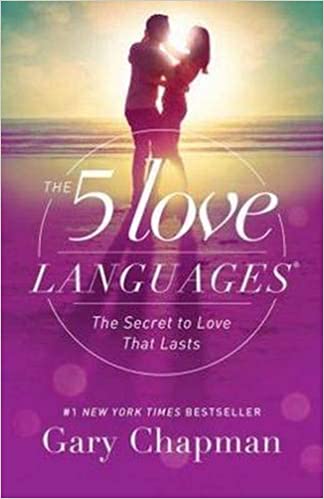
5 Love Languages, 7 Days, 1 Couple

Nothing in life stays the same. Nothing. Things are either getting better or deteriorating.

According to the law of entropy, a system will constantly move from order to disorder, unless sufficient energy is used to keep the system in order. More simply put: you and I can’t coast.

  • If you’re married, put energy into finding new ways to cherish your spouse.
  • If you’re a parent, put energy into better parenting skills.
  • If you’re a friend, put energy into deepening that friendship.
  • If you’re an employee, put energy into doing your job better.
  • If you’re a leader, put energy into leading better.

I love this article 5 Love Languages, 7 Days, 1 Couple in WebMD (you can read it here) about a couple skeptical of how Gary Chapman’s book on love languages could improve their marriage. But they decided to try it for one week. They put in the energy and got something better out. You can also read my thoughts about Dr. Chapman’s book by clicking here.

Are you willing to invest a week of energy into your marriage, family, job, or friendships? If you will keep applying energy, you will keep improving. And that’s a lot better than deteriorating!

Codependent?

Modern psychologists have coined the term codependent to mean someone who allows their life to be controlled by another person, much like the moon controls the tides on the earth’s oceans. Almost always this relationship ends up being a lose-lose relationship: both the person being controlled and the person doing the controlling are headed the wrong way.

Codependent is not a biblical term.

But there is a concept in Scripture that is the anti-codependent. I would call it interdependent. Here’s a couple of verses to back it up…

Dear brothers and sisters, if another believer is overcome by some sin, you who are godly should gently and humbly help that person back onto the right path. And be careful not to fall into the same temptation yourself. Share each other’s burdens, and in this way obey the law of Christ. (Galatians 6:1-2)

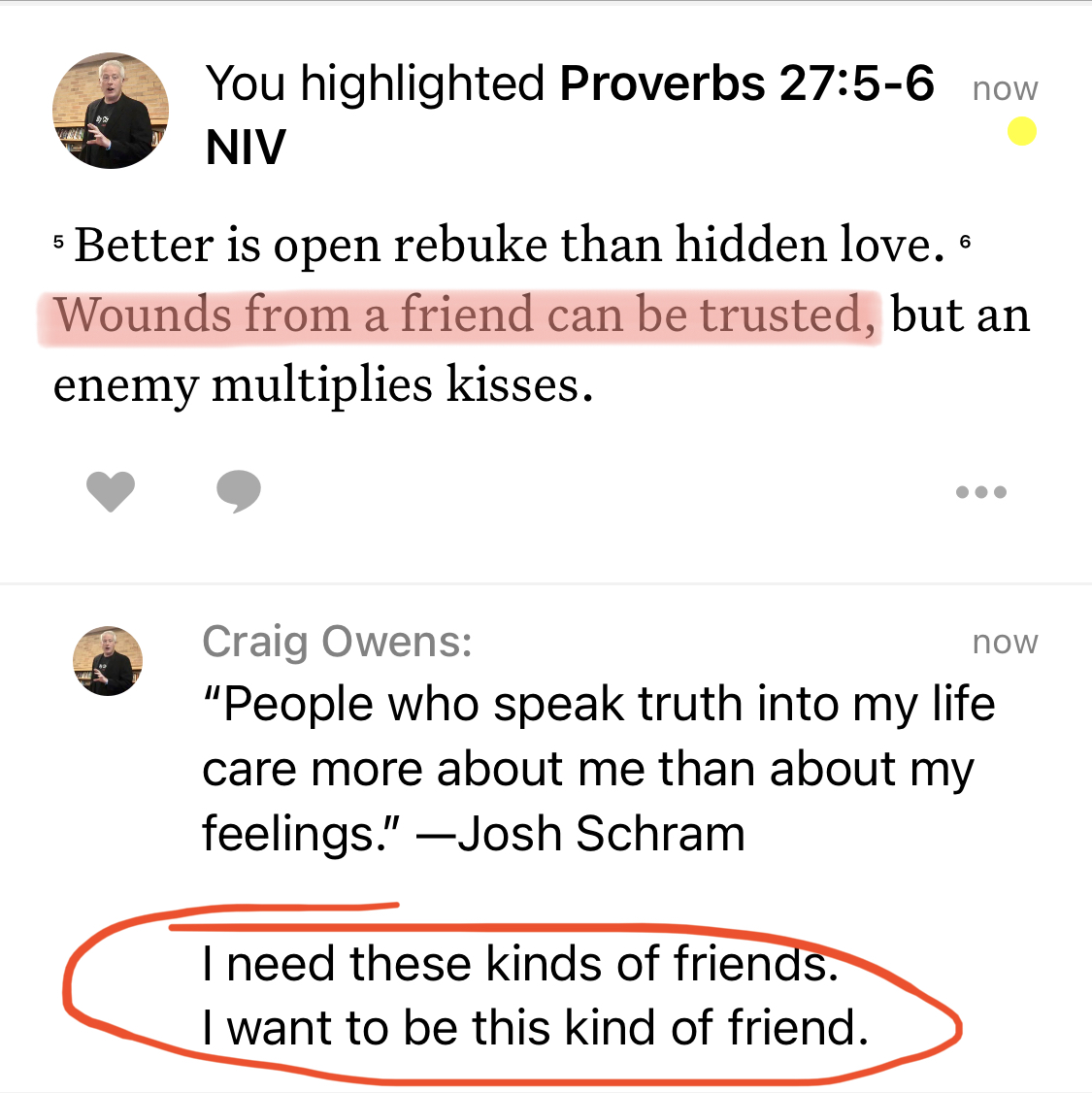
Wounds from a friend can be trusted, but an enemy multiplies kisses. (Proverbs 27:6)

It is absolutely clear that God has called you to a free life. Just make sure that you don’t use this freedom as an excuse to do whatever you want to do and destroy your freedom. Rather, use your freedom to serve one another in love; that’s how freedom grows. (Galatians 5:13)

God has given each of you a gift from His great variety of spiritual gifts. Use them well to serve one another. (1 Peter 4:10)

This isn’t excusing bad behavior, or winking at poor choices, or rescuing someone from the consequences of sin. Excusing, winking, and rescuing are symptoms of codependency.

Interdependency is saying, “I need you to be stronger—to be healthy—because I may need to lean on you someday.”

Christians try to get stronger and develop their own spiritual gifts so that they can help a friend-in-need get stronger and develop his/her spiritual gifts.

The Body of Christ needs you to be interdependent, which completely trumps codependent.

Get In Their Way

It’s true that you should not get in their way when your friends are pursuing their dreams.

But if you are a true friend, you will get in their way when they are heading for danger. Setup roadblocks, wave flags, intervene, tackle them (if you have to) to keep them from hurting themselves.

As my good friend Josh Schram said, “People who speak truth into my life care more about me than about my feelings.”

If you don’t get in their way when they are headed for danger, you’re not really a friend at all, you are their enemy.

Wounds from a sincere friend are better than many kisses from an enemy (Proverbs 27:6).

Are you a true friend? Cheer on their pursuit of their dreams, and get in their way if they are headed for danger.

Encouraging Presence

Have you ever been down in the dumps? Ever been discouraged or blue? Have you ever felt like no one gets you? In those moments, have you asked God for encouragement?

The Apostle Paul was feeling a little down, and he asked God to send him encouragement. God answered this way

But God, who encourages those who are discouraged, encouraged us by the arrival of Titus.

Paul says in the next verse, Titus’ presence was a joy.

This word for encourage simply means showing up for a friend. Do you realize you could be a huge source of encouragement to someone just by showing up?

“A real friend is one who walks in when the rest of the world walks out.” —Walter Winchell

Who needs you to just show up by their side today? Just by showing up, you could be the answer to someone’s desperate prayer for encouragement.

Go, be there for a friend!

Loyalty

Listen to the podcast of this post by clicking on the player below, and you can also subscribe on AppleSpotify, or Audible.

How would you define loyalty? All of the dictionary definitions have to do with faithfulness. It’s almost implied that there is a blindness (at worst), or a dogged persistence (at best), to remain loyal to a person or to an idea. The thinking goes, “If I’m loyal to someone, like it or not, I become their Yes-man.”

But I think…

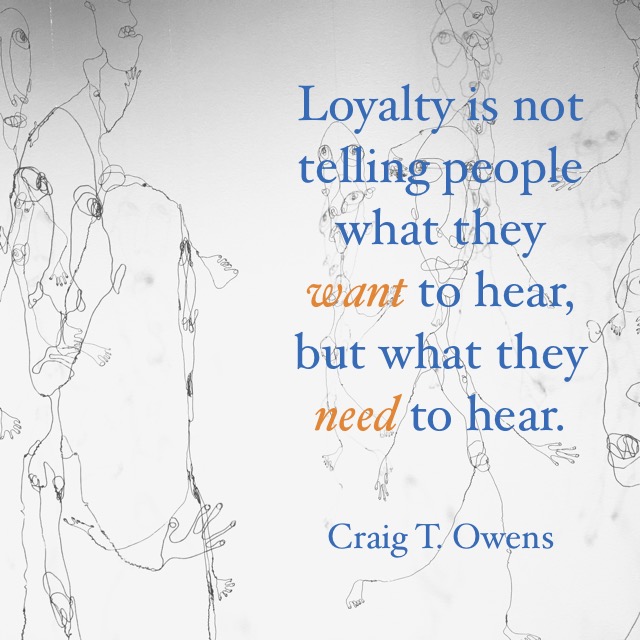
Loyalty is not telling people what they want to hear, but what they need to hear.

For an example, take the prophet Nathan in the Bible. We don’t know how old he is when he steps on the scene, or even where he came from. There isn’t a clue as to his tribal ancestry or even his father’s name.

King David wanted to build a temple for the ark of the covenant of the Lord, and he asked Nathan about this. Nathan immediately said, “Yes!” (kinda reinforces that idea of loyalty = Yes-man, doesn’t it?) But wait! That night, God speaks to Nathan and says, “Tell David he’s not the one to build the temple for Me.” So Nathan returns to David and loyally tells him no.

Later on, David steals another man’s wife and contrives a plan to have that man murdered on the battlefield. David thinks he’s gotten away with it until Nathan, the loyal friend, shows up to confront David with his sin. Nathan didn’t want to see David fail, but he wanted to give him a chance to confess and repent.

Near the end of David’s life, one of David’s sons, Adonijah, wanted to take the throne for himself. Many of the officials in David’s palace jumped on the bandwagon, but loyal Nathan did not. In fact, Nathan even got word to the King about Adonijah’s plans. As a result, David asked Nathan to anoint his son Solomon as king.

During David’s life, Nathan wrote David’s biography. If Nathan was just a mindless Yes-man, he could have easily left out the messy parts of David’s life. But the loyal friend wanted to show future readers that we all mess up, but God forgives and restores us when we repent.

Nathan’s name means the gift God gave or a giver. Both meanings fit this loyal man.

David was so blessed by Nathan’s loyalty that he named one of his own sons after the prophet.

Loyal friends give their friends the gift of life. They don’t let friends go down a destructive path. They don’t join with others when they attack. They remain constant, always-there, friends.

What a blessing to be called a loyal friend! And what an even greater blessing to have “Nathans” in our own lives!

►► Would you please prayerfully consider supporting this ministry? My Patreon supporters get behind-the-scenes access to exclusive materials. ◀︎◀︎

My Best Friend

Craig & Betsy

My Dearest Betsy,

Twenty-six years ago I began a relationship with my first girlfriend. Twenty years ago today I married my first and only girlfriend. Today I am more in love with you than I ever thought would be possible!

You are my best friend, my confidant, my favorite playmate, and still the only woman I’ve ever had eyes for.

Solomon wrote:

He who finds a wife finds what is good and receives favor from the LORD.

I’m so grateful that Solomon’s words have been a massive understatement for me. Being married to you has been so beyond good, and God’s favor has saturated my life.

So here’s to the next 20 years… I can hardly wait to see all that God has in store for us. And having you right by my side to share this adventure makes it all the more fulfilling.

I love you, my bride!

Rules Of Engagement (book review)

In whatever criteria you want to measure him, Chad Hennings is a man’s man: accomplished wrestler, US Air Force fighter pilot, Outland Trophy winner, and Super Bowl champion with the Dallas Cowboys. So when Chad sets out to write a book for men, Rules Of Engagement, you know it’s going to be right on target.

And it is.

Chad doesn’t pull any punches. He calls men out on the games we tend to play to hide our insecurities or our shortcomings. Using his military background, the book is divided into two main sections: basic training and active duty.

In basic training, you will learn how to become a well-rounded man. Chad covers the emotional, spiritual, mental, and physical regimens that will prepare men for the battles we fight every day. In this section, I especially appreciated the insights on character and vision, the foundations for a successful life. Chad writes, “Character and vision go hand in hand because a man’s vision comes directly from his character.”

In the active duty, section, you will learn how to put all of this training and hard work into practice. Chad covers the areas of family, accountability with another strong man (your wingman), money, and community involvement.

This book would be excellent for a man to read by himself. But I think it would take on even more effectiveness if two or three men read the book together and then enlisted each other as their wingmen. Accountability is a key factor in making all of this stick.

I am a FaithWords book reviewer.

Get A Better Story

My friend Chuck and I run through a silly routine to make a point about the superficial conversations that many people have. It goes something like this—

Chuck: Hi! How are you?

Craig: I’m good. And you?

Chuck: Good. I’m good.

Craig: How’s work going?

Chuck: It’s good. How about for you?

Craig: Good.

Chuck: How’s your family?

Craig: They’re good. And yours?

Chuck: Good.

You get the idea. At the end of this conversation have I learned anything new about Chuck? Of course not. Has he learned anything new about me? Nope. Do you think either one of us is telling the truth? No, because we don’t want to really open up what’s going on inside us.

(In case you haven’t figured this out, this is just a silly thing Chuck and I do on purpose. After joking around, we do get down to the more “real life” conversation!) 

Last week I had several great sit-down meetings with some people that I already knew, but I wanted to get to know better.

In order to get to know them better, I have to get them to tell me a better story!

A better story about who they really are and what they’re really feeling.

This requires two things:

  1. I have to ask better questions. Not questions that can just be answered with a simple “good” or “fine” or “yes” or “no.”
  2. I have to be willing to tell the other person a real story about me, one that reveals who I really am and how I’m really feeling.

Sometimes asking these questions or telling these stories may seem awkward. But you have to pass through the awkward if you truly want to get to know someone better. Don’t just settle for “good,” but take a risk to go deeper.

Interruptions: The Relationship Killer

Listen to the podcast of this post by clicking on the player below, and you can also subscribe on AppleSpotify, or Audible. 

Don’t you hate it when…

…someone finishes your sentences.

You’ve got a brilliant thought to share and…

…your friend shares it for you.

Like that killer joke with…

…the great punch line.

Yeah, the one about…

…the guy running to the restroom.

Sometimes it can…

…work.

But sometimes…

…it doesn’t.

No, it gets really…

…creepy?

Annoying. Like when I’m trying to tell you about…

…that great ski weekend.

The great church service where…

…the band really rocked it.

Where the pastor totally connected with me. And I realized…

…he’s a great speaker.

That I really need to make some changes in my…

…prayer life.

Listening skills.

Oh, um, yeah.

Scientists estimate that our brains can process up to 25,000 words per minute, but a normal speaking pace is only 140-160 words per minute. Since my brain is zipping along about 150 times faster than my friend is speaking, I really have to guard against jumping to conclusions.

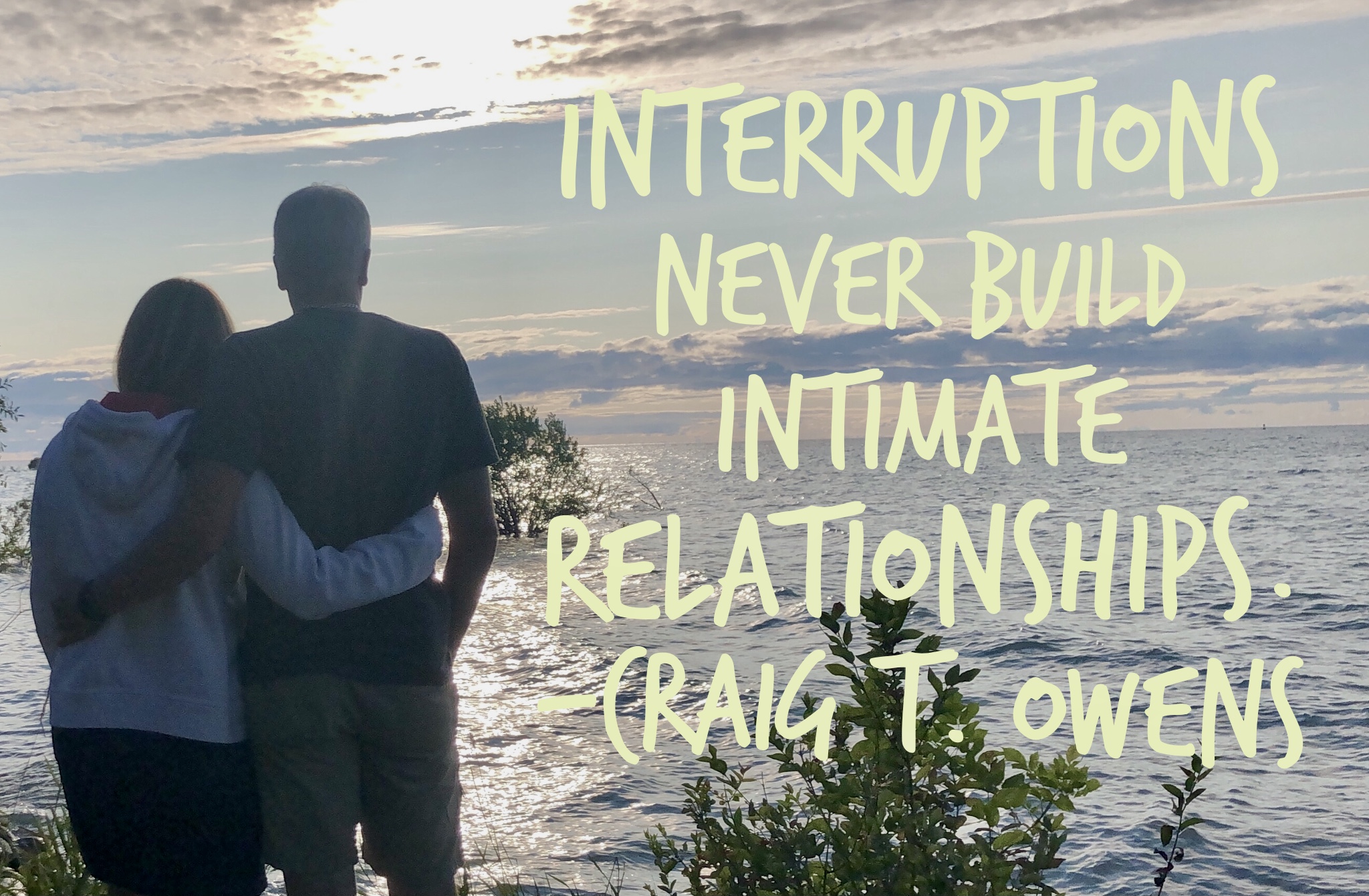
Interruptions never build intimate relationships.

But you can reverse this tendency. Resist the urge to run ahead, to interrupt, to anticipate where your conversation partner is going. You can do it. You can reverse the tendency to interrupt.

I shared a series of messages on Relationship Builders And Killers, if you want to dig deeper into this topic.

►► Would you please prayerfully consider supporting this ministry? My Patreon supporters get behind-the-scenes access to exclusive materials, like this recent video where I explain how God reveals previously-unknown truths to us. ◀︎◀︎