Listen to the podcast of this post by clicking on the player below, and you can also subscribe on Apple, Spotify, or Audible.
Everyone wants to fit in—it’s an entirely natural human instinct to desire the approval of those around you. However, when this instinct causes us to change who we are it can become very destructive to us both personally and professionally. In today’s episode Greg and I discuss how being a poser is a sneaky leadership killer that can creep in without you even noticing.
[0:00] Introduction
[1:38] Posing is a leadership killer that might not be obvious to a leader.
[2:52] Why would a leader think they have to pose in front of certain groups?
[5:38] Leaders need to be cautious of thinking, “I have to fit in. I have to be liked by this group.”
[7:31] Posing isn’t changing a style of communication.
[8:26] Being misunderstood is very difficult for everyone, but we cannot fall into the posing trap in order to try to be understood.
[10:30] Our teams need to know what to expect from us.
[11:48] How does posing limit leadership effectiveness? How does authenticity launch a team?
[15:15] Posing leaders force their teams to think inside-the-box.
[16:54] Authentic leaders want to hire authentic team members to promote an authentic culture.
[19:40] Leaders need to be confident to be authentic, and that authenticity is incredibly freeing!
[23:40] Coaches who listen and observe and can help you spot the hidden areas of posing. Check out the Maximize Leadership coaching services.
Listen to the podcast of this post by clicking on the player below, and you can also subscribe on Apple, Spotify, or Audible.
Did you know that’s possible for your greatest strength could become your most limiting weakness? Let’s learn how to spot and avoid this pitfall on this episode of The Podcast.
As leaders, we need to continually work on the “unconscious” areas of our lives. Here are some additional resources to help you.
Listen to the podcast of this post by clicking on the player below, and you can also subscribe on Apple, Spotify, or Audible.
Sanctification (saint-ification) is an ongoing process that brings out fruitfulness, joy-fullness, and enhances our testimony to others. And an essential part of this process involves other saints. Notice that this word “saints” it plural. That’s because it is a plural word every place it appears in the Bible.
Saints have gotten themselves into trouble when they tried to go solo. Like David’s sin with Bathsheba, Elijah’s slide into depression, or Peter’s denial of Jesus. But we also see saints thriving through difficult situations when they have a fellow saint alongside. Like how Barnabas gave Saul his start, Paul and Silas could sing together in prison, Silas and Timothy helped Paul minister, and how Jesus sent out His ambassadors by twos (Luke 10:1).
How does accountability to other saints work? Since we see togetherness so much in the early Church (look for the phrases like “each other” or “one another”), think A.C.T.S.—
(1)Admit my need for accountability. James tells us that we all stumble and that even my so-called little slip-ups are major in God’s eyes (James 3:2, 2:10). So I need help.
John Maxwell said, “Every person is undisciplined in some area of their life; in the area that I am undisciplined, that is the area where I need greatest accountability. I will not do well in my areas of weakness unless I am held accountable for better results.” We all have blind spots, we all have weak areas, and we must be humble enough to admit to those things.
(2)Choose my accountability partners prayerfully and carefully (Proverbs 12:26; 2 Corinthians 6:14). These should be trustworthy people who have the emotional and spiritual capacity to be able to come alongside me (Proverbs 17:9; Galatians 6:2).
(3)Trust my friend. Trust their counsel even when it stings a bit (Proverbs 27:6), and trust the effectiveness of their prayers for me (James 5:16).
(4)Stick with them through thick and thin. Be your brother’s keeper and let them be your keeper (Hebrews 3:12-14). We need to keep at it especially in difficult times. Notice the phrase “let us” that appears five times in Hebrews 10:19-25.
If we are living with a biblical worldview, we realize that the saints here on earth are those we will also be with for eternity. Our biblical worldview should form our understanding of both being accountable to another saint and holding other saints accountable as well.
As Jack Hayford so wisely noted, “The believer’s best defense against self-deception is through mutual accountability to one another.”
If you would like to check out the other messages in our series B.A.S.I.C. Christianity, you can click here.
Listen to the podcast of this post by clicking on the player below, and you can also subscribe on Apple, Spotify, or Audible.
In our last episode, Greg and I discussed how vital it is to focus on your own internal development. If you’ve been doing that, chances are you have identified a few blind spots in yourself. While it might feel more comfortable to simply hide these away and hope nobody notices, we would like to encourage you to be vulnerable: Drag your blind spots into the light, address them, and watch how your leadership improves as a result.
[1:30] Leaders have to get comfortable with being vulnerable if they are going to make any meaningful changes in their life.
[2:17] Blind spots have to be brought out into the light.
[5:44] Paying attention to the feedback from others requires us to slow down to process what we need to change.
[7:35] Leaders need to understand the speed of their team in the area of productivity.
[8:34] Greg shares a “blind spot” example from one of his kids.
[9:53] Why do leaders avoid their blind spots?
[11:45] Peripheral vision isn’t good just for athletes, but for leaders too.
[13:11] I share how asking good questions has helped my teammates with their blind spots.
[14:50] If leaders assume things about their teammates or work with their favorite teammates, they will never improve the morale of the team.
[18:17] Greg talks about the movie “Blindside” as a learning point about having the right people watching out for us.
[20:10] We need to be thinking about the kind of people we need around us.
[25:42] The one word most people are afraid to say.
[26:59] Sometimes a fresh set of eyes is necessary to see a blind spot. Maximize coaching would love to be a resource for you in this area.
Check out this episode and subscribe on YouTube so you can watch all of the upcoming episodes. You can also listen to our podcast on Spotify and Apple.



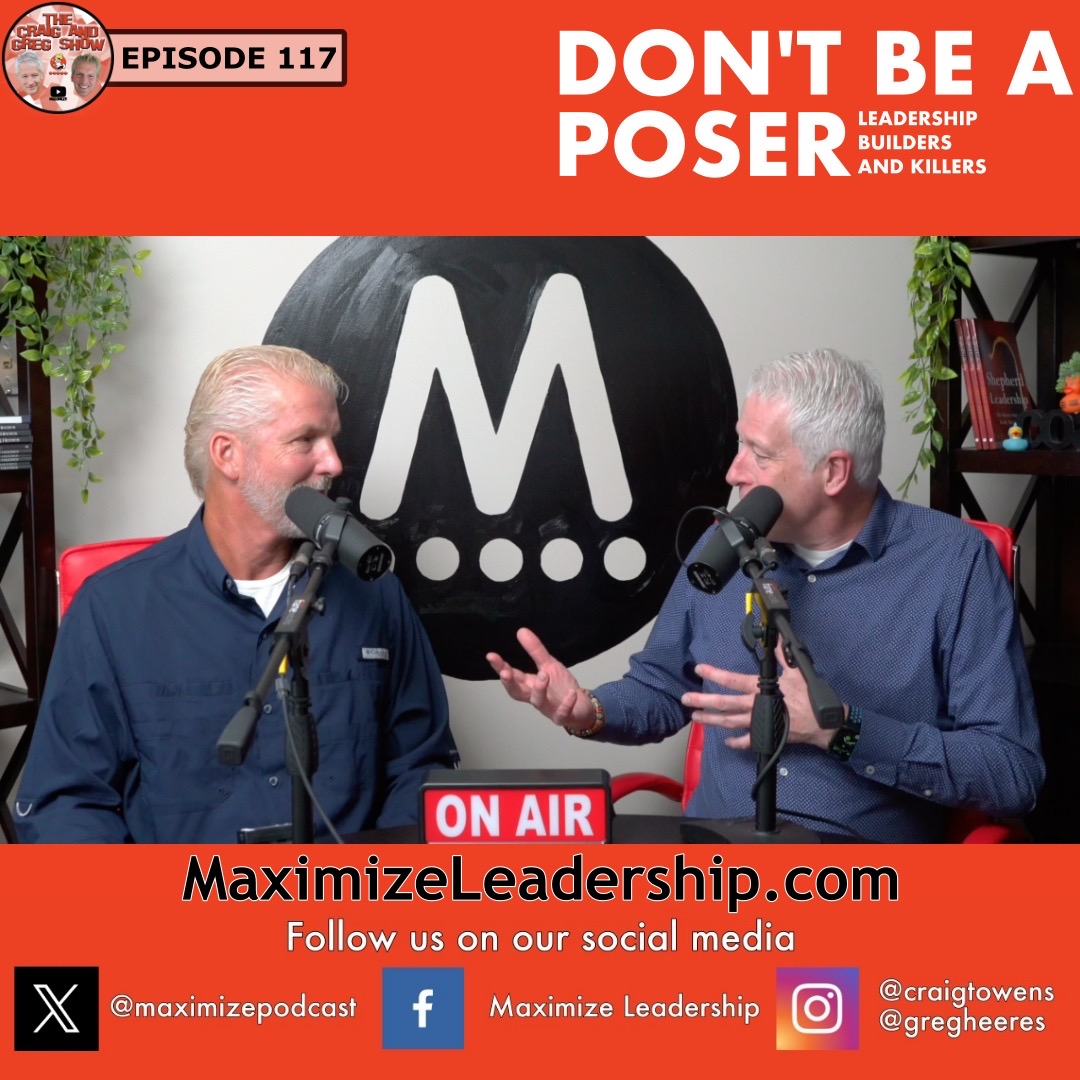 Everyone wants to fit in—it’s an entirely natural human instinct to desire the approval of those around you. However, when this instinct causes us to change who we are it can become very destructive to us both personally and professionally. In today’s episode Greg and I discuss how being a poser is a sneaky leadership killer that can creep in without you even noticing.




 Craig T. Owens