Got Hope?

In my position as a pastor, you can probably imagine that many people come to me with pretty desperate situations. One of the common things I hear from these hurting people is something along the lines of, “I really thought God had directed me on this, but it seems like it’s not going to work out.”

In other words, their hope is wavering.

For a Christian, hope is not blind trust. It’s not a feeling that things might work out. It’s not even holding on tighter.

For a Christian, hope is about a promise and a Person.

It’s about what God said and Who God is.

It’s about believing that His Word is true and that He is trustworthy.

Let me stitch together a few phrases about Abraham—

Against all hope, Abraham in hope believed. …Without weakening his faith, he faced the fact that his body was as good as dead… yet he did not waver through unbelief regarding the promise of God, being fully persuaded that God had power to do what He had promised. (Romans 4:18-21)

Abraham didn’t deny the facts, but he trusted the promise and the One Who gave him the promise!

And then there’s this promise for us about hope—

And we boast in the hope of the glory of God. Not only so, but we also glory in our sufferings, because we know that suffering produces perseverance; perseverance, character; and character, hope. And hope does not put us to shame, because God’s love has been poured out into our hearts through the Holy Spirit, who has been given to us. (Romans 5:2-5)

Do you need hope? Get the promise from God’s Word, and then trust the One Who spoke that word. Hang on—God IS doing something great!
Do Your Own Growing

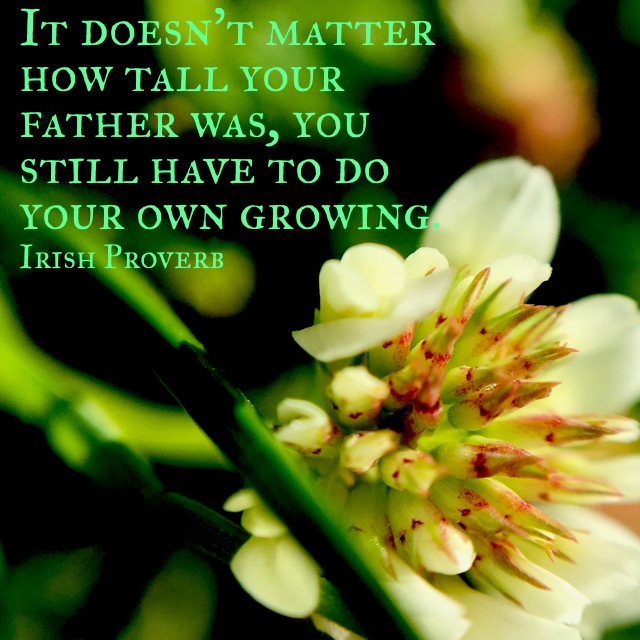
An Irish Proverb says, “It doesn’t matter how tall your father was, you still have to do your own growing.” In other words, my genes may give me a certain predisposition, but I still have to grow on my own.

The same could be said spiritually: “It doesn’t matter how close to God your parents were, you have to approach Him yourself.”

Abraham was so close to God that he was called “friend of God.” His son Isaac had some great spiritual genes, but he still had to do his own growing.

Isaac had the perfect opportunity shortly after Abraham’s death. He and his wife Rebekah wanted to start a family, but they weren’t able to do so. Then comes this great phrase:

…Isaac prayed to the Lord on behalf of his wife…

He got it! And God heard his prayer: Rebekah became pregnant with twins.

Rebekah’s parents were also close to God. But now pregnant and far, far away from home, she was having difficulty with her pregnancy. That’s when Rebekah had her chance to do her own spiritual growing,

…Rebekah went to inquire of the Lord…

She got it too!

Not only was this good for them as individuals, but undoubtedly it strengthened their marriage as well. I have found that couples who pray stay.

  • They stay close to God
  • They stay close to each other
  • They stay more committed to their families
  • They stay in a growth pattern

Are you doing your own growing today?

If you’re still riding someone else’s coattails, it’s time to start doing your own growing.

If you’re still blaming a parent for holding you back, it’s time to start doing your own growing.

You can do it—start talking to God yourself today!

Listen To Me

Have you ever been involved in high-level negotiations? The stakes are high. The potential for reward is great, but the chances of crashing-and-burning are also great. Everyone is on their A-game both mentally and emotionally. No one wants to misstep or misspeak.

Sounds like a hostage negotiator, or a government official brokering a treaty, or a business leader finalizing a multi-million dollar business deal, right?

Actually, these high-level, high-stress, high risk-or-reward negotiations happen almost every day. And you’re involved. Whenever you have a conversation with someone where you’re opening your heart to them—or they’re opening up to you—you’ve stepped into a place where wonderful or tragic things can happen.

Think about how your blood pressure rises when you hear…

  • …your spouse say, “We need to talk.”
  • …your boss intercoms you and says, “Will you come into my office.”
  • …your friend says, “This isn’t very easy for me to tell you this, but….”
  • …your coworker says, “You need to sit down for this.”

Here’s a scene from the Bible: Abraham’s beloved wife Sarah has died, and he wants to bury her somewhere special. The problem is, Abraham doesn’t own any land. So for the first time since leaving Ur, he has to negotiate the purchase of land. The Hittites know Abraham is a powerful man. They don’t want to give anything away for free, but neither do they want to anger him. Abraham is a wealthy man. He can probably pay any price for the land, but he doesn’t want to be seen as a sucker.

Let the negotiations begin. Multiple times throughout their conversation a phrase is repeated:

“Listen to me.”

In the Hebrew language, there is nothing unique or noteworthy about these words. But the fact that the phrase is repeated so frequently in so few verses is interesting. In fact, this phrase is only used one other time in all of Genesis.

Both parties are saying, “I realize that one misspoken word here could be hurtful. This is a difficult, touchy subject, but I want it to be a win-win. So don’t just listen to my words, hear my heart.

Here’s my takeaway for my emotionally-charged conversations:

  1. Take a deep breath and ask God for help.
  2. Go slowly.
  3. Make sure I’m in the right place emotionally to listen to them.
  4. Listen to the other person’s heart, not just their words.
  5. Be committed to finding a win-win.
  6. Go slowly.

Keep this in mind the next time you hear one of those blood-pressure-elevating opening phrases. When you hear those phrases, you have just entered into high-level negotiations. You can successfully broker a win-win for everyone if you’ll just hear their heart.

Hurrying To Wait

In Genesis 18 God comes to visit Abraham. It’s interesting to note how Abraham responds. In a word: quickly.

  • He hurried from where he was sitting to meet God.
  • He hurried back to his wife Sarah and said, “Quick, make some bread for our Guest.”
  • He ran to his herd to pick out a calf to serve.
  • His servant then hurried to prepare the calf.

Abraham hurried to get into God’s presence.

However, once he’s there everything slows down.

  • He stood nearby while the Lord and His angels ate the food.
  • He walked with God as He continued toward Sodom.

Abraham WASN’T quick to leave God’s presence.

At this point, the Bible gives us an important word: Then. After Abraham hurried to get into God’s presence and continued to linger there, THEN God took Abraham into His counsel.

Why is it that my natural tendency is to do just the opposite?

  • I delay going into God’s presence because I try to figure things out on my own.
  • Once I finally go into His presence, I share my need with Him and then hurry along my way.

Abraham was called God’s friend. Maybe because he hurried into God’s presence, and then stayed right there.

Today I’m going to try it Abraham’s way.

Square One

One of my all-time favorite movies is The Princess Bride. There is a scene about halfway through the movie where Inigo and Fezzik are reunited:

[Scene: Outside a hut. Inigo is sitting, nursing a bottle]

Inigo:      I am waiting for you, Vizzini. You told me to go back to the beginning. So I have. This is where I am, and this is where I will stay. I will no be moved.

Assistant Brute:    Ho there!

Inigo:      I do not budge. Keep your “Ho there.”

Assistant Brute:     But the prince gave orders.

Inigo:      So did Vizzini. When the job went wrong he went back to the beginning. Well, this is where we got the job, so it’s the beginning. And I am staying till Vizzini come.

Even though Inigo was slightly the worse for alcohol, he gives some sage advice. When we run into problems—when we get off track—it’s good to go back to the beginning.

After his ill-advised trip to Egypt, Abraham returns to square one. He goes back to the last place he heard from God.

He moved on from the Negev, camping along the way, to Bethel, the place he had first set up his tent between Bethel and Ai and built his first altar. Abram prayed there to God. (Genesis 13:3-4)

When I seem to be on the wrong path, I must go back to the place I last heard from God. Perhaps it’s significant where Abraham’s tent and altar were set up. Between two cities:

  • Ai which means “heap of ruins.” It comes from a root word meaning “bend, twist, distort.”
  • Bethel which is made up of two words beth (house) + El (God) = house of God.

This is my life: always between two options. I can have a distorted/twisted view that leads to a heap of ruins, or I can live where God dwells.

I can have my way or God’s way.

I can have blessing or ruin.

When I find what I’m doing is a mess, it’s time to go back to the beginning—to go back to square one—to go back to the last place I heard from God.

Too Good To Be True

You know the old cliché: If something sounds too good to be true, it probably is. Yet time after time we buy into the hype…

  • “I get all of this for free!”
  • “I’ll be able to make this big score and it’s gonna cost me next to nothing.”
  • “He agreed to help me out with this just because he likes me. He’s not charging me a dime.”
  • “I think they really want to be my friend.”

It never works out that way, does it? Because if it sounds too good to be true, it probably is.

Do you know when those with these great offers show up? Right after you’ve done something well. Like Abraham in the Bible when he had just won a dramatic victory.

Here’s what happened. The bad guys swept in, defeated the good guys, and in carrying off the loot from their victory, they took Abraham’s nephew Lot with them. Abraham called out his special forces team and conducted a surprise night raid on the bad guys’ lair. He not only rescued Lot but all of the other captives too.

Abraham comes back loaded with everything he’s just recovered, and the King of Sodom comes out to meet him. This king is a big shot. It would be a career-advancing move to get in good with him. The King of Sodom says to Abraham, “Great work! Just let me have all the hostages, but you can keep all of the other loot. Even the stuff that was mine that the bad guys stole, I’m going to let you keep it.”

But Abraham knew that if it sounded too good to be true, it probably was.

Abraham wisely answered, “I’m God’s man. I’ve given Him my word: I will accept nothing that belongs to you, not even a thread or the thong of a sandal so that you will never be able to say, ‘I made Abram rich.’”

Smart move. Those things that seem to be free always come with strings attached. How much better to simply trust God for everything. So when God makes you successful, no one else gets the credit but Him.

Here’s the simple decision: Trust God or rely on “freebies” from men. Who are you going to trust?

Unintended Consequences

Sometimes even with the best of intentions, our actions can create a series of events that we never anticipated. What’s worse, like a row of neatly arranged dominos, once the first one has been knocked over, it’s hard to stop the tumble of the other dominos.

Case in point: Abram (or Abraham, as he would come to be known later).

He followed God’s call to leave his homeland of Ur and travel to Canaan—the Promised Land. He came to Canaan as a fairly wealthy man, having built quite a portfolio in his home country. After he arrived, he built a couple of altars to God and things appeared to be going well.

Until the famine. [you can read the story for yourself here]

Then without asking God, Abram left Canaan and traveled to Egypt. This was the first domino to be knocked down. The rest that fell were the unintended consequences of this single decision.

Abram lied to the Egyptians about his wife, telling them that she was his sister. As a result, she was taken into Pharaoh’s harem. Did Pharaoh sleep with her? The Bible doesn’t say for sure. Was Sarai mad at Abram? The Bible doesn’t answer this one either, but I think we all know the answer to this question!

Abram got richer. Because Pharaoh was so happy with Sarai, Pharaoh gave him sheep and cattle, donkeys and camels, and servants.

But this newly acquired wealth caused yet another domino to fall.

Abram and his nephew Lot began to have arguments about their large herds of animals. To settle their dispute, they split up.

Another domino fell.

Lot, without Abram’s mentorship, moved near Sodom. He got caught up in its sinful lifestyle and lost everything he owned. All he had left were two daughters, who were wicked, manipulative young ladies.

And yet another domino.

Abram and Sarai couldn’t have children. So Sarai suggested that Abram sleep with Hagar, their Egyptian maid. Would Sarai have suggested this if Abram hadn’t abandoned her to Pharaoh? If they hadn’t gone to Egypt, Hagar wouldn’t even have been there!

And the final domino.

Hagar did get pregnant. But her son Ishmael became the father of the Arabic people. A race of people that is openly hostile to the Jewish people to this day.

So many unintended consequences. So many dominos knocked down because of just one decision.

I’m grateful that God made something good out of this, but what incredible pain and hardship exist to this day because of one decision 4000 years ago.

My takeaway: I need to lean on, trust in, and be confident in the Lord with all my heart and mind and do not rely on my own insight or understanding.