


 Shalom is the Hebrew word for peace. Some of the best definitions of shalom include ideas of completeness, soundness, and wholeness. One Jewish rabbi commented that when you say “Shalom” to someone, you’re really saying, “may you be full of well-being.” Or another way of thinking of shalom is—nothing missing, nothing broken.
Some have tried to describe shalom as the absence of conflict, but that’s not quite accurate. On the verge of going into the Promised Land to fight their enemies, God commanded Aaron to speak a blessing of peace of the people (Numbers 6:24-26). And just before Jesus said, “Blessed are those who are persecuted because of righteousness,” He said, “Blessed are the peacemakers” (Matthew 5:9-10).
Shalom is not controlled by outward circumstances. Shalom is a deep-seated, rock-solid, unshakable assurance that I am in God’s hand.
Isaiah describes how we live in shalom like this—
You will guard him and keep him in perfect and constant peace whose mind—both its inclination and its character—is stayed on You, because he commits himself to You, leans on You, and hopes confidently in You. (Isaiah 26:3)
How do we do keep our mind stayed on God? The Apostle Paul says, “We take captive every thought to make it obedient to Christ” (2 Corinthians 10:5). Psychologists call this process metacognition: when we think about what we’re thinking about. It’s being aware of our anxious thoughts that are robbing us of shalom and then talking back to them.
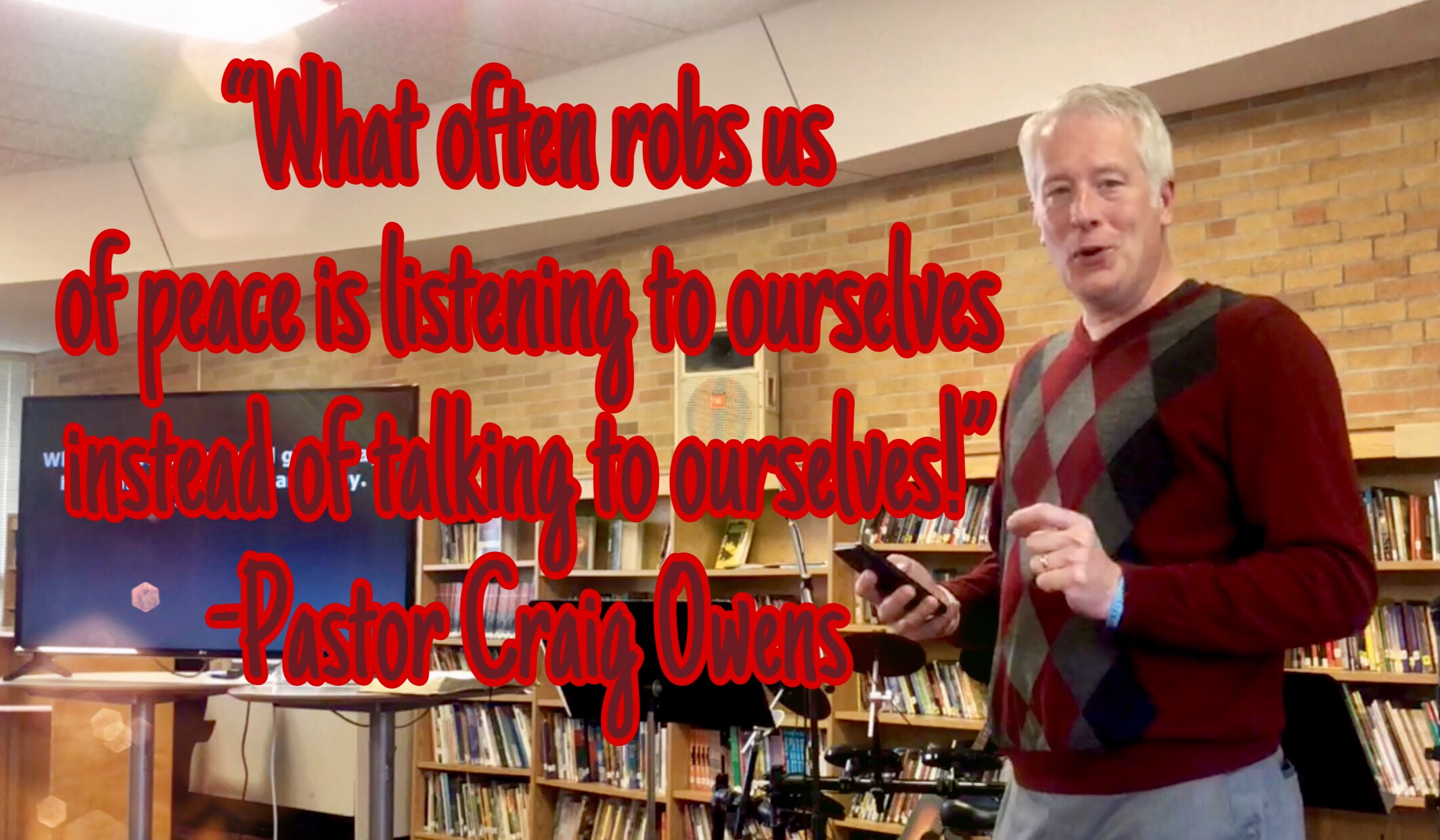
What often robs us of peace is listening to ourselves instead of talking to ourselves!
Someone once asked evangelist Smith Wigglesworth, “Smith, how do you feel?” He replied, “I never ask Smith how I feel. I tell him how he feels!” Exactly right!
Why do we make our thoughts obedient to Jesus? Because one of the titles given to Jesus before He was born was Prince of Peace (Isaiah 9:6), and Jesus assures us that His peace is unlike anything we can ever find in earthly things (John 14:27, 16:33).
God’s peace is always there, but our divided minds keep us from experiencing His peace. So Isaiah tells us to keep our mind steadfast on God’s goodness, and Paul says the same thing—Don’t fret or worry. Instead of worrying, pray. Let petitions and praises shape your worries into prayers, letting God know your concerns. Before you know it, a sense of God’s wholeness, everything coming together for good, will come and settle you down. It’s wonderful what happens when Christ displaces worry at the center of your life. (Philippians 4:6-7)
I want to encourage you to practice what the Bible calls capturing your thoughts—or what psychologists call metacognition. Ask yourself, “Why am I thinking that?” Capture those thoughts and make them obedient to Christ. Don’t let your worrisome thoughts rob you of God’s shalom.
Join me this Sunday as we take a closer look at the “shalom cycle,” including the things that can derail it.


November 12, 2018 at 6:03 am
[…] I talked about last week—we need to think about what we’re thinking about. This is the key to spotting those grumbling, ungrateful thoughts before they derail the cycle and […]
LikeLike
November 19, 2018 at 6:02 am
[…] need to correct and reverse unbelief as quickly as possible. We do this through capturing our thoughts—or thinking about what we’re thinking about—and identifying three warning […]
LikeLike
November 26, 2018 at 6:06 am
[…] has unshakable security and tranquility. The Hebrew word is shalom, and the Bible gives us a “Shalom Cycle” that keeps us centered and grounded in God’s […]
LikeLike
December 31, 2018 at 6:06 am
[…] What is Shalom? […]
LikeLike
May 20, 2021 at 6:03 am
[…] passively listen to your doubts and the devil’s lies, but actively talk back to them! Get into God’s Word and let God’s Word get into you so that you can speak the truth to every […]
LikeLike
December 29, 2021 at 5:15 pm
[…] What is Shalom? […]
LikeLike
September 3, 2022 at 3:31 pm
[…] how do I guard my heart? Part of guarding my heart does start with my head: I need to think about what’s going into my heart. But, as Oswald Chambers says, the head is just the “finish off” of what is happening in the […]
LikeLike
December 12, 2022 at 6:02 am
[…] The Hebrew word for peace is shalom. An easy-to-remember definition of shalom is “nothing lost, nothing missing.” Our Great Shepherd makes sure nothing is lost or missing that would cause us anxiety or doubt, so we can have total peace—we can have shalom! […]
LikeLike
April 24, 2023 at 6:01 am
[…] Hebrew word for “peace” in this passage is shalom. One of the most basic definitions for shalom is “nothing missing.” In other words, we are blessed people when we realize there is nothing […]
LikeLike
October 14, 2025 at 5:05 am
[…] What is Shalom? […]
LikeLike
December 22, 2025 at 5:05 am
[…] means a Ruler or Overseer. Peace is the Hebrew word shalom which means completeness, soundness, and contentment. Some have described shalom as there being […]
LikeLike
December 22, 2025 at 9:25 am
[…] a Ruler or Overseer. Peace is the Hebrew word shalom which means completeness, soundness, and contentment. Some have described shalom as there […]
LikeLike