


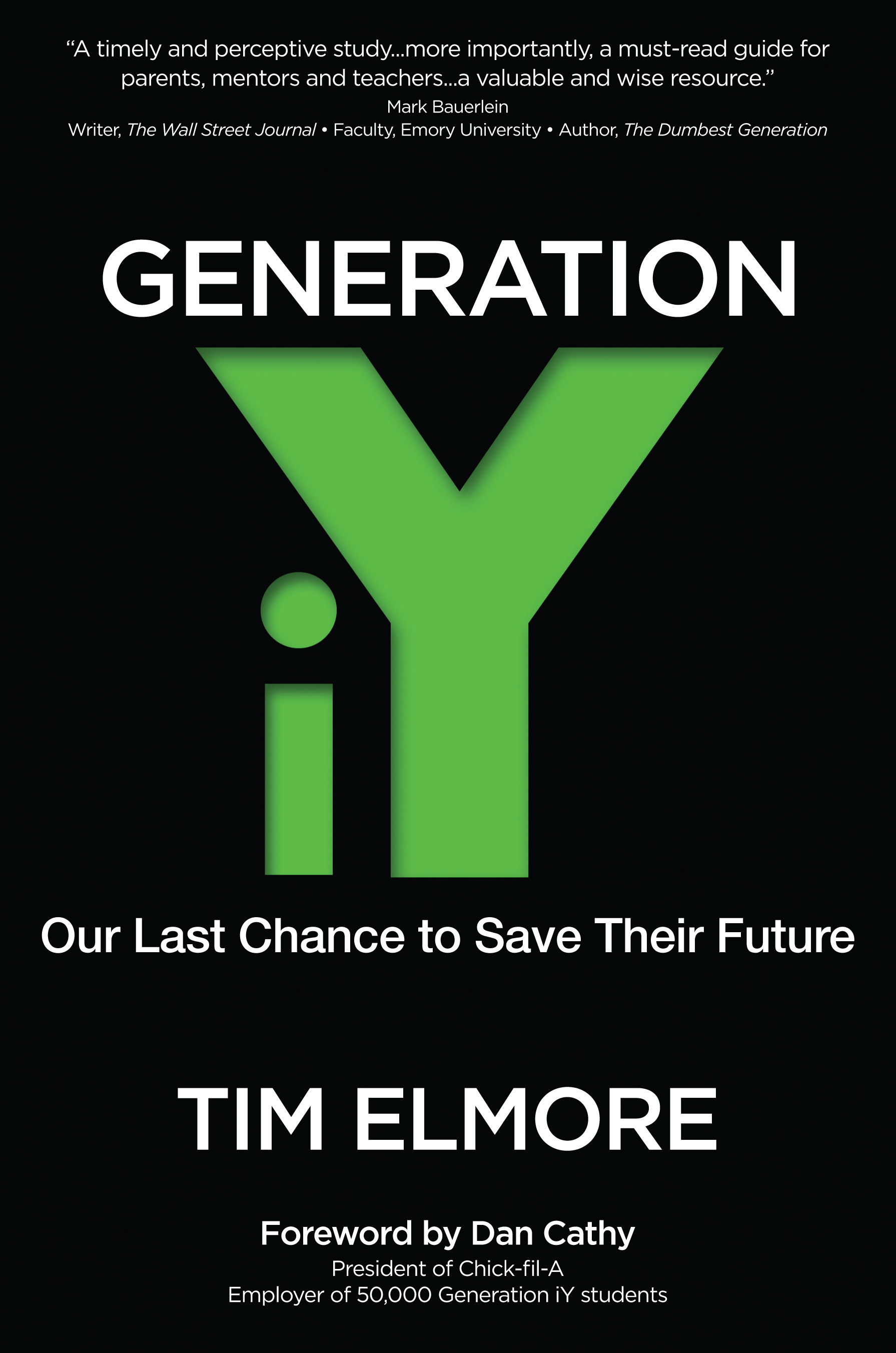
 Three years ago I posted this—
I’m going to make a statement about Dr. Tim Elmore’s book Generation iY that I rarely make: This book is a MUST READ for parents and anyone who works with youth!
Yes, a must read. The subtitle of this book is not over-dramatized, but really is an understated truth: Our last chance to save their future.
Recently Tim Elmore released in ebook format a final chapter to Generation iY. After reading this I was just as convinced that anyone who works with our youth must read this book (read my full book review by clicking here). Here are a few quotes from this chapter.
“Historical trends suggest that every time there is a population explosion among the youth (between 15-29 years old), violence follows. Sociologist Gunnar Heinson reported that countries are vulnerable when the youth population is 30 percent or higher.”
“Our assessment of 8,500 high school and college students clearly reveals a drop in:
- Resilience—we removed the ability to bounce back after a failure.
- Empathy—we have pushed them toward self-expansion.
- Work ethic—their short attention spans make the daily grind a turn-off.
- Stamina—sticking with the task when the novelty’s going is difficult.
- Ambition—the internal drive to succeed is replaced by external stimuli.
- Self-awareness—few adults have been honest about their blind spots.”
“Condoleezza Rice and Joel Klein released a report recently saying that the state of our youth is now an issue of national security. Seventy-five percent of America’s youth are not even fit for the military due to obesity, criminal records or failure to graduate high school.”
- As technology goes up, empathy goes down. We can find a direct parallel between screen time and the lack of empathy in adolescence. It makes sense, doesn’t it? A text that says ‘I am having a bad day’ doesn’t elicit the same empathy as being face to face with a person in tears, in the midst of a crisis. It seems virtual, so our empathy is virtual. Kids often laugh at what they cried about a decade ago.
- As information expands, attention spans diminish. Resilience, patience, and attention spans have dropped thanks to today’s quick, convenient, and saturated world. When overwhelmed, we surrender readily. Herbert Simon said it best: “A wealth of information creates a poverty of attention.”
- As options broaden, long-term commitment shrinks.
- As life speeds up, patience and personal discipline drop.
- As external stimulation increases, internal motivation decreases. Experiments among students show that external rewards actually reduce internal drive and ambition. Kids work for the reward, not the satisfaction of the work. The external (and possibly artificial and superficial) reduces incentive and, consequently, self-sufficiency.
- As consequences for failure diminish, so does the value of success.
- As virtual connections climb, emotional intelligence declines.
- As free content swells, so does our sense of entitlement.


 Craig T. Owens
Tell me what you think about this...