

What’s So Good About Good Friday?

Good Friday? Good for whom?

For you and me? Yes.

Good for Jesus, no. It was Bad Friday for Him, wasn’t it?

Or was it?

The writer of Hebrews says, “For the joy set before Him, Jesus endured the Cross, scorning its shame.”

What joy?

It was for the joy of what was nailed to the Cross.

So what exactly was nailed to the Cross?

Isaiah records an usual statement from God –

Comfort, comfort My people, says your God. Speak tenderly to Jerusalem, and proclaim to her that her hard service has been completed, that her sin has been paid for, that she has received from the Lord’s hand double for all her sins.

That seems unfair! We receive double (!) for our sins! Here’s a brief video where I explain what this means culturally –

Only when invoices were paid-in-full did they get doubled-up.

The Bible tells us that we’ve all sinned, and that the invoice or penalty for our sin is death. We have the IOUs of sin nailed to the door of our heart where God says “You owe Me your life!” But we cannot pay this debt by ourselves.

But Jesus can. And Jesus did! Check this out –

He personally carried our sins in His body on the Cross…. (1 Peter 2:24, NLT)

Having cancelled and blotted out and wiped away the handwriting of the note with its legal decrees and demands which was in force and stood against us. This He set aside and cleared completely out of our way by nailing it to His Cross. (Colossians 2:14, AMP)

That’s what is good about Good Friday. Jesus knew that taking our sins on His body, and then allowing His body to be nailed to the Cross, would double-up and nail-down our sin once and for all!

When Jesus said, “It is finished!” He was really saying, “It is was paid-in-full!”
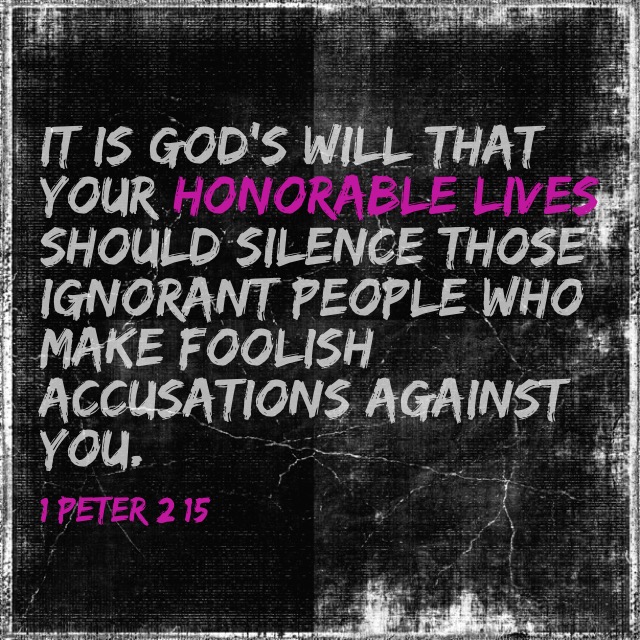
What Jesus Didn’t Say

All throughout the first four books of the New Testament—Matthew, Mark, Luke, and John—there are lots of “red letters” (words spoken by Jesus). But as each of these gospel writers begins to recount the arrest and sham trial of Jesus, I’m struck by how many “black letters” there are. This fulfilled an Old Testament prophesy—

He was oppressed and treated harshly, yet He never said a word. He was led like a lamb to the slaughter. And as a sheep is silent before the shearers, He did not open His mouth (Isaiah 53:7).

The chief priests and the Sanhedrin brought out a string of witnesses to falsely accuse Jesus, but even then these witnesses couldn’t get their stories to jive, so Jesus remained silent. In exasperation the chief priest Caiaphas lashed out at Jesus, “Aren’t You going to answer these charges? Don’t You hear what they’re saying about You? Why won’t You defend Yourself?”

So here’s how Jesus responded to His accusers: But Jesus remained silent (Matthew 26:63). His silence resonated louder than any words could have!

How could Jesus do this? How could He stand silently when all of these nasty things were being said about Him?

He looked back—”…He had done no violence, nor was any deceit in His mouth…” (Isaiah 53:9). All four Gospels record Jesus saying, “You heard Me speaking in public all the time. My life has been on display for You. If I had said or done anything wrong, you could have arrested Me earlier, but the facts are: I haven’t said or done anything sinful.”

He looked forward—”…Because of the joy awaiting Him, He endured the Cross, disregarding its shame…” (Hebrews 12:2). He knew that one wrong word could undo all of the good words which He previously spoke, so He looked forward to the joy that would come after this was over.

I just went through a period of my life where people threw incredibly hurtful lies at me, but what was that compared to the horrific abuse heaped upon Jesus? If He could remain silent, how much more should I?

While I was in the midst of this difficult time, a prayerful friend handed me a notecard which I have kept close to me. Perhaps these words will be helpful to you, too—

May kindness be the response in you
where such a response is not expected.
May gentleness have the power
to overrule an offense and the power to heal. (David Teems)

May this Good Friday be a time of reflection in what Jesus didn’t say. And may I, along with you, learn this power of silence when falsely accused.