


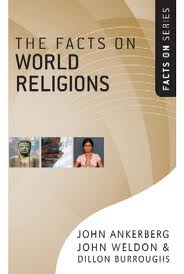
 The Facts On World Religions is a broad overview of the four major religions of the world—Christianity, Islam, Buddhism and Hinduism. You can read my full book review by clicking here. These are some of the passages I found noteworthy….
“Positive criticism: Being critical of other people’s beliefs is necessary for the sake of what is true and what is good. Every idea in the world is not true, regardless of what relativists claim. And some ideas are harmful, including religious ideas. We have also been critical of our own faith when needed, so when we ask adherents of other religions to analyze their own perspectives, we are not requesting that they do something we ourselves have neglected.”
“The Bible’s uniqueness in some 20 different areas—including many specific predictions of the future (especially as to the Messiah), theology and content, textual preservation against all odds, the physical resurrection from the dead of its central character, scientific and medical prevision, the miraculous existence of Israel, historic and archaeological accuracy, victory over all criticism, and massive influence in human history—is virtual proof that the Bible comprises God’s revelation to humanity. Because it alone is evidentially and independently verified, at points of conflict all other scriptures are, by definition, false. … The manuscript evidence proving the New Testament’s accuracy is about a thousand times better than for ancient manuscripts that scholars everywhere concede are reliable.”
“Historical facts confirm that the Qur’an has experienced significant corruption through various means. Texts such as The Origins of the Qur’an (edited by Ibn Warraq), though sometimes displaying a rationalistic bias, nevertheless prove beyond doubt that the Qur’an is not a pure text. … Dr. William Miller reveals that for some years after the death of Muhammad there was great confusion as to what material of all that had been preserved should be included in the Qur’an. Finally, in the caliphate of Uthman (644-656 AD) one text was given official approval, and all other material was destroyed.”
“Buddha did not even claim that his teachings were a unique and original source of wisdom. Buddha always said, ‘Don’t take what I’m saying [that is, on my own authority], just try to analyze as far as possible and see whether what I’m saying makes sense or not. If it doesn’t make sense, discard it. If it does make sense, then pick it up.’” —Clive Erricker
“Internal contradictions in Buddhism make it impossible to know what is true and what is false, leading to an emphasis on subjectivism and experientialism to discover ‘truth,’ rather than upon objective data.”
“Consider the Wall Street Journal/Heritage Foundation’s ‘Index of Economic Freedom Report.’ From 1995 to 2008, the ‘mostly free’ categories of nations include only some Muslim states, while the ‘mostly unfree’ and ‘repressed’ categories include the large majority of Muslim nations; no Muslim nation exists in the ‘free’ category. Some 600 million souls live in dismal poverty. And it’s not difficult to see why: The average man, woman or child living in a repressed or mostly unfree economy lives a life of poverty on only about $2,800 a year. Compare this with the prosperous residents of the world’s free economies, where the average per-capita income is $21,200, or nearly eight times greater. Put simply, the difference between poverty and prosperity is freedom.”
“Islam may be called a ‘religion of peace,’ but history paints a different picture, no matter how many individual Muslims are peace-loving. The book that most regulates Islam, the Qur’an, is mixed at best in this regard. Entirely different religions, both logically justified, can be extracted from its pages. There are verses about peace and tolerance, but also verses about intolerance, Holy War against non-Muslims, and subjugating the world to the will of Allah. … Evils done in the name of Christian faith have been committed either by nominal Christians who are unbelievers or by deceived believers. In both cases the people are acting inconsistently with Christian faith and the clear teachings of Christian Scripture.”
“Too few appreciate how critically unique biblical Christianity is when compared to other religions—or the implications. For example, Christianity is the only religion based on the death of its founder, a death that forever altered the course of human history. No other religion has the literal physical resurrection of its founder. Biblical Christianity is the only religion having solid evidence to prove it true. It’s the only religion offering eternal life as a free gift through grace, and the only religion demonstrating beyond the shadow of a doubt that God truly loves us—as demonstrated at the Cross. Biblical Christianity is the only religion to dramatically improve the welfare of humanity in a score of areas.”



 Craig T. Owens