Anger That Crosses The Line

Last night in our Bible study we looked at some words that David penned when he was angry. He was on the run from his son Absalom, and it seemed like everywhere he turned people were after him, or slandering him, or just doing their best to make him miserable. Yet in two back-to-back Psalms David says, “I lay down every evening and get a great night of rest.”

His sweet sleep comes from a moment of reflection before dozing off. He says:

In your anger do not sin; when you are on your beds, search your hearts and be silent. Selah.

  • Did my anger today cross the line into sin?
  • Am I allowing the time for the Holy Spirit to search my heart?
  • When the Holy Spirit points out where my anger crossed the line, do I justify my anger, or am I silent?

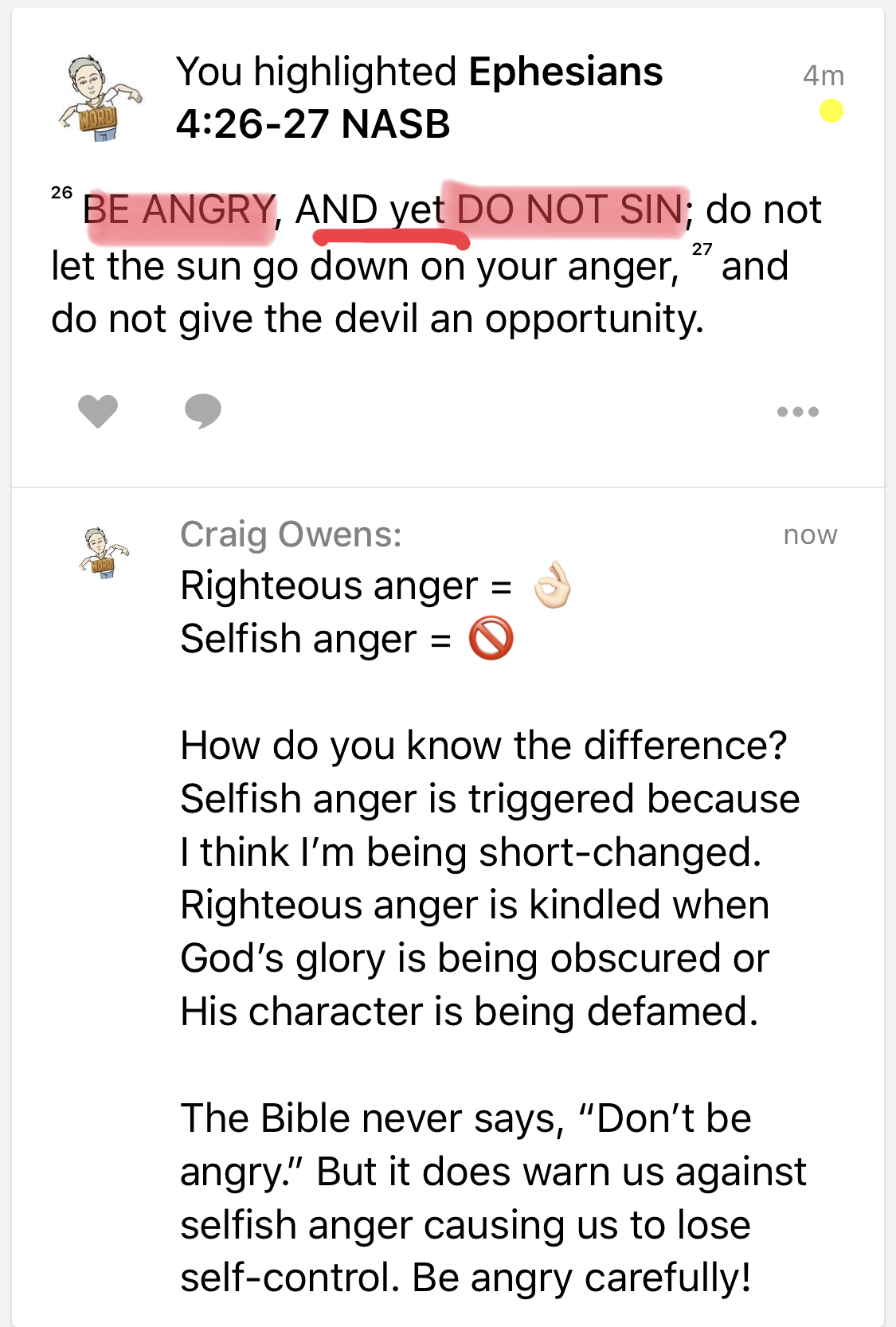
How do we know if our anger has not crossed that line and become sin?

Aristotle wrote, “Anybody can become angry—that is easy; but to be angry with the right person, and to the right degree, and at the right time, and for the right purpose, and in the right way—that is not within everybody’s power and is not easy.”

Being angry is not the issue. David said it (and Paul quoted it in Ephesians 4:26): “Be angry; just don’t sin.” God gets angry, but He does not sin. Jesus, in His public ministry, got angry, but He did not sin. We need to search our hearts to make sure our anger has not crossed the line to sin. We have to be angry in a godly way.

I see at least four ways to become angry without crossing the line into sin:

1.  Selfless Anger = anger at sin, but not angry at the sinner.

Love is not rude, it is not self-seeking, it is not easily angered, it keeps no record of wrongs. Love does not delight in evil but rejoices with the truth. (1 Corinthians 13:5, 6)

2.  Slow Anger = lengthen your fuse a bit.

Do not be quickly provoked in your spirit, for anger resides in the lap of fools. (Ecclesiastes 7:9)

My dear brothers, take note of this: Everyone should be quick to listen, slow to speak and slow to become angry, for man’s anger does not bring about the righteous life that God desires. (James 1:19, 20)

Good advice from Thomas Jefferson: “When angry, count to ten before you speak; if very angry, a hundred.”

3.  Protective Anger = when sinners entice others to join them in their sin. God is sad when people leave Him; He is angry at them when they take others with them.

But they put God to the test and rebelled against the Most High; they did not keep His statutes. Like their fathers they were disloyal and faithless, as unreliable as a faulty bow. They angered Him with their high places; they aroused His jealousy with their idols. When God heard them, He was very angry; He rejected Israel completely. (Psalm 78:56-59)

4.  Righteous Anger = against those who are keeping others from coming closer to God.

For I endure scorn for Your sake, and shame covers my face. I am a stranger to my brothers, an alien to my own mother’s sons; for zeal for Your house consumes me, and the insults of those who insult You fall on me. (Psalm 69:7-9)

This verse was recalled by Jesus’ disciples when they saw Him get angry and clear out the Temple in Jerusalem. Jesus was angry because of the religious clutter that was keeping God’s house from being a house of prayer for all nations.

I think everyone is familiar with the acrostic WWJD = What Would Jesus Do?

I’d like to propose something similar: WGGA = Would God Get Angry?

This is a great question to ask to make sure our anger does not cross that line into sin. Get angry—in a godly way—and do not sin.

Standing On A Promise

Just before Joshua’s farewell address to the Israelites, he makes one final comment to sum up the whole campaign that secured Israel’s borders—

Not one of all the Lord’s good promises to the house of Israel failed; every one was fulfilled.

Every one.

You can trust God! You can stand on His promises. They will not fail; they will all be fulfilled.

Dr. Robert Lockyear estimates that there are 7,457 promises of God in the Bible!

Which one are you standing on today? Get into God’s Word, and let His promises get into you. Write them down. Memorize them. Repeat them again and again. Believe that not one of all the Lord’s good promises will fail.

Here are a few you can stand on:

  • He forgets your forgiven sins.
  • He will give you abundant life now, and eternal life later.
  • Nothing can separate you from His love.
  • All things are working together for the good for those who love God.
  • He will never leave or forsake you.
  • He will continue to develop the best in you.
  • He will never place you in a situation where you cannot stand.

(check out all of the biblical references for these promises by clicking here)

“We take away from this most precious promise, and, by refusing to take it in its fullness lose the fullness of its application and power. Then we limit God’s power to keep: we look at our frailty more than His omnipotence. Where is the line to be drawn, beyond which He is not ‘able’? Why should we pare down the promises of God to the level of what we have hitherto experienced of what God is ‘able to do,’ or even what we have thought He might be able to do for us? Why not receive God’s promises, nothing doubting, just as they stand?” —Frances Ridley Havergal

What promise are you standing on today?

Everything I Need Is Right Here

God wants to bless people. He wants it so much, that He puts everything we need to receive His blessing right in front of us.

It’s not elusive. It’s not obscure.

I don’t need a Master’s in Divinity to figure this out:

Now what I am commanding you today is not too difficult for you or beyond your reach. … No, the word is very near you; it is in your mouth and in your heart so you may obey it.

The New Testament amplifies this:

  • God’s laws are written on my heart, and my conscience tells me if I’m obeying them or not (Romans 2:15).
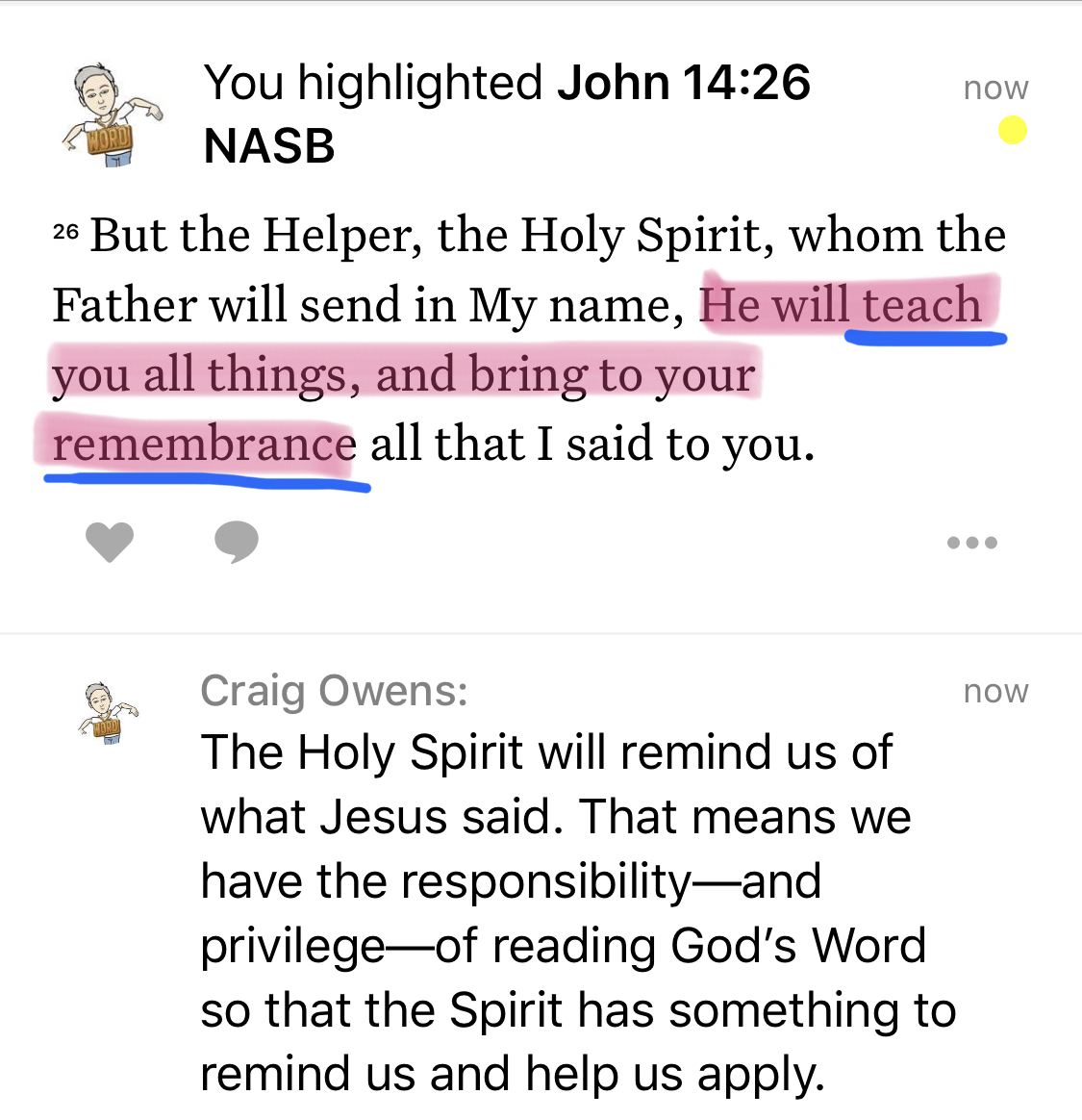
  • The Holy Spirit teaches and reminds me of everything I need (John 14:26; 16:8; 13).

You don’t need a spiritual pilgrimage to find God. He’s already written on your heart what you need to call out to Him. Don’t delay another day!

No Crutches

In preparing for the continuation of our Ignite series, I’ve been reviewing some of my notes about the Holy Spirit. This quote from R. Hollis Gause has really been working on me:

“[Jesus] was not a crutch for [the disciples’] immaturity. … Jesus did not encourage a mindless dependency on His physical presence; instead, He expected them to be interpretive of His instructions about their mission.”

Jesus said He wasn’t leaving us orphans, but He would send us the Holy Spirit to be a constant Counselor. When I submit to the Holy Spirit’s counsel, it’s not a mindless giving in, but a mind-full acknowledgment of His role. The Holy Spirit didn’t come to be my crutch, but to be my Liberator.

The Holy Spirit prepares me to be a conduit for God’s blessings.

I cannot touch in love…

I cannot speak with power…

I cannot truly represent Christ…

if I’m operating in my own strength.

The Holy Spirit comes alongside me to

Develop agape love in my heart…

stimulate my mind with the right words…

help me behave more like Jesus…

and live mind-full of His empowerment.

To do things on my own is to live with a crutch—to live a limited life.

To live in the flow of the Holy Spirit is to live a life that is fully engaged.

That’s how I want to live every day.

What If…

…for just one day you and I only said what God told us to say?

“Everything?” you ask, “Is that even possible?”

Yes! Jesus did it. Look:

I don’t speak on My own authority. The Father who sent Me has commanded Me what to say and how to say it.

Everything Jesus said was directed by His Father. Yes, everything.

Want to try it today? First, we have to spend more time in God’s presence to hear His words. Then here’s a simple gauge to use (as given to us by James). Are my words…

  • true?
  • pure?
  • peace-promoting?
  • considerate?
  • courteous?
  • gentle?
  • sincere?
  • merciful?

Are you ready to give it a try?

The Point Of The Gospel

While I was preparing for our Spiritual Self-Defense class, Rick Warren tweeted this timely reminder: “If you spend more time defending the truth than actually sharing it, you will have missed the point of the Gospel.”

What is the point of the Gospel? Isn’t it simply that mankind is lost without God, and that only a relationship with Jesus can bring true life? If that’s the point, we can never argue someone into this divine relationship.

Here are some other thoughts I’m trying to keep in mind for this exciting class:

  • Jesus never shouted down those who disagreed with Him. Isaiah’s prophesy about Jesus said, “He will not shout or cry out, or raise His voice in the streets.” And that’s exactly how Jesus conducted Himself.
  • Jesus said, “God didn’t go to all the trouble of sending His Son merely to point an accusing finger, telling the world how bad it was. He came to help, to put the world right again.” Jesus didn’t come to win an argument, but to win lost people to a relationship with His Father.
  • There are very few exclamation points in Christ’s dialogue in the Gospels, but there are a lot of question marks. He was interested in engaging people in conversation.
  • G. K. Chesterton said, “The principle objection to a quarrel is that it interrupts an argument.” We need to discuss, not argue.

I’m really looking forward to leading this class, but I’m also excited about what I’m learning in the process.

He Gave His Own Blood

I just read an amazing story about a West Michigan doctor working in Haiti. You can read the full article here, but let me highlight one section:

At a small health clinic east of capital city Port-Au-Prince, a teenage boy with a broken pelvis was dying from loss of blood.

West Michigan orthopedic surgeon Gregory Golladay sized up the options, then acted.

“He was the same blood type as me. He had a hemoglobin level of 5. You don’t have that and live long. His heart rate was 150. His blood pressure was 80 and going south. He was going to die.”

“I gave as much as I could into an IV bag and he lived,” recalled Golladay, 39, who is among a rotating group of physicians from Orthopedic Associates of Michigan offering critically needed medical care in Haiti.

“It is indescribable really. To see him survive was a very emotional experience. We said we were brothers and I believe it.”

Sounds just like Jesus, doesn’t it?

We were dying. Crushed by sin. There wasn’t much time left. Then Jesus came to earth to die on a Cross for you and me. He gave us His blood so that we could live:

For God so loved the world that He gave His one and only Son. That whoever would believe on Him should not die but have everlasting life. (John 3:16)

And now, when we accept what Jesus did for us, we are His brothers and sisters:

God decided in advance to adopt us into His own family by bringing us to Himself through Jesus Christ. This is what He wanted to do, and it gave Him great pleasure. (Ephesians 1:5)

Don’t Fight It

A couple of weeks ago I wrote about some unique insights I gathered from taking a trip with my wife’s TomTom GPS unit. Well, I was taking another trip with TomTom the other day, and I got really annoyed!

I was running late. I grabbed my laptop and my cell phone, fired up the TomTom and hit the road. I got about a mile down the road and realized I forgot something for my meeting. So I turned my car around and quickly headed back home. All of a sudden a voice was reminding me…

  • “At the first possible place, make a legal u-turn.”
  • “Turn right at the next road and turnaround.”
  • “To return to your entered route, make a legal u-turn.”

This voice was still just as sweet and even-keeled as before, but it was really getting on my nerves. I knew I was heading in the wrong direction, but I wanted to get this taken care of quickly, but the voice kept reminding me. I tried to tune the voice out—tried to ignore it—but it didn’t work.

I turned the voice off.

When I wrote about TomTom earlier, I equated it to the moral GPS of the Holy Spirit. And that analogy still stands:

The Holy Spirit does convict us. He warns if we’re on the wrong path, and He lovingly and persistently keeps reminding us to do a u-turn. Those who listen and respond are fully restored. Those who don’t listen—those who switch off their moral GPS—can have their conscience permanently seared.

Are you listening to the Holy Spirit? Do you hear Him encouraging you? Do you hear Him challenging you? Do you hear Him reminding you to turn around? Stay tuned in—He only has the best in mind for you.

The Power Of -Ing

Have you ever heard someone say something like:

  • “Wow, look at her. She arrived in style!”
  • “I think I’ve finally arrived.”

This is weird because arriving implies stopping. When I’m driving to the store and I arrive at the store, I don’t keep on driving; I stop at the store. That’s the whole reason I left my house in the first place.

So when we talk about people arriving, do we really mean that they are supposed to stop and park? Correct me on this, but I think the only time we stop in life is when life stops. In other words: We’re dead!

We don’t really want to arrive, do we? We want to hit goals and then keep on going. We want to keep on “ing”ing. Here’s how I’m trying to leverage the power of ing:

I love the words of Abraham Lincoln, who knew the power of ing:

“I do the very best I know how—the very best I can; and I mean to keep on doing so until the end.”

Don’t arrive. Don’t stop. Keep on “ing”ing the right things—God’s things—and see how God will bless your efforts. There is an incredible power in ing!

TomTom Directions

My wife is a beautiful, talented woman, but she tends to be, uh, directionally-challenged. That is to say, it’s not hard for her to get on the wrong road, heading the wrong direction. So a wonderful Christmas gift from my folks this year was a TomTom GPS unit.

Yesterday I took a trip and borrowed her TomTom. My first destination was a familiar one, but my second stop was somewhere I hadn’t been before. So I’m driving along when all of a sudden I hear a pleasant female voice tell me, “In two miles, exit to the right.”

Cool!

The Bible tells us that we can have a moral GPS system just like my wife’s TomTom. Check this out:

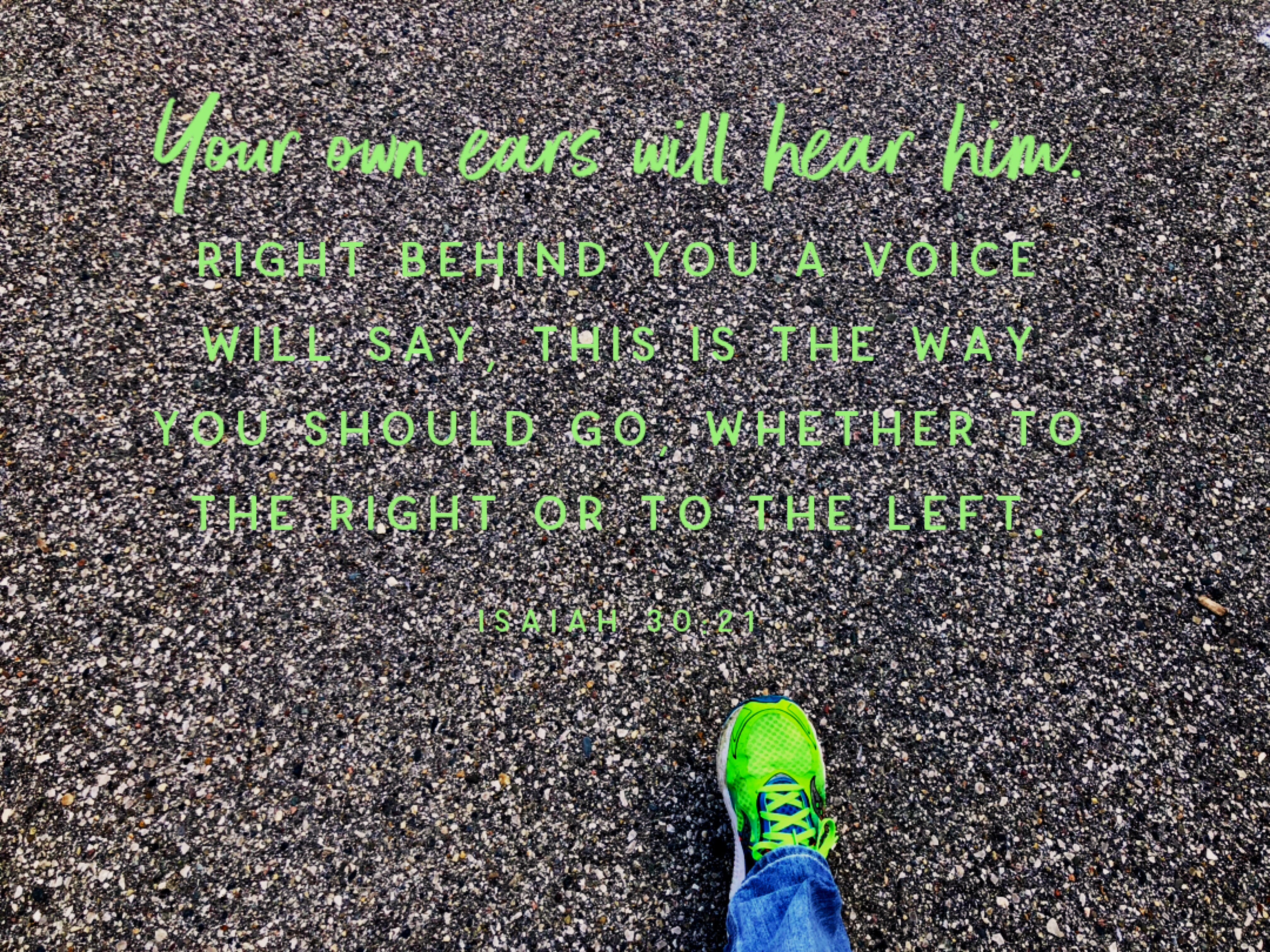
Whether you turn to the right or to the left, your ears will hear a Voice behind you, saying, “This is the way; walk in it.”

That Voice is the Holy Spirit. Jesus said the Holy Spirit would guide us in the right ways to go:

But when the Father sends the Advocate as My representative—that is, the Holy Spirit—He will teach you everything and will remind you of everything I have told you.

You have this moral GPS system at your disposal. Are you using it? Prayer is the power supply that activates the Voice. Turn Him on and make better decisions, live a better life, and do greater things for God.