


Listen to the podcast of this post by clicking on the player below, and you can also subscribe on Apple, Spotify, or Audible.
 One of the misconceptions about Jesus is that He first appears on the scene in a manger in Bethlehem. Nothing could be further from the truth! Jesus appears in the opening words of the Bible—In the beginning God created—and in the last words of the Bible—Yes, I am coming soon. And He appears in every word in between!
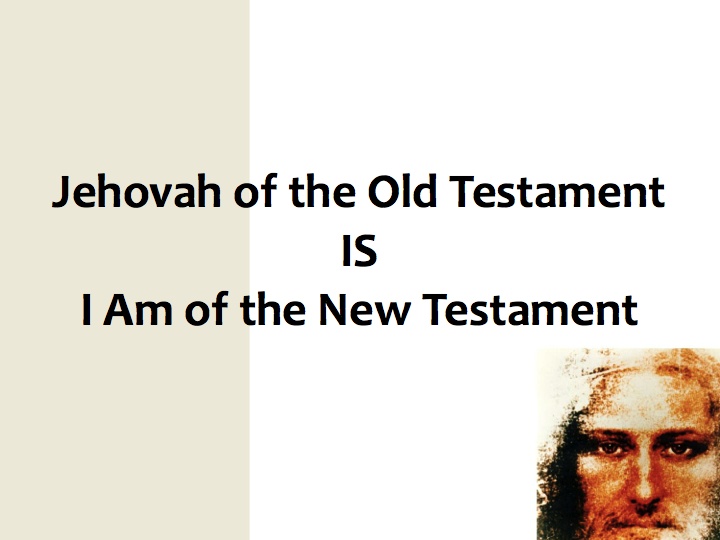
It was Christ’s claims of being one with the Father that enraged the Jewish religious leadership. When He proclaimed His “I Am” statements in the New Testament, they knew He was tying Himself to the “Jehovah” titles of the Old Testament.
B.B. Warfield has a great picture of the Old Testament being a mansion with richly-decorated, beautifully-ornate rooms, but which are dimly lit. So with just the Old Testament by itself, it is hard to appreciate the magnificent beauty that’s there. In Jesus, the light is turned on, and we can now appreciate the glory and majesty that was always there!
So notice how the “I Am” statements shine a bright light on the titles of “Jehovah”—
- Jehovah Jireh (I Am Your Provider) → I am the Bread of Life (John 6:35)
- Jehovah Rapha (I Am Your Healing) → I am the Resurrection and the Life (John 11:25-26)
- Jehovah Nissi (I Am Your Source) → I am the Vine (John 15:5)
- Jehovah Shalom (I Am Your Peace) → I am the Light of the world (John 8:12)
- Jehovah Raah (I Am Your Shepherd) → I am the Good Shepherd (John 10:11)
- Jehovah Sabaoth (I Am Your Wall Of Protection) → I am the Gate (John 10:9)
- Jehovah Tsid-kenu (I Am Your Righteousness) → I am the Way, Truth, and Life (John 14:6)
- Jehovah Shammah (I Am Here) → I am the Alpha and Omega (Revelation 1:8; 22:13).
(Check out all of the above Scriptural references here.)
In essence Jesus is saying “I Am Jehovah in all His fullness.” So what are we to make of that? What are we to make of Jesus Christ? Here’s how C.S. Lewis addressed that very question:
 “This is a question which has, in a sense, a frantically comic side. For the real question is not what are we to make of Christ, but what is He to make of us? The picture of a fly sitting deciding what it is going to make of an elephant has comic elements about it. But perhaps the questioner meant what are we to make of Him in the sense of ‘How are we to solve the historical problem set us by the recorded sayings of this Man?’
“The problem is to reconcile two things. On the one hand you have got the almost generally admitted depth of sanity of His moral teaching, which is not very seriously questioned, even by those who are opposed to Christianity. In fact, I find when I am arguing with very anti-God people that they rather make a point of saying, ‘I am entirely in favor of the moral teaching of Christianity….’
“On the one side clear, definite moral teaching. On the other, claims which, if not true, are those of a megalomaniac, compared with whom Hitler was the most sane and humble of men. There is no halfway house and there is no parallel in other religions. If you had gone to Buddha and asked him, ‘Are you the son of Bramah?’ he would have said, ‘My son, you are still in the vale of illusion.’ If you had gone to Socrates and asked, ‘Are you Zeus?’ he would have laughed at you. If you had gone to Mohammed and asked, ‘Are you Allah?’ he would first have rent his clothes and then cut your head off. If you had asked Confucius, ‘Are you Heaven?’ I think he would have probably replied, ‘Remarks which are not in accordance with Nature are in bad taste.’
“The idea of a great moral teacher saying what Christ said is out of the question. In my opinion, the only person who can say that sort of thing is either God or a complete lunatic suffering from that form of delusion which undermines the whole mind of man.” (emphasis mine)
In this quote, C.S. Lewis gives us three choices about Jesus. We can either say (1) He is a liar, (2) He is a lunatic, or (3) He is who He says He is.
What do you say about Him?
(You may also be interested in my post and sermon about the divinity and humanity of Jesus.)
If you have missed any of the messages in this series called Who Is Jesus?, you can find them all here.
►► Would you please prayerfully consider supporting this ministry? My Patreon supporters get behind-the-scenes access to exclusive materials. ◀︎◀︎


 Craig T. Owens
August 26, 2020 at 6:02 am
[…] out how the “I AM” statements of Jesus in the Second Testament shine a bright light on the names of Jehovah in the First […]
LikeLike
November 19, 2020 at 6:02 am
[…] Jesus is Jehovah God from beginning to end. He is the “one sermon of God” that we can read and understand. Think about this: the same Spirit who inspired the pens of the biblical writers is the same Spirit in you who can help you understand and apply those words to your life. More than that, the Holy Spirit wants to make the Word of God clear to you. […]
LikeLike
November 22, 2020 at 12:39 pm
[…] of Christ’s powerful “I AM” declarations in the Gospel of John are less than 140 […]
LikeLike
March 8, 2021 at 6:03 am
[…] think the best evidence for the Deity of Jesus is the connection He Himself made between the “Jehovah” titles of the First Testament and His “I AM” statements in the […]
LikeLike
March 21, 2022 at 1:55 pm
[…] The words of Jesus are so countercultural, so counterintuitive, that they might be shocking to our human ears. We get used to thinking along certain lines, and then Jesus says, “That’s not the way. I AM the only way.” […]
LikeLike
March 21, 2022 at 2:29 pm
[…] made a lot of amazing I AM statements. But there are two linked together in John 10 that I find fascinating. He […]
LikeLike
June 25, 2024 at 5:21 pm
[…] I Am Jehovah […]
LikeLike
September 29, 2024 at 6:44 am
[…] (When Jesus proclaimed His “I Am” statements in the New Testament, He was tying Himself to all of the “Jehovah” titles of the Old Testament. Check out I Am Jehovah.) […]
LikeLike
August 12, 2025 at 1:01 pm
[…] I Am Jehovah […]
LikeLike