Links & Quotes

link quote

Some good reading from today…

“There is not a single instance in history in which civil liberty was lost, and religious liberty preserved entire.” —John Witherspoon

Religious persecution alert: ISIS is eliminating Christians in Iraq.

“It is a serious fault if a believer is in want, and thou knowest it, or if thou knowest that he is without means, that he is hungry, that he suffer distress, especially if he is ashamed of his need…. If he is in prison, and—upright though he is—has to suffer pain and punishment for some debt (for though we ought to show mercy to all, yet we ought to show it especially to an upright man); if in the time of his trouble he obtains nothing from thee; if in time of danger, when he is carried off to die, thy money seems more to thee than the life of a dying man; what a sin is that to thee!” —Ambrose

[VIDEO] Detroit Tigers radio announcer Ernie Harwell broadcasting his last game.

Interesting: Why The First Hospital To Do Sex-Reassignment Surgeries No Longer Do Them.

“When the Middle East is fragmented in this horrible war, this savage, savage war between militant Shiites and militant Sunnis … the only place where you have freedom, tolerance, protection of minorities, protection of gays, protection of Christians and all other faiths is Israel,” said Benjamin Netanyahu, Israeli Prime Minister. Read more about the wrong-headed decision of the Presbyterian (USA) Church to divest in Israel.

More young adults are having kids outside of marriage, and that is creating a dangerous environment for the kids.

“Kind words are the music of the world. They have a power which seems to be beyond natural causes, as if they were some angel’s song which had lost its way and come on earth. It seems as if they could almost do what in reality God alone can do—soften the hard and angry hearts of men. No one was ever corrected by a sarcasm—crushed, perhaps, if the sarcasm was clever enough, but drawn nearer to God, never.” —Frederick William Faber

Links & Quotes

link quote

Some good reading from today…

“A good mind is also a good possession. And, further, a pure inner life is a valuable possession. Hedge in, then, this possession of thine, enclose it with thought, guard it with thorns, that is, with pious care, lest the fierce passions of the flesh should rush upon it and lead it captive, lest strong emotions should assault it, and, overstepping their bounds, carry off its vintage.” —Ambrose of Milan

“Unlike in physics and chemistry, very few of the findings in the social sciences can be characterized as incontrovertible. But there’s one major exception: the impact of fatherlessness on American children. To name but a few grim examples, 63 percent of teen suicides are from fatherless homes; 90 percent of homeless children and runaways are from fatherless homes; and 71 percent of all high school dropouts are from fatherless homes.” —Eric Metaxas

Great historial article: What Can Pentecostals Learn From John Wesley?

A former abortion worker testifies, “We would find women’s weaknesses and work on them” to convince them to have an abortion.

Joel Osteen says he doesn’t like the term “prosperity preacher” applied to him, and then describes what he believes (which sounds a lot like a prosperity doctrine to me!). John Piper debunks this garbage better than I can in this video.

4 Ways Selfishness Ruins Your Life.

[VIDEO] Ted Cruz blasts the attempt by Democrat Senators to obliterate the First Amendment.

“We only know God in His works, but we are forced by science to admit and to believe with absolute confidence in a Directive Power—in an influence other than physical, or dynamical, or electrical forces.” —William Thomson (Lord Kelvin)

13 Quotes From “The Bare Facts”

The Bare FactsJosh McDowell knows the mindset of today’s youth well, and he very ably lays out an honest discussion about sex in his book The Bare Facts: 39 Questions Questions Your Parents Hope You Never Ask About Sex. You can read my full book review by clicking here. Below are some of the quotes and statistics that especially stood out to me.

“Research by the National Center for Health Statistics and the University of Maryland found that women who save sex for marriage face a considerably lower risk of divorce than those who are sexually active prior to marriage. … Studies indicate that women who engage in early sexual activity and those who have had multiple partners are less satisfied with their sex lives than women who entered marriage with little or no sexual experience.”

“If you cannot define love, how do you know if you are in love? If you cannot define love, how can you know if you are being loved? If you cannot define love, how do you know if you have a loving, intimate relationship? … Love cannot be a feeling because you cannot command an emotion. … Love is more than a feeling. It is a series of choices. When we choose to love, our emotions can be transformed, but love is expressed by acts of the will.”

“When you have sex outside of marriage, the lines between love and lust are blurred. It is easy to misinterpret the chemical reactions in your brain for feelings of love. You can’t trust your feelings to verify if sex is right or wrong, and feelings of love aren’t proof that your relationship is mature or beneficial.”

“Since God designed sex to bind us to each other, when we choose to engage in sex outside of marriage it turns relationships upside down and confuses emotions to the point where a person can misinterpret sex for love. When we follow God’s plan, the love between a man and woman is already established before sex enters the equation.”

“Clearly, God doesn’t ask us to wait for sex in order to spoil our fun or restrict us unnecessarily. His commandments regarding sex are evidence of His love for us as He seeks to protect and provide for our good.”

“Female brains receive especially high doses of oxytocin whenever there is touching and hugging. Vasopressin is a hormone that does the same thing in the male brain. … When we continually change partners, oxytocin levels decrease and the brain’s oxytocin release function doesn’t work as it’s supposed to. Promiscuous sexual activity wears down vasopressin production in the male brain, causing men to become desensitized to the risk of short-term relationships.”

“Today, doctors recognize twenty-five major STDs, nineteen of which have no cure. In the 1960s one out of every sixty sexually active teens got an STD. By the 1970s that number jumped to one out of every forty-seven. Today one in four sexually active teenagers is infected.”

“While condoms offer only partial protection against HIV, gonorrhea, and chlamydia, they offer zero protection from many other STDs. In fact, for the most part, condoms do not reduce STDs, because most STDs are viruses. They are passed by areas of the body not covered by a condom. … With an average woman, between twenty and twenty-four years of age, when condoms were used 100 percent of the time, there was a 31 percent failure rate. … The FDA refuses to certify condoms. Why? Because the failure rate is off the charts. Another government agency, the CDC, says that abstinence is the only surefire way to prevent STDs.”

“Girls, imagine making the choice to become sexually active your sophomore year of high school. You never show any symptoms of an STD and you never get tested. Several years later you meet the man of your dreams. You marry and try to start a family, but you can’t get pregnant. When you go to the doctor to discuss your infertility, your doctor tells you that you have PID. You have had no symptoms but at one time you were infected with chlamydia. You now have to drive home and tell your husband that he will never have children of his own. Guys, imagine a similar scenario. You lose your virginity to a girl you thought you loved at age fifteen. Ten years later you learn what true love is when you meet and marry your wife. She is a virgin on your wedding day. Several years into your marriage your wife begins to experience abnormal bleeding. She goes to the doctor and discovers she has cervical cancer, likely caused by HPV that you unknowingly gave to her. Even though she chose to wait, she is forced to pay a huge price because you didn’t.”

“Sexually active teenage girls are 300 percent more likely to attempt suicide than their virgin peers. Sexually active teenage boys are more than twice as likely as sexually active girls to be suicidal. In fact, sexually active teenage boys are 700 percent more likely to attempt suicide than peers who are waiting.”

“Dr. Freda McKissic Bush of the Medical Institute for Sexual Health noted, ‘One of the greatest risk factors for depression, loss of self-esteem, and a lot of emotional consequences has to do with the number of people you have [sexual] relations with.’ She went on to say, ‘The more people you have [sexual] relations with, the more likely you are to have difficulty forming healthy relationships in the future when you are ready to be with one person.’”

“When it comes to sex, the mechanics almost always work. Bad sex isn’t the result of too little experience or sexual incompatibility. The problem is relationships. The problem is a lack of a character, trust, respect, and commitment. On your wedding night, experience is the last thing you need.”

“An article titled ‘Aha! Call It the Revenge of the Church Ladies,’ published in USA Today concluded that Christian woman (and the men who sleep with them) are among the most sexually satisfied people on the planet. … Men and women who test the waters of sexual compatibility before marriage are the least likely to be sexually fulfilled.”

Rescuing Those Who Might Harm Themselves

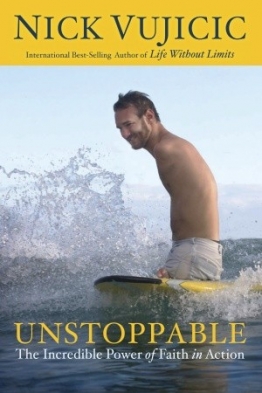
UnstoppableIn Nick Vujicic’s book Unstoppable (you can read my book review by clicking here), he is very transparent about his thoughts of suicide. He wrote—

“My youthful self-acceptance and self-confidence did not begin to crumble until I began relentlessly comparing myself to my peers. Then, instead of taking pride in what I could do, I dwelled on those things my mates could do that were beyond my abilities. Instead of seeing myself as enabled, I saw myself as disabled. Instead of taking pride in my uniqueness, I yearned to be what I was not.”

According to the World Health Organization, the rate of suicides has increased dramatically, and is now the third leading cause of death for fifteen- to twenty-four-year-olds. I had a friend that committed suicide, and it wasn’t until after the fact that I could put together the warning signs that he had been exhibiting.

Nick lists some indicators that someone close to you might be depressed enough to harm themselves:

  • Unusual changes in eating and sleeping habits
  • Withdrawal from friends, family, and regular activities
  • Violent actions, rebellious behavior, or running away
  • Excessive drug and/or alcohol abuse
  • Unusual neglect of personal appearance
  • Marked personality change
  • Persistent boredom, difficulty concentrating, or a decline in school performance
  • Frequent complaints about physical symptoms, often related to emotions, such as stomachaches, headaches, and fatigue
  • Loss of interest in favorite activities
  • Intolerance of praise or rewards
  • Giving or throwing away favorite possessions or belongings
  • Becoming suddenly cheerful after an episode of depression

From Nick’s own experience, he offers these helpful words—

“Often individuals in distress don’t want to talk about their issues. Don’t push it, but keep the communication open without offering advice or judgment. Just being there for them, hanging out with them, and letting then know you care can make a difference. You don’t have to solve their problems unless you are a mental health professional. …

“Sometimes it won’t be easy to stand by a friend or loved one who is dealing with despair or depression. Your loyalty will be tested. You may feel hurt, slighted, or abandoned. I would never suggest that you allow someone to mistreat you. If that happens, maintain a safe distance, but do whatever you can to help. That may mean simply being there for those who are hurting, listening to them when they are willing to talk about their concerns, and assuring them that they are loved and valued by reminding them that other people care about them. If you sense that someone is more troubled than you are equipped to handle, you should contact a guidance counselor, a trusted clergy member, or a medical or mental health professional and seek his or her advice on what to do.”

If anyone around you is exhibiting any of these signs, please reach out to them in love. It would be much better to have a friend tell you, “I’m okay, but thanks for asking,” than for you to miss an opportunity to save someone’s life.

Contact the National Suicide Prevention Hotline online or call them at (800) 273-8255.