
No Contradictions

Listen to the podcast of this post by clicking on the player below, and you can also subscribe on AppleSpotify, or Audible. 

…I will hide My face from this city because of all its wickedness. Nevertheless, I will bring health and healing to it… (Jeremiah 33:5-6) 

God’s anger at Judah’s sin is blazing hot! And rightly so: Dr. Henry Halley points out, “Most of the 20 Davidic kings who reigned over Judah during the 400 years between David and the Babylonian exile were very bad. Only a few were worthy of the name of David.” So it is understandable that God would need to punish that sinful nation. 

Then comes that word “nevertheless.” In spite of the rampant sin, God’s promise of restoration is even greater than the pain of His punishment. 

God promises healing, restoration, complete cleansing from sin, and more descendants of David and Levi than can be counted. And He promises this to the exact same people that He promised to punish. 

I don’t know about you, but to me this almost seems like a contradiction. Does God want to punish them or does He want to bless them? 

The apparent contradiction is hard for our finite brains to comprehend. That’s why God makes an important statement to Jeremiah before He begins describing the punishment and the blessings: “Call to Me and I will answer you and tell you great and unsearchable things you do not know” (v. 3). 

Aha! When we call on God to help us with unsearchable things, we find there are no contradictions in God nor in the Bible itself. 

If you feel stumped on a text of Scripture, I have previously shared how I handle the tough texts, but step number one is always calling on God to help. 

C.S. Lewis wrote, “Heaven will solve our problems, but not, I think, by showing us subtle reconciliations between all our apparently contradictory notions. The notions will all be knocked from under our feet. We shall see that there never was any problem”—or any contradiction at all. 

►► Would you please prayerfully consider supporting this ministry? ◀︎◀︎
Assyrian Kings Involved With Israel

A helpful Bible study tool—

Assyrian Kings Involved With Israel

  • Shalmaneser III (858-824 BC)—2 Kings 17:3-4
  • Adad-Nirari III (810-782 BC)—took tribute from Israel; king during Jonah’s visit (Jonah 3) 
  • Tiglath-Pileser III (745-727 BC)—deported most of the northern part of Israel 
  • Shalmaneser V (727-722 BC)—besieged Samaria (2 Kings 18:9) 
  • Sargon II (721-705 BC)—deported the rest of Israel (Isaiah 20) 
  • Sennacherib (704-681 BC)—invaded Judah (Isaiah 36) 
  • Esar-Haddon (681-669 BC)—very powerful king 
  • Ashurbanipal (668-626 BC)—most powerful and brutal Assyrian king 

Two weak kings followed (626-607 BC), and Assyria fell in 605 BC. 

Source: Halley’s Study Bible 

You may also want to check out my chart of the kings and prophets of the divided kingdom of Judah and Israel.

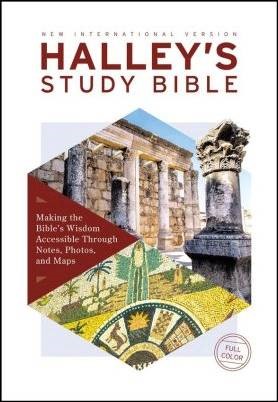
Halley’s Study Bible (book review)

I believe Halley’s Bible Handbook may have been the first Bible study resource I got my hands on when I was a pre-teen. It was a slender book but packed with insights that even this third-generation Pentecostal boy hadn’t heard before. So I was quite intrigued when I heard about Halley’s Study Bible. 

Let me get something out of the way right upfront. I’m a blogger for the BibleGateway Blogger Grid (sometimes called #bgbg2 on Twitter), so I’m occasionally offered a free book in exchange for my honest book review. However, there are more books that I pass on than books I agree to review. Since I am already working my way through the Faithlife Illustrated Study Bible, I wasn’t too eager to dive into another study Bible just yet. But I’m so glad I did! 

Reading Henry Halley’s concise overview of each book of the Bible was nostalgic for me, reminding me of what initially intrigued about his handbook: taking voluminous information and giving such a clear, concise overview. 

The study notes on each page offer fascinating insights, and the unique perspective Halley offers of the people, places, and practices chronicled in the pages of Scripture are unparalleled. And what I especially appreciate is Halley’s whole-Bible approach. By that, I mean his ability to show you a theme that originates in the Old Testament and finds its fulfillment in the New Testament, showing how all of the Bible is interconnected. 

If you are looking for a new way to study your Bible, I highly recommend Halley’s Study Bible to you. 

I am a HarperCollins book reviewer.