
Thursdays With Oswald—Bitter, Dogmatic, Intolerant, And Utterly Un-Christlike

This is a weekly series with things I’m reading and pondering from Oswald Chambers. You can read the original seed thought here, or type “Thursdays With Oswald” in the search box to read more entries.

Oswald ChambersBitter, Dogmatic, Intolerant, And Utterly Un-Christlike

     Spiritual maturity is not reached by the passing of the years, but by obedience to the will of God. Some people mature into an understanding of God’s will more quickly than others because they obey more readily, they more readily sacrifice the life of nature to the will of God, they more easily swing clear of little determined opinions. 

     It is these little determined opinions, convictions of our own that won’t budge, that hinder growth in grace, and makes us bitter and dogmatic, intolerant, and utterly un-Christlike. 

From Bringing Sons Unto Glory 

Ouch! It’s so important that I read God’s Word with a heart ready to obey whatever the Holy Spirit shows me, even if it means sacrificing what I’ve always thought to be true. I must not cling to my own “little determined opinions” if I want to grow in spiritual maturity.

The contrast is crystal clear: Either I am maturing through complete obedience to God, or I am becoming bitter and dogmatic, intolerant, and utterly un-Christlike.

 

What Does It Mean To Fear God?

Fear GodWhat does it mean to fear God? Does it mean we cower before Him? That He is utterly unapproachable? Or maybe it means we’re always looking over our shoulder wondering if God is coming after us in anger?

Let me ask the question another way:

  • Are you afraid that you won’t buy the right Christmas gift for someone?
  • Are you afraid that you’ll forget someone?
  • Are you afraid that your response won’t be right when you open a gift?
  • Are you afraid you’ll offend a family member by something you say or do?
  • Do other people’s opinion of you factor into your decisions?

If you answered “Yes” to the above questions, you have a fear problem. That is: you fear letting other people down.

I think this was the issue for Joseph in the Bible (Matthew 1:18-25). When he found out that Mary was pregnant before their marriage, Joseph carefully deliberated his response. Based on the meaning of the words had in mind and considered, and examining the way the angel told Joseph to “Fear not,” it appears that Joseph, too, lived in this same fear of letting others down.

But here’s the issue: Joseph placed greater value on people’s opinions than he did on God’s opinion. And what makes it even worse is that Joseph simply assumed what people would say about him, as he never actually asked anyone.

The angel challenged Joseph to re-evaluate his value system. To give greater weight to God’s opinion than to man’s opinion. In short, to change his fear of man to fear of God.

That’s really what it means to fear God: To give greater weight to His Word and His opinion than to anyone or anything else.

The wise king Solomon explored everything he could to find the meaning of life. He tried money, education, art, travel, women, food, power, and the like. At the end of his exploration, he came to this conclusion—

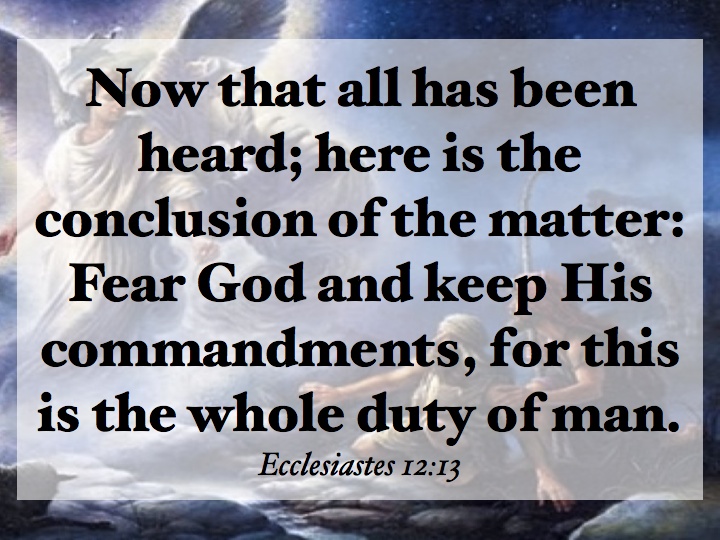
Now all has been heard; here is the conclusion of the matter: Fear God and keep His commandments, for this is the whole duty of man. (Ecclesiastes 12:13).

We should be living for the approval of an Audience of One. 

We should be longing to hear, “Well done, good and faithful servant” from our Creator. 

We should be listening only for the applause from nail-scarred Hands. 

“The remarkable thing about fearing God is that when you fear God you fear nothing else, whereas if you do not fear God you fear everything else.” —Oswald Chambers

If you have missed any of the messages in our Fear Not! series, you can find them all by clicking here.

Let Me Give You A Piece Of Advice

How many times have you heard someone say you, “Let me give you a piece of advice”? Ah, yes, everyone has some advice to share. Everyone has an opinion. Everyone wants to give you a piece of their mind. Everyone is an expert in an area where they think you’re deficient.

I remember going through comment cards at the end of a long week of youth camp. I’d read one card that would say the food was excellent. Just a couple of cards later some “expert” would share how terrible the food was. One would say they loved the evangelist, another would give their “advice” on where the evangelist missed it.

Whom should I listen to? Who should get my ear?

In William Shakespeare’s Hamlet, Polonius gives this counsel to Laertes “Give every man thine ear, but few thy voice: Take each man’s censure, but reserve thy judgment.”

Nice prose, but how do we live it out?

I like the example I see from a man named Jethro in the Bible. Jethro is Moses’ father-in-law, and he really only appears on the scene in just one chapter (Exodus 18), but his method of giving advice should be a model for us all.

Credentials—Jethro was a God-fearing man. If you are a follower of Jesus Christ, weigh carefully the advice given to you by those who don’t have the same biblical foundation.

Relationship—Jethro had a personal relationship with Moses, he wasn’t just a business acquaintance. That means Jethro had a vested interest in Moses’ success or failure.

Firsthand—Jethro heard about what was happening, but he came to see it for himself. Beware of those “experts” who only have secondhand information about you or your situation.

Up-Close—Jethro spent an entire day right by Moses’ side just watching and listening. He saw what was going on from the front row.

Questions—Jethro led with questions, not with advice. Before giving Moses his opinion, Jethro asked clarifying questions.

Wisdom—Only after all of this did Jethro give his opinion to Moses. The words that he shared were then received by Moses as God-given wisdom.

Your counselors should earn the right to be heard. Just because someone has an opinion doesn’t make him an expert. And just because someone has been-there-done-that doesn’t mean that her way should be your way.

Screen out the clamoring voices by making sure they have credentials, a relationship with you, firsthand experience, and godly wisdom.