


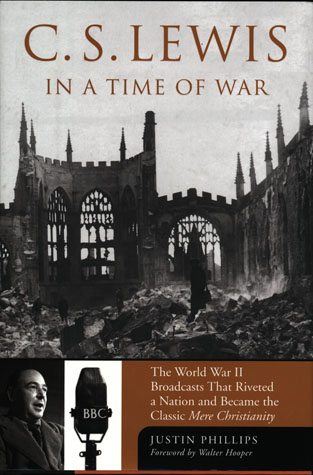
 I loved C.S. Lewis In A Time Of War by Justin Phillips! It appealed to my interests in World War II history, old-time radio, and one of my favorite authors: C.S. Lewis. You can read my book review by clicking here. Below are 10 quotes from this book which will give you a little of the flavor of this work.
“In a time of uncertainty and questioning it is the responsibility of the church—and of religious broadcasting as one of its most powerful voices—to declare the truth about God and His relation to man. It has to expound the Christian faith in terms that can be easily understood by ordinary men and women, and to examine the ways in which that faith can be applied to present-day society during these difficult times.” —James Welch, the BBC director of religious broadcasting responsible for getting C.S. Lewis on the air
“It seems to me that the New Testament, by preaching repentance and forgiveness, always assumes an audience who already believe in the law of nature and know they have disobeyed it. In modern England we cannot at present assume this, and therefore most apologetic begins a stage too far on. The first step is to create, or recover, the sense of guilt. Hence if I gave a series of talks, I should mention Christianity only at the end, and would prefer not to unmask my battery till then.” —C.S. Lewis
“Having seen more of his original manuscripts than probably anybody else, Walter Hooper observes that there is next to no evidence of rewriting or of copious changes. The manuscript of The Screwtape Letters is a case in point. There was only the one draft.” —Justin Phillips
“A charitable trust was set up called The Agape Fund, using the Greek word for love. Until his marriage in 1957, two-thirds of all Lewis’s royalties went into this fund to help those in need—normally under the cover of anonymity.” —Justin Phillips
“If the whole universe has no meaning, we should never have found out that it has no meaning.” —C.S. Lewis
“Walter Hooper had discovered a calculation made by Warnie [Lewis] in 1967, described in his diary some four years after Jack’s [C.S. Lewis] death, that by the time the typewriter was finally packed up Warnie must have written at least 12,000 letters on it on his brother’s behalf.” —Justin Phillips
“Any amount of theology can now be smuggled into people’s minds under the cover of romance without them knowing it.” —C.S. Lewis
“But if you will go to God just as you are, fully admitting that you care about Him very little, and put yourself in His hands, if you’re even ready to be made to care and leave Him to work, He’ll do the rest.” —C.S. Lewis
“All I am in private life is a literary critic and historian, that’s my job. And I am prepared to say on that basis if anyone thinks the Gospels are either legends or novels, then that person is simply showing his incompetence as a literary critic. I’ve read a great many novels and I know a few amount about the legends that grew up among early people, and I know perfectly well the Gospels are not that kind of stuff. They are absolutely full of the sort of things that don’t come into legends. Take one simple example. The passage in which Our Lord is scribbling in the dust before He gives His answer about the woman taken in adultery. Nothing whatever comes of it, no doctrine has ever been based on it, it has no point at all; there’s no conceivable reason why anyone should ever have written it down, unless he’s seen it happening. From first to last the things strike me as records of fact. And, in my opinion, the people who think that any of the episodes in the Gospels are imaginary are the people who have no imagination themselves and have never understood what imaginative story-telling is.” —C.S. Lewis
“Numbers vary, but in the year 2000 some estimates put worldwide sales of Lewis’ books at over 200 million copies in more than thirty languages.” —Justin Phillips


 Craig T. Owens