
Full Tank

The other day a friend of mine wrote on Facebook that he was shopping with his daughter. He half-jokingly added, “I think that is her love language!” I say half-jokingly because I think the time with Daddy was speaking volumes to his daughter.

Spending time shopping with Dad was filling her love tank!

Have you ever felt like one of your relationships was in a rut? Or maybe even in a rut with ends in it (also known as a grave!)? Do you ever feel like the other person just doesn’t get you? Have you ever been frustrated that the other person doesn’t understand all that you are doing for him/her?

My guess is that you are speaking different love languages.

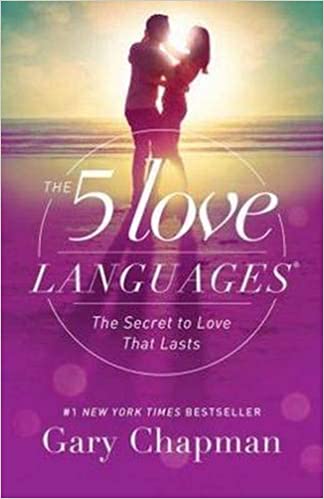
Dr. Gary Chapman wrote an amazing book called The Five Love Languages. In his book, he lays out five “languages” that we use to communicate our love to one another:

  • Words of affirmation
  • Quality time
  • Gifts
  • Acts of service
  • Physical touch

When you and I communicate, we naturally communicate in a way that is most comfortable to us. We communicate in our primary love language. But if the other person in the relationship has a different love language, no matter how much you love them, you are simply not getting through effectively. You are leaving the other person with a near-empty love tank.

I would suggest you start by taking a brief love language assessment (download the free PDF here → 5 Love Languages assessment) to determine YOUR OWN love language first. This is the language you will feel most comfortable using. Second, you need to learn the love languages of OTHERS CLOSE TO YOU so you can change your love dialect.

In the great love chapter in the Bible, the apostle Paul says this, “When I was a child, I spoke and thought and reasoned as a child. But when I grew up, I put away childish things” (v. 11, New Living Translation). Our love—and the way we express it to others—should always be growing up. If you are trying to communicate your love to someone special in the same ways (the same “languages”) you’ve always used, there’s a good chance your love is being viewed as childish.

As you mature in your expressions of love — as you speak the other person’s love language — you will begin to fill their love tank. Guess what happens next? Out of a full love tank, the other person is motivated to begin to speak your love language, to fill your tank. It can become so much fun to love with a full tank! Because when the other person’s love tank is full, almost any love language will work for them—wow, what a blast!

For married couples, YouVersion has an excellent reading plan that teaches specifically how the love languages operate in the context of your marriage.

UPDATE… my friend Greg Heeres and I host a leadership podcast on YouTube. Recently, we discussed the value of leaders learning and speaking the love languages of their teammates.

The Not-So-Little Stuff

Listen to the podcast of this post by clicking on the player below, and you can also subscribe on AppleSpotify, or Audible.

My youngest son showed up at the dinner table one evening with a swollen left eyelid. I looked at it a little more closely and could see what looked to be a bug bite in the corner of his eye.

“No big deal,” I thought. “It’s just a mosquito bite. Happens all the time in Michigan.” (After all the mosquito is slated to become our new state bird!)

But when he woke up the next morning, his left eye was only open a slit. By the time I got him to the urgent care, his eyelid was a deep pink color and he was feeling very lethargic.

Guess what? It’s not such a little thing anymore!

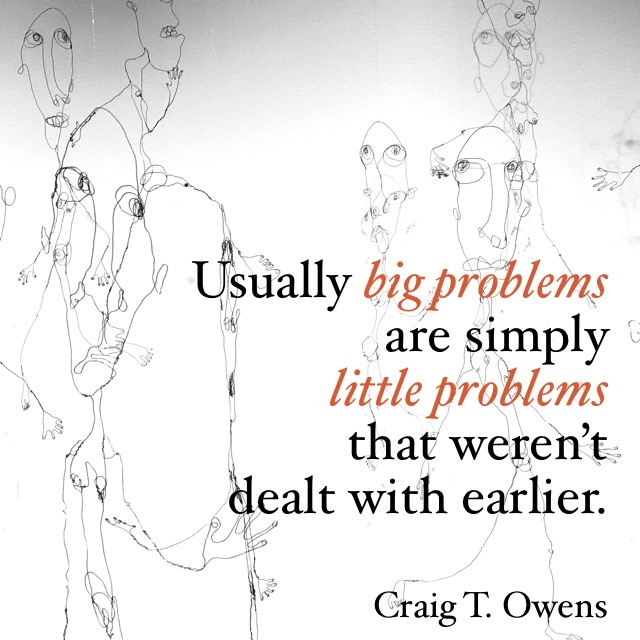
Frequently I hear people saying, “Don’t sweat the small stuff.” And I suppose to a certain extent that’s true. But typically the big stuff started off as the little stuff. Usually big problems are simply little problems that weren’t dealt with earlier.

  • Someone says, “My marriage failed last night” (big stuff). But the small warning signs had been there for months, but they weren’t taken care of.
  • Someone says, “My finances just hit rock bottom” (big stuff). But the small unnecessary purchases over time led to this moment.
  • Someone says, “I gave in to temptation” (big stuff). But the little flirting with the temptation created just the right environment for the big tumble.

Charles Simmons wrote —

“Life is made up of little things. It is very rarely that an occasion is offered for doing a great deal at once. True greatness consists in being great in the little things.”

On the flip side, rarely is a big problem presented all at one; it’s usually just the little things compounded over time.

The apostle Paul warned the church at Corinth about the little things that can blow up into the big things:

Your flip and callous arrogance in these things bothers me. You pass it off as a small thing, but it’s anything but that. Yeast, too, is a “small thing,” but it works its way through a whole batch of bread dough pretty fast. So get rid of this “yeast.” (1 Corinthians 5:6-7, The Message paraphrase)

A final thought from Paul to his protégé Timothy: “Keep a close watch on how you live” (1 Timothy 4:16 NLT). Great advice!

By the way, my son was fine after a little steroid treatment and some Benadryl, but some people never recover from their lack of attention to the little things.

Don’t let this happen to you! Watch out for the little things because you may find that they’re not so little after all!

►► Would you please prayerfully consider supporting this ministry?  My Patreon supporters get behind-the-scenes access to exclusive materials, like a 10-minute video I just shared on study tips for the poetic books of the Bible. ◀︎◀︎

Lessons From A Puppy

I’m learning great lessons from hanging out with my puppy Grace. Today I was observing how Grace lives in the moment—how she is fully there in whatever and wherever there is.

  • When she’s hungry, she eats.
  • When she’s full, she walks away from her dish.
  • When she’s thirsty, she drinks.
  • When she’s satisfied, she walks away from the water bowl.
  • When someone is around to play with her, she’s on full-throttle GO!
  • When she’s alone, she amuses herself.
  • When she’s tired, she takes a nap.
  • When I leave a room, she follows me.
  • When I have to go somewhere in my car, she’s right with me.
  • When I’m happy, she wags her tail.
  • When I’m upset, her tail and ears hang low.

In short, whatever there is to do, she does just that without holding anything back. And most of the time what she’s doing is based around who’s doing what around her. She’s always fully there in the moment.

I have had a quote in my files for quite some time from Dr. Richard Dobbins. I’m challenged by this thought about married love because it can easily apply to every relationship I have:

“But most of the time Christian married love comes dressed in overalls—it is practical, down-to-earth, everyday hard work. It is really thinking of the other person and doing what the other person needs and being what the other person needs when he or she needs you to be there.”

The great “love chapter” in the Bible (1 Corinthians 13) really is about being there for others … focusing on others … and then living fully in the moment for them. Check out a few verses from this chapter from The Message paraphrase:

Love never gives up.
Love cares more for others than for self.
Love doesn’t want what it doesn’t have.
Love doesn’t strut,
Doesn’t have a swelled head,
Doesn’t force itself on others,
Isn’t always “me first,”
Doesn’t fly off the handle,
Doesn’t keep score of the sins of others,
Doesn’t revel when others grovel,
Takes pleasure in the flowering of truth,
Puts up with anything,
Trusts God always,
Always looks for the best,
Never looks back,
But keeps going to the end.

I’m working on being fully there for the ones I love today. How about you?