Eyewitnesses And Embarrassment

Listen to the podcast of this post by clicking on the player below, and you can also subscribe on AppleSpotify, or Audible. 

In his Gospel, John gives eyewitness testimony to the physical death of Jesus. “Instead, one of the soldiers pierced Jesus’ side with a spear, bringing a sudden flow of blood and water. The man who saw it has given testimony, and his testimony is true. He knows that he tells the truth, and he testifies so that you also may believe” (John 19:34-35). 

John was at Calvary to report this event as an eyewitness, and so were the women who had been so involved with the public ministry of Jesus. 

Matthew, however, was not there. He ran away when Jesus was arrested. So in his historical account, he shares the eyewitness testimony of those who were there—

When the centurion and those with him who were guarding Jesus saw the earthquake and all that had happened, they were terrified, and exclaimed, ‘Surely He was the Son of God!’ Many women were there, watching from a distance. They had followed Jesus from Galilee to care for His needs. Among them were Mary Magdalene, Mary the mother of James and Joseph, and the mother of Zebedee’s sons. (Matthew 27:54-56)

These details in both Matthew and John’s Gospels are what lends credibility to this whole event. I’m sure it was embarrassing to Matthew for him to admit, “I ran away and hid in fear.” I’m sure it pained him again and again when he heard John, the women, and the Roman centurion recounting their eyewitness testimony. 

But this is what makes the reporting of this account real. 

If Matthew and John were attempting to perpetuate a hoax on the world—if they were concocting a conspiracy to fool people about the resurrection of Jesus—they certainly would have told their stories the same way. Matthew could have inserted himself as personally there on Calvary. John and Mark could have listed the names of the other disciples as eyewitnesses. The disciples could have given falsified information to Luke for his Gospel. And all of them could have left out the part about the female testimony, since in their day women were deemed unreliable witnesses in the courtroom. 

The fact that all four of the Gospels relate their accounts as they do—with the embarrassing details intermingled with the eyewitness accounts—is precisely what gives legitimacy to this historical event. 

Details like these are just another factor in a long, long list of evidences that attest to the historicity of all that is recorded in the Bible. 

Earlier in his Gospel, Matthew tells about the doubts of John the Baptizer (Matthew 11:2-6). John was imprisoned and sent his friends to ask Jesus, “Are You really the One?” Jesus sends John’s friends back with eyewitness testimony, and with these words: “Blessed is anyone who does not stumble on account of Me” (v. 6). 

The testimonies of both eyewitnesses and those who were embarrassed that they couldn’t give eyewitness testimony should bolster your faith in all that the Bible says. If you don’t stumble away from these testimonies, you can know the blessing of your faith in Jesus. 

►► Would you please prayerfully consider supporting this ministry? My Patreon supporters get behind-the-scenes access to exclusive materials. ◀︎◀︎
Reason To Hope And To Proclaim

Listen to the podcast of this post by clicking on the player below, and you can also subscribe on AppleSpotify, or Audible. 

On Resurrection Sunday, Christians celebrate an event that is the foundational truth for all of the Bible and for the Christian faith which springs from the Scriptures: The resurrection of Jesus. 

If Jesus wasn’t resurrected, this is a terrible, cruel lie we are perpetuating. If Jesus was resurrected, we have been given the key to eternal life. No one has ever made the bold claims that Jesus made about His own death and resurrection and then backed them up! 

On the Sunday morning after Jesus was crucified, some women arrived at His tomb to finish preparing His body for burial, but Luke records something fascinating: “They did not find the body of the Lord Jesus” (Luke 24:1-8). 

Think about this in a modern-day setting. If you were at the bedside of your loved one when they took their last breath, if you heard the doctor pronounce them dead, if you were at the funeral and saw their body in a casket, and if you saw that casket closed, sealed, and lowered into the ground, you would have every reason to find a body if that casket were re-opened. 

These women were on Golgotha when Jesus died, they saw the Roman soldiers verify His death, they witnessed Joseph and Nicodemus wrap His body in linen strips, and they saw His body placed in a sealed tomb. 

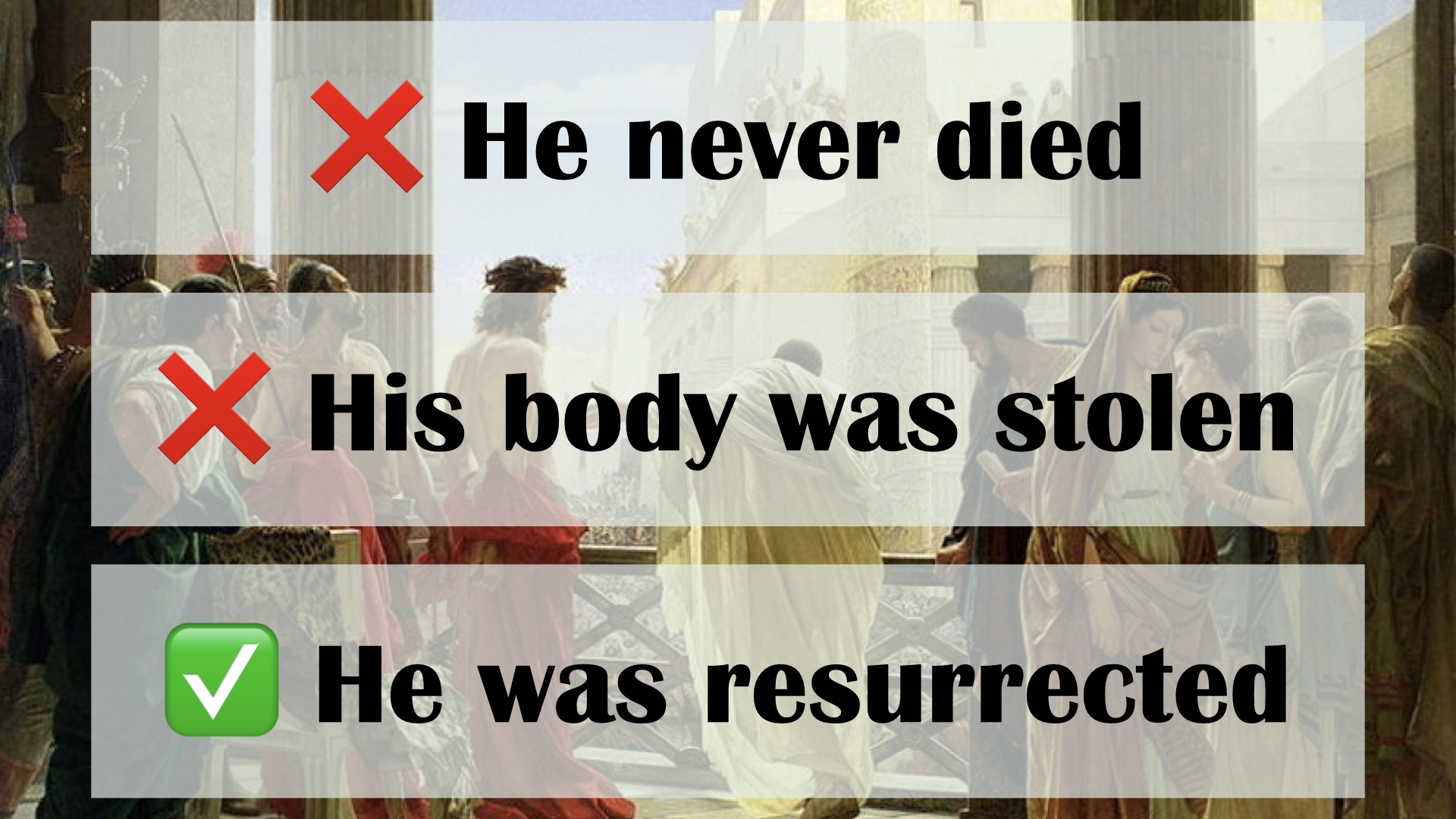
Then when there is no body where the dead body of Jesus is expected, there are only three possibilities: 

(1) He never died

Medical experts have concluded that the horrific torture that Jesus endured prior to even being crucified resulted in significant blood loss, and would have put His body in shock. Then the strain on His weakened body during crucifixion would have resulted in His body experiencing either pleural effusion or cardiac effusion, which is attested to by the flow of “blood and water” from Jesus’ dead body when His side was pierced by a Roman spear (John 19:34). 

The dead body of Jesus was thoroughly examined by both the Romans who conducted the crucifixion and His friends who prepared His body for burial (Mark 15:43-45; John 19:38-40). And two contemporary historians—Tacitus and Josephus—who were unfriendly to the cause of Christianity both attested to Christ’s death by crucifixion. 

(2) His body was stolen

The Sanhedrin was so insistent on Jesus being crucified, they wouldn’t have left the “conspiracy” option open. So they convinced Governor Pontius Pilate to allow them to both seal the tomb and place a group of soldiers outside the tomb to guard it (Matthew 27:62-66). It is highly unlikely that the disciples who fled before the temple guard and who were now locked in a room because they were quaking with fear would somehow gain the courage to undertake a mission to steal Jesus’ body. Nor is it likely that they could have escaped the notice of the highly-trained Roman soldiers guarding the tomb. 

(3) He was resurrected 

The angels at the empty tomb reminded the women that Jesus had foretold both the manner of His death and the assurance of His resurrection. Jesus described His death in detail multiple times, including such key details as His death would be in Jerusalem, the religious leaders would pronounce a death sentence but the Romans would crucify Him, and that He would be resurrected three days later (Matthew 20:18-19; Luke 18:31-33). In addition, Paul tells us that there were hundreds of eyewitnesses to the resurrected Jesus (1 Corinthians 15:3-8). 

Jesus said, “The reason my Father loves Me is that I lay down My life—only to take it up again. No one takes it from Me, but I lay it down of My own accord. I have authority to lay it down and authority to take it up again. This command I received from My Father” (John 10:17-18). 

If Jesus foretold this and fulfilled this, we can also trust His other promises. Assurances such as:

  • He is preparing an eternal home for us and He will come back to take His followers there 
  • That He alone holds the keys to Death and Hades
  • And that only those who have been cleansed from their sins will be able to enter Heaven

(see John 14:1-3; Revelation 1:18, 22:12-14)

The bold claim that Jesus would be resurrected back to life is adequately backed up by the events on Resurrection Sunday! So now we can say that believing the bold claim of Christ’s resurrection gives us hope for the future and reason to tell others about Him! 

If you’ve missed any of the other bold claims that we have discussed, you can find them all by clicking here. 

►► Would you please prayerfully consider supporting this ministry? My Patreon supporters get behind-the-scenes access to exclusive materials. ◀︎◀︎