
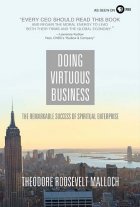
Doing Virtuous Business (book review)

The quote on the front cover of Doing Virtuous Business by Theodore Roosevelt Malloch says it well: “Every CEO should read this book.” I agree!

It seems that our mainstream media has become more and more anti-capitalism and anti-private business. It seems a small — but very vocal — group would prefer that our government oversee every business enterprise. According to Theodore Malloch, nothing could be farther from the biblical way of thinking about business.

By using both real-time examples of virtuous businesses and the wisdom of Scripture, Mr. Malloch makes the strong case that businesses operating on biblical virtues become spiritual enterprises that can benefit all of society. As a former business owner myself, I couldn’t agree more.

A few quotes from the book to whet your appetite—

By creating wealth, we use God’s gifts responsibly, and provided that we work toward that goal in a spirit of humility and gratitude, we benefit all those with whom we deal long the way.

When people join together in an enterprise, they create a new person, the firm itself, which is something greater than the sum of its parts. It, too, has a soul, and if its members honor God, then it, too, honors God.

Profitability comes last among the principles: it is not the primary goal of the company, but the consequence of doing business in the right way, so as to honor God.

A company guided by faith will possess the virtues that I have described in this book: it will have the courage and perseverance to pursue its goals and also the humility, compassion, and forgiveness to guard against arrogance and offensiveness.

This is the first book I have read in quite awhile that deals head-on with the weak arguments the anti-capitalists use. And it does so winsomely, kindly, and quite persuasively. I repeat it again: every CEO should read this book!

I am a Thomas Nelson book reviewer.
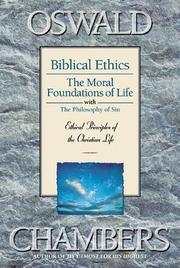
Biblical Ethics (book review)

Like every book from Oswald Chambers, be prepared for Biblical Ethics to hit you right between the eyes! In my lifetime the term ethics has had so many qualifiers added to it: situational ethics … biomedical ethics … wartime ethics. As though ethics becomes something changeable if you are in a difficult situation.

But in clear, unequivocal language, Oswald Chambers brings all ethics back to the Bible.

Keying in most frequently on the teachings of Jesus from the Sermon on the Mount, Chambers helps us get to the true intention behind the ethical requirements of God’s Law. For any who would say, “But it’s too hard to figure out what Jesus actually meant,” Chambers replies,

“When we come across something we don’t like, we say we don’t understand it; it is too plain not to be understood.”

This is not light reading, but it is valuable reading. Serious disciples of Christ will be well-rewarded by reading and studying the wisdom in Biblical Ethics. If you would like to read more thoughts from Oswald Chambers, check out my weekly installment Thursdays With Oswald.

Thursdays With Oswald—God’s “Oughts”

Two of my favorite authors are C.S. Lewis and Oswald Chambers. Lewis helps me to see biblical truths in a way I’ve not seen them before. Chambers helps me live out those biblical truths differently than I’ve been living them before.

I’m working my way through the complete works of Oswald Chambers (or maybe I should say, his writings are working their way through me!), so I thought I’d share with you, my dear reader, what’s challenging me.

We’ll see how this goes, but on Thursdays, I’ll share with you something I’ve been reading and thinking about from the writings of Oswald Chambers. Sometimes I may just let the teacher speak for himself, and sometimes I may offer a thought or two of my own. As always, you are welcome to weigh in with your thoughts as well. I’m excited to share these lessons with you.

God’s “Oughts”

      Strictly speaking, there is no disobedience possible to an imperative law, the only alternative being destruction. In this sense the moral law is not imperative, because it can be disobeyed and immediate destruction does not follow. And yet the moral law never alters, however much men disobey it; it can be violated, but it never alters. Remember, at the back of all human morality stands God.

      The Ten Commandments were not given with any consideration for human ability or inability to keep them; they are the revelation of God’s demands made of men and women who had declared that if God would make His law known, they would keep it. …

      If the “Oughts” of the Old Testament were difficult to obey, Our Lord’s teaching is unfathomably more difficult. Remember, the commandments were given irrespective of human ability or inability to keep them; then when Jesus Christ came, instead of doing what we all too glibly say He did—put something easier before men, He made it a hundredfold more difficult, because He goes behind the law to the disposition.

      The purity God demands is impossible unless we can be re-made from within, and that is what Jesus Christ undertakes to do through the Atonement. … It is not a question of applying Jesus Christ’s principles to our actual life first of all, but of applying them to our relationship to Himself, then as we keep our souls open in relation to Him our conscience will decide how we are to act out of that relationship.

From Biblical Ethics

A growing relationship with Jesus = Greater sensitivity to my conscience and the Holy Spirit = Correct disposition to obey God’s laws.
