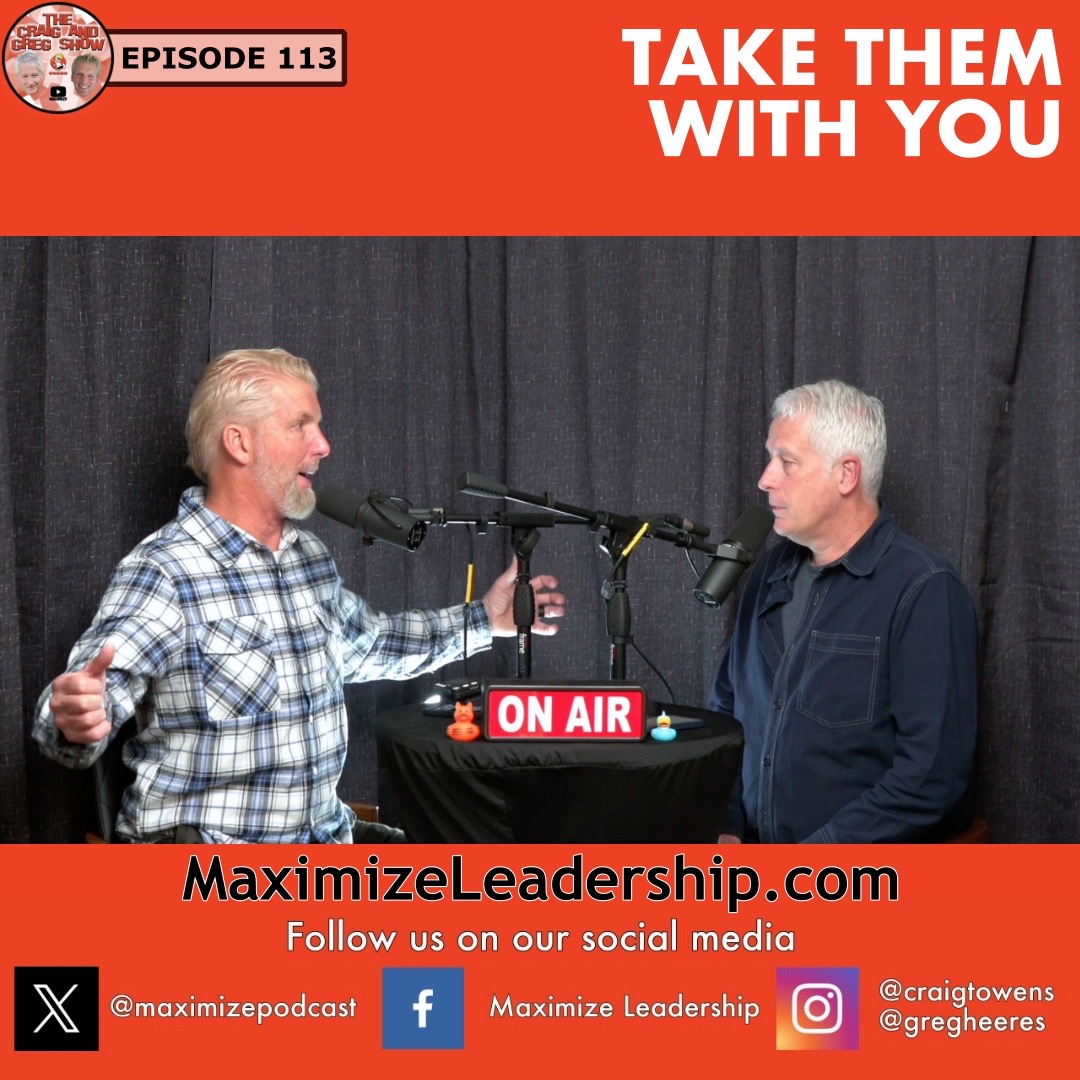
The Craig And Greg Show: Take Them With You

Listen to the podcast of this post by clicking on the player below, and you can also subscribe on AppleSpotify, or Audible.

In a previous episode we brought you the exciting news that Greg and I are collaborating to write a series of books called Business By The Book. In today’s episode, we revisit the first book in this series—A CEO’s Vision—and discuss how once the vision has been cast the next vital step is to bring your team along with you. 

  • [0:00] Introduction
  • [0:11] I welcome Greg to an exclusive club!
  • [0:49] We show why we think we are over-achievers.
  • [2:00] Leaders need to take others along with them, transitioning from “I” to “we.”
  • [4:39] How do leaders handle the frustration of a slow-moving team?
  • [6:51] How we wrote “Business by the Book” for a CEO who is casting vision.
  • [7:11] The importance a leader going first.
  • [10:53] Be realistic with your team about the challenges ahead.
  • [11:49] How do leaders handle doubts or questions from their teammates?
  • [14:37] Leaders need to know the pitfalls of casting vision.
  • [16:59] Watch out for the things that will distract from your vision!
  • [20:25] The courage to take the first step is vital.
  • [22:03] Leaders need to help the stragglers catch up with everyone else on the team.
  • [23:23] The last crucial step is for leaders to move forward confidently.
  • [24:31] Maximize Leadership has a lot of resources to help you on your leadership journey.

Check out my blog, my other podcasts, my books, and so much more at http://linktr.ee/craigtowens 

►► Would you please prayerfully consider supporting this ministry? My Patreon supporters get behind-the-scenes access to exclusive materials. ◀︎◀︎

Eliminating Toxicity

Listen to the podcast of this post by clicking on the player below, and you can also subscribe on AppleSpotify, or Audible. 

On an episode of The Craig and Greg Show, Greg and I discussed some toxic behaviors that can creep into your workplace and cause major discord. Two attitudes to watch out for are confidence without humility, and humility without confidence. 

Check out this full Craig and Greg Show episode here. 

And check out my Shepherd Leadership book where I dive into this topic in greater depth. 

►► Would you please prayerfully consider supporting this ministry? My Patreon supporters get behind-the-scenes access to exclusive materials. ◀︎◀︎

The Craig And Greg Show: Leadership Lessons From Veterans

Listen to the podcast of this post by clicking on the player below, and you can also subscribe on AppleSpotify, or Audible. 

The entire Maximize team loves our veterans! Those that volunteer to serve and protect our nation deserve our utmost respect, and we honor their sacrifice. In today’s episode Greg and I discuss the leadership lessons we have learned from veterans—some directly and others by simply observing the way our nation’s protectors conduct themselves. Join us as we salute the contributions of veterans!

  • [0:00] Introduction 
  • [0:15] One of our favorite days of the year
  • [1:08] Leadership lesson #1 from veterans: Sacrifice
  • [2:28] Leadership lesson #2: Selflessness
  • [4:12] Leadership lesson #3: Camaraderie
  • [5:33] Leadership lesson #4: Organization in planning and training
  • [8:52] Leadership lesson #5: Emotionally invested
  • [9:31] Leadership lesson #6: Training in action
  • [11:18] Leadership lesson #7: Communication skills
  • [12:53] Leadership lesson #8: A bigger cause—a heritage of service
  • [15:41] Leadership lesson #9: A visible leadership style
  • [17:27] Greg’s salute to veterans
  • [19:02] Our challenge to our audience

Personal Vision Comes First

Listen to the podcast of this post by clicking on the player below, and you can also subscribe on AppleSpotify, or Audible. 

Before a leader can cast a compelling vision for an organization, he or she has to be living a compelling personal vision. Greg and I explain why this is an indispensable first step. 

https://youtube.com/shorts/bqnLzYp4VN8?feature=share

This clip is from an episode of The Craig and Greg Show where we are discussing the first book in our new series of books called Business by the Book. The first book is What the Bible says about a CEO’s vision-casting. 

Check out my other podcasts, my books, and so much more by clicking here.

►► Would you please prayerfully consider supporting this ministry? My Patreon supporters get behind-the-scenes access to exclusive materials. ◀︎◀︎

Links & Quotes

We have a culture where respect for others is eroding quickly. The Bible makes it clear that reverence for God results in respect for people, and respect for people helps us reverence the God who created them.

I have a lot of new video content on my YouTube channel every week. Please check it out and subscribe so you don’t miss anything.

AI models can develop brain rot just as assuredly as humans can. You are what you consume!

“The real great man is the man who makes every man feel great.” —G.K. Chesterton

Dr. Louis A. Markos has an insightful article on the works of C.S. Lewis that help us learn how to stay human. “Christians today who are committed to restoring a proper view of man have an ally in the greatest apologist of the twentieth century, C.S. Lewis (1898–1963). Though Lewis offers much help in his best-known apologetics books (Mere Christianity, The Problem of Pain, The Screwtape Letters, The Great Divorce) and his beloved Chronicles of Narnia, we would do well to expand our reading of Lewis to include his searing critique of modern educational philosophy (The Abolition of Man) and his anthropologically incisive science fiction novels, The Ransom (or Cosmic) Trilogy: Out of the Silent Planet, Perelandra, That Hideous Strength.

The ICR has an article about a fascinating new dinosaur that was unearthed. “Even now in the twenty-first century, paleontologists are still at a loss as to the origin of the dinosaurs. As recently as 2024, five evolutionists stated, ‘Today, inspired by clues from fossils and footprints from a lost world, scientists continue to piece together the puzzle of how various dinosaur groups arose, behaved, and diversified.’ In contrast, the creation model argues that all dinosaur kinds were created during the same period—specifically on Day 6 of the creation week—several thousand years ago. From this perspective, the lack of definitive transitional forms or ancestral precursors in the fossil record aligns with the expectation that dinosaur kinds appeared fully formed and distinct, as observed in the fossil record.”

Axis’ Culture Translator discusses an article posted in Harper’s: “Many have written about how porn warps the expectations users have for relationships; this article demonstrates that, for young men in particular, pornography is often willingly embraced as a complete replacement for human connection. … Woven throughout this subculture is also conscious self-degradation; as the Harper’s article points out, ‘ruin your mind,’ ‘go deeper,’ and ‘give up on life’ are embraced as the movement’s rallying cries. Many young men and women are trapped in this spiritual prison, convinced there is nothing better to live for. Who will show them the way out?” Two helpful resources are Fight The New Drug and Pure Desire.

Leaders need to learn that disagreement on your team is normal and can be healthy. Disagreement doesn’t mean people distrust their leader, but it may mean that they want the bring out the best in their leader. Check out the full conversation Greg and I had on this subject.

The Craig And Greg Show: Disagreeing Is Not Disagreeable

Listen to the podcast of this post by clicking on the player below, and you can also subscribe on AppleSpotify, or Audible.

We can all agree that disagreeable people are some of the hardest to work with, constantly shooting down ideas without providing anything constructive in return. These types of people can quickly put a strain on any organization if left unchecked. However, we need to be careful not to lump disagreement into the category of disagreeable. In this episode Greg and I discuss why people in disagreement are actually the exact opposite of disagreeable, and are a valuable asset to your organization.

  • [0:00] Introduction 
  • [1:02] A strong quote about “no men” from Dick Brogden—“Strong leaders respect and need ‘no’ men. It is weak leaders who surround themselves with the ever agreeable. Unity requires honorable disagreement. Otherwise, you don’t have unity; you just have uniformity.”
  • [2:06] Disagreeing people are not necessarily troublemakers.
  • [2:59] What bothers me about disagreeable people?
  • [3:49] Opinions vs facts have to be considered to determine if someone is disagreeable vs disagreeing.
  • [4:36] Leaders are required to listen more to people who disagree with them.
  • [7:00] Many new leaders mistakenly treat disagreeable people as an enemy.
  • [8:44] Greg and I share how we misunderstood disagreeing people early on in our leadership journey.
  • [11:04] Leaders need some thoughtful boundaries for disagreeable people.
  • [13:28] How many times do we call someone disagreeable when they are simply disagreeing with us?
  • [15:53] Make sure disagreeable people don’t dominate the conversation in meetings.
  • [16:48] I apply a proverb from the Bible to disagreeing people.
  • [18:35] Leaders need to guard against defensiveness when people disagree with them.
  • [19:52] Greg shares a great quote to wrap up our discussion.
  • [20:36] A leadership coach can help you sort out the disagreeing from the disagreeable.

My book When Sheep Bite is a great resource for dealing with people who are disagreeing to the point of becoming disagreeable. Check it out!

Micromanagement Stifles Creativity

Listen to the podcast of this post by clicking on the player below, and you can also subscribe on AppleSpotify, or Audible. 

Leaders have an important balancing act to perform every day: remaining in control of their organization without becoming a controlling leader. Over-controlling leaders who micromanage end up stifling creativity that could be unleashed in their teammates. 

Check out the full conversation on The Craig and Greg Show episode The Balance of Control. 

Here’s that quote I shared from Tim Irwin’s book Derailed: “Lack of courage shows up in many organizations as micromanagement, failure to empower others, risk aversion, overcontrol, and perfectionism.”

The Craig And Greg Show: Business By The Book—A CEO’s Vision

Listen to the podcast of this post by clicking on the player below, and you can also subscribe on AppleSpotify, or Audible.

One of the amazing things about the Bible is that it has practical application for every aspect of our lives—including the business world! Today Greg and I are excited to announce that for the first time in our long friendship we are writing collaborators on a new series of books entitled Business By The Book. In today’s episode we preview the first book in this series about a CEO’s vision.

  • [0:56] Some new and exciting news on a great new project—a book that we have co-written. The first book in our series called Business by the Book. 
  • [2:20] Vision cannot be delegated to a committee, but the CEO must be the chief vision-caster.
  • [2:54] Greg and I first met on a basketball court, but there was an important lesson in that game that teaches CEOs about vision-casting.
  • [4:40] Why does a CEO need to have a personal vision statement before they lay out a vision for their organization?
  • [7:23] We layout how the book is organized and share insights on the first two chapters.
  • [9:17] CEOs would do well to show the way to the vision before they tell others the way to the vision.
  • [11:00] Greg uses a concept from “Alice in Wonderland” to talk about minimizing the things that distract leaders from pursuing their vision.
  • [16:45] Here’s what we hope you will takeaway from this series of books.

Links & Quotes

Greg and I shared some insights for leaders interacting with people from different generations. Check out this clip about Gen Y.

I have a lot of new video content on my YouTube channel every week. Please check it out and subscribe so you don’t miss anything.

G.K. Chesterton penned these words over a century ago. If they were true then, imagine how much more so they are now: “These are the days when the Christian is expected to praise every creed except his own.”

“The only way to do great work is to love what you do. If you haven’t found it yet, keep looking. Don’t settle.” —Steve Jobs 

Epaphras literally put his life on the line to tell others about Jesus (Colossians 1:7; Philemon 23) and then tenaciously wrestled in prayer for the saints he led to the Lord (Colossians 4:12). That is a life worth emulating!

Sarah Young uses passages of Scripture and writes in the first-person voice as though Jesus Himself was speaking to us. “When you bring Me prayer requests, lay out your concerns before Me. Speak to Me candidly; pour out your heart. Then thank Me for the answers that I have set into motion long before you can discern results. When your requests come to mind again, continue to thank Me for the answers that are on the way. If you keep on stating your concerns to Me, you will live in a state of tension. When you thank Me for how I am answering your prayers, your mind-set becomes much more positive. Thankful prayers keep your focus on My Presence and My promises.”

The Craig And Greg Show: Leading Generations

Listen to the podcast of this post by clicking on the player below, and you can also subscribe on AppleSpotify, or Audible.

“Kids these days just don’t understand!”

That’s probably a phrase you’ve heard more than a few times from members of generations your elder, and there is some truth to it! Each generation has very diverse experiences which make them unique from the groups before and after them. In today’s episode, Greg and I want to encourage you to understand and embrace generational differences to make your team stronger.

  • [0:00] Be sure to pick up Greg’s new book Sales Armageddon.
  • [0:32] I got called a Boomer!
  • [1:18] Communicating with a multi-generational team requires different approaches.
  • [2:52] Many from the Boomer generation are past retirement age, but still enjoy the work they do.
  • [4:09] Boomers tend to respect authority, where Gen X might be more skeptical.
  • [4:42] Boomers value formality, but Gen X have embraced a more relaxed work culture.
  • [6:01] “Put in the time” versus “the value I bring” mentalities.
  • [6:59] Boomers have a very work first mentality, Gen X embraced more of a work-life balance.
  • [8:33] Newer generations are much more likely to work multiple jobs in their career.
  • [9:43] Motivations and loyalties across different generations.
  • [12:31] Generation iY.
  • [13:32] The learning and work styles of different generations.
  • [14:39] Gen Y are heavily influenced by internet and social media thought.
  • [16:01] Gen Y are very well informed, but sometimes lack practical experience.
  • [16:44] Desire to collaborate varies across generations.
  • [17:33] We like to lead in our preferred style, but that isn’t always the best approach.
  • [20:18] Gen Z have in many ways begun to mirror Boomers.
  • [21:18] The top line takeaway is respect.
  • [22:51] I share my biggest lessons learned growing in the workforce.
  • [24:14] Greg shares his final thoughts on generational divides.
  • [26:43] Maximize coaching can help you learn to better connect with your team.