Thursdays With Oswald—True Liberty

This is a weekly series with things I’m reading and pondering from Oswald Chambers. You can read the original seed thought here, or type “Thursdays With Oswald” in the search box to read more entries.

True Liberty

     True liberty is the ability earned by practice to do the right thing. There is no such thing as a gift of freedom; freedom must be earned. The counterfeit of freedom is independence. When the Spirit of God deals with sin, it is independence that He touches, that is why the preaching of the Gospel awakens resentment as well as craving. Independence must be blasted right out of a Christian, there must be only liberty, which is a very different thing. Spiritually, liberty means the ability to fulfill the law of God, and it establishes the rights of other people.

From Biblical Ethics

Freedom usually means, “I’m free to do what I want to do.”

Liberty is, “I’m free to help you do the right thing.”

Instead of using my freedom to do what I want to do, I choose to use my freedom to help someone else earn their liberty.

If All Your Friends Were Jumping Off A Cliff…

…would you do it too?

Okay, quick show of hands: how many of you heard your Mom or Dad say this to you? I’ve got both my hands up!

I always hated this statement, because I felt like saying, “Mom, I’m not an idiot. I know where to draw the line.” This an extreme example (a hyperbole) intended to get a point across. The point that our parents were trying to make is: humans tend to be crowd followers.

We want to be accepted, so sometimes we bend ourselves a little bit to get the stamp of approval from our peers. It might be a little more obvious among teenagers with clothing choices, music preferences, or attitudes toward those “outside” the mainstream. Although it gets a little more subtle among adults, I think the desire to be accepted—to go along with the crowd—is always there.

Or else we become rebels. If society says “Right” the rebel says “Left.” If society says “War” the rebel says “Peace.” If Mom and Dad say, “Go to church,” the rebel says, “I’m going to stay away from church.” Which shows another tendency of human nature: we tend to go to extremes.

God says, “Do what is right. Period”…

You must not follow the crowd in doing wrong. When you are called to testify in a dispute, do not be swayed by the crowd to twist justice. And do not slant your testimony in favor of a person just because that person is poor.

Don’t go along with the crowd just to be accepted.

Don’t go alone just to be an individual.

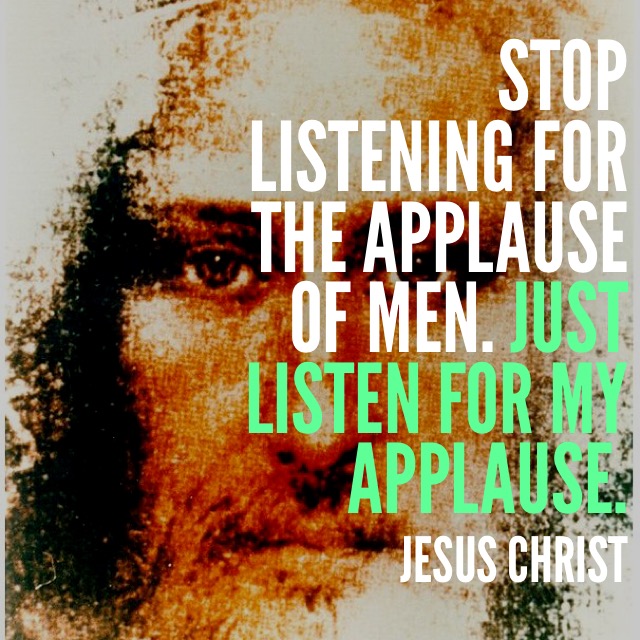
Live for the approval of an audience of One.

It’s only when I take the time to reflect on my conversations, my actions, my thoughts, that I see these two tendencies in me: I do one thing to go along and then do something entirely different to show that I’m my own man. Instead of these extremes, I need to ask, “Is this pleasing to God?”

I’m working on it. How about you?

Unintended Consequences

Sometimes even with the best of intentions, our actions can create a series of events that we never anticipated. What’s worse, like a row of neatly arranged dominos, once the first one has been knocked over, it’s hard to stop the tumble of the other dominos.

Case in point: Abram (or Abraham, as he would come to be known later).

He followed God’s call to leave his homeland of Ur and travel to Canaan—the Promised Land. He came to Canaan as a fairly wealthy man, having built quite a portfolio in his home country. After he arrived, he built a couple of altars to God and things appeared to be going well.

Until the famine. [you can read the story for yourself here]

Then without asking God, Abram left Canaan and traveled to Egypt. This was the first domino to be knocked down. The rest that fell were the unintended consequences of this single decision.

Abram lied to the Egyptians about his wife, telling them that she was his sister. As a result, she was taken into Pharaoh’s harem. Did Pharaoh sleep with her? The Bible doesn’t say for sure. Was Sarai mad at Abram? The Bible doesn’t answer this one either, but I think we all know the answer to this question!

Abram got richer. Because Pharaoh was so happy with Sarai, Pharaoh gave him sheep and cattle, donkeys and camels, and servants.

But this newly acquired wealth caused yet another domino to fall.

Abram and his nephew Lot began to have arguments about their large herds of animals. To settle their dispute, they split up.

Another domino fell.

Lot, without Abram’s mentorship, moved near Sodom. He got caught up in its sinful lifestyle and lost everything he owned. All he had left were two daughters, who were wicked, manipulative young ladies.

And yet another domino.

Abram and Sarai couldn’t have children. So Sarai suggested that Abram sleep with Hagar, their Egyptian maid. Would Sarai have suggested this if Abram hadn’t abandoned her to Pharaoh? If they hadn’t gone to Egypt, Hagar wouldn’t even have been there!

And the final domino.

Hagar did get pregnant. But her son Ishmael became the father of the Arabic people. A race of people that is openly hostile to the Jewish people to this day.

So many unintended consequences. So many dominos knocked down because of just one decision.

I’m grateful that God made something good out of this, but what incredible pain and hardship exist to this day because of one decision 4000 years ago.

My takeaway: I need to lean on, trust in, and be confident in the Lord with all my heart and mind and do not rely on my own insight or understanding.

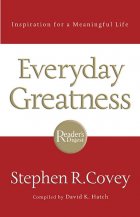
Everyday Greatness (book review)

Everyday Greatness

I have read almost everything that Stephen Covey has written, so when I saw this newest title—Everyday Greatness—with his name on it, I was really looking forward to it. I know the classic rule is “Never judge a book by its cover,” but I admit I broke this rule!

When I saw “Stephen Covey” on the cover I was prepared for his typical thought-provoking insights. Instead what I got in Everyday Greatness was anecdotal support of Covey’s profound teachings from other authors. I was actually pleasantly surprised by this.

The premise of this book is similar to Covey’s other books; namely, you have the power to make the choices that will make your life more effective, more fulfilling, and more beneficial to those around you. Everyday Greatness reinforces this message by letting you hear Covey’s thoughts through the stories of “everyday people.”

The book is divided up into seven categories that everyday people live each day—

  • Searching for meaning
  • Taking charge
  • Starting within
  • Creating the dream
  • Teaming with others
  • Overcoming adversity
  • Blending the pieces

Each of these seven categories is supported by three principles, and each of these principles are illustrated by three short stories and a few pages of noteworthy quotes. So in essence Everyday Greatness presents Covey’s thoughts in 63 short stories and several pages memorable quotes.

Stories are so much more effective at driving a point home than is a lecture, and these stories are the perfect length for anyone. This is a book I’ll keep handy on my shelf so I can return to these stories time and time again. An excellent read!

Choices

“…Choose for yourselves this day whom you will serve.” (Joshua 24:15)

I have to choose.
Not my parents.
Not my heritage.
To choose for me.
Myself.

I have to choose.
Not trapped by yesterday.
Not anxious for tomorrow.
To choose this day.
Everyday.

I have to choose.
Not to be in control.
Not to be the master.
To choose whom I will serve.
Jesus.

I have chosen.
Myself.
Today.
Jesus.

“There is a choice you have to make
in everything you do.
So keep in mind that in the end,
the choice you make makes you.” (John Wooden)

Are you choosing? For yourself? Today? Jesus?
What “you” are your choices making?