
The Patriot Financier

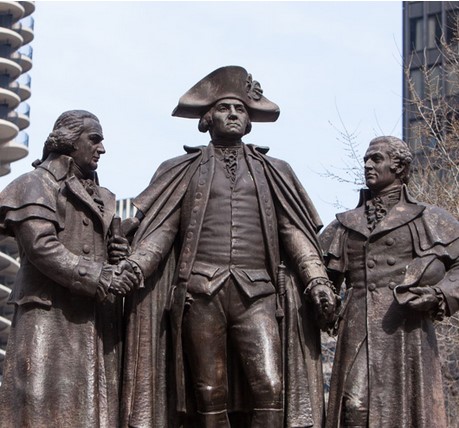
Monument of George Washington with Haym Salomon (L) and Robert Morris (R)

My friend Douglas Carmel shared an amazing story in his monthly newsletter. I am reposting it here with his permission.

July 4th is the “birthday” of America, but we may have never celebrated that date without the contribution of a long-forgotten Jewish man in American history. His name was Haym Salomon.

Haym Salomon’s life was brief (1740–1785), but his impact on America was substantial. A Polish-born Jewish businessman, Salomon advanced from a penniless refugee to become one of the most important financiers of the American Revolution.

Risking his personal fortune, he helped fund General Washington’s army by securing loans. Records show Haym Salomon’s fundraising and personal lending helped provide over $650,000 (over $17 million in today’s dollars) in financing to help George Washington in his war effort.

In August 1781, the Continental Army had trapped British Lieutenant General Charles Cornwallis in the Virginian coastal town of Yorktown. George Washington decided to march to Yorktown and deliver the final blow. But Washington’s war chest was completely empty, as was that of Congress. Without food, uniforms, and supplies, Washington’s troops were close to mutiny.

When he was told there were no more funds and no more credit available, George Washington gave a simple but eloquent order: “Send for Haym Salomon.” Salomon lent even more personal funds and raised even more money for the cause. Washington conducted the Yorktown campaign, which proved to be the final battle. The British were finally defeated. America was now a free country. The war was won!
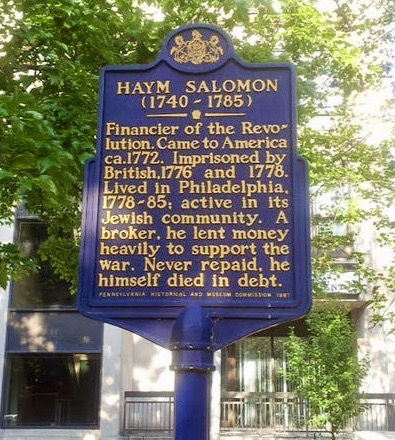
Even after the war was won, Salomon used his own money to help finance America’s newly formed but impoverished government. Sadly, his generosity was not repaid. It seemed that Congress did not recognize their debt to Salomon, refusing to repay the money they borrowed. Salomon died in poverty in 1785, at the age of just 44. His family was left penniless, unable to reclaim their debt from the government. In 1975, the U.S. Postal Service issued a stamp hailing Salomon as a Financial Hero of the American Revolution. 

In 1941, the City of Chicago erected the statue of George Washington, flanked by Haym Salomon and Robert Morris. It stands today at the intersection of Wabash and Wacker Drive. Under the image of Salomon it says, “Haym Salomon—Gentlemen, Scholar, Patriot. A banker whose only interest was the interest of his country.”

Washington’s Immortals (book review)

Listen to the podca

st of this post by clicking on the player below, and you can also subscribe on AppleSpotify, or Audible. 

There’s an old proverb that says,

For want of a nail the shoe was lost,
for want of a shoe the horse was lost,
for want of a horse the knight was lost,
for want of a knight the battle was lost,
for want of a battle the kingdom was lost.
So a kingdom was lost—all for want of a nail.

I thought of this proverb as I began reading Washington’s Immortals by Patrick K. O’Donnell, which recounts the history of a regiment from Maryland that not only turned the tide of a crucial battle in the American Revolutionary War, but who were at the center of nearly every vital battle throughout the war. 

At the outset of the war, the British army and navy nearly overwhelmed George Washington’s forces in New York. One regiment from Maryland stood their ground, keeping the British bottled up for just one hour. But that one hour allowed General Washington precious time to get his retreating army to safety. Without the bravery and tenacity of these Marylanders, the war could have been over almost before it started. So to paraphrase the old proverb above, for want of the brave stand of the Marylanders, the American cause could have been lost! 

As General Washington watched those brave men not only stand their ground, but repeatedly counterattack the far superior British forces, he said, “Good God! What brave fellows I must this day lose!” 

If that were the only service to the American colonies that this elite group had supplied, it would have been enough. But time and time again, General Washington and General Nathaniel Green placed the Marylanders in the most vulnerable or the most crucial places on the battlefield, knowing that these men would not fail to come through. 

O’Donnell follows the movements of the Marylanders from the beginning of the war all the way through to its conclusion in a very readable manner. He shares just enough of the details of the battle for us to get a feel for the gravity of the situation, but not so many details that it becomes laborious reading. 

Any students of American history, military history, or leadership-under-fire will appreciate reading Washington’s Immortals. 

►► Would you please prayerfully consider supporting this ministry? ◀︎◀︎

Politics In The Pulpit

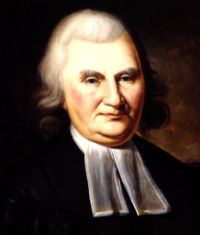
John Witherspoon

John Witherspoon

Is there right time to address politicized topics from the pulpit? I believe there is, but I believe we must make sure we’re not promoting our opinion but standing up for biblical principles.

Pastors were pivotal in swaying public opinion prior to the American Revolution and in the abolition of slavery in the United States. One pastor that spoke forcefully and biblically about the independence of the thirteen colonies was John Witherspoon—

“If your cause is just—you may look with confidence to the Lord and intreat [sic] Him to plead it as His own. You are all my witnesses, that this is the first time of my introducing any political subject into the pulpit. At this season however, it is not only lawful but necessary, and I willingly embrace the opportunity of declaring my opinion without hesitation, that the cause in which America is now in arms, is the cause of justice, of liberty, and of human nature.”

Commenting on the decision of Rev. Witherspoon to address this topic from the pulpit, theologian T.M. Moore wrote—

“Preachers tend to stay away from sticky moral and political issues, simply because they know it riles up certain folks for them to do so. Witherspoon spoke out in his day because the cause of the nation was just. But so many unjust causes are afoot in our nation at the moment, that for pastors not to speak up and equip their people to understand the times and know what we as communities should do, is not only a betrayal of our Founders, but a betrayal of their calling and of the Word of God (Ezekiel 33).”

That’s a strong statement: Pastors that don’t speak out on the immoral issues of our time are betraying their calling. I tend to agree with him. What do you think? Is there a time and place for politics in the pulpit?

You may also want to check out my videos How Christians can live biblically in an election season and The Church should be pre-political