


Listen to the podcast of this post by clicking on the player below, and you can also subscribe on Apple, Spotify, or Audible.
 Parents, I want you to think back to your children asking you for something they really wanted. How many times did they ask? How many different ways did they ask? What sort of strategies did they use? Did you ever sense any hesitation in them coming to you to make their request?
Do you have this firmly in mind? Good, because this is how Jesus explains prayer.
Jesus called God His Father, and when His disciples asked Him how to pray, Jesus instructed them to address God as “Father” (Luke 11:1-2).
(Check out all of the Scriptures in this post by clicking here.)
This is so remarkable!
- Hindus don’t call God “father” but they flip it around by saying, “Father is like God” to teach children to respect their earthly fathers.
- Buddhists don’t believe in a God that anyone can worship or even have a relationship.
- Islam gives Allah 99 names, but not one of the names is “Father.”
- Jewish rabbis don’t see how anyone other than Jewish people can even think of God as their Father, but even they don’t presume to address Him that way in their prayers.
And yet Jesus tells us to come to prayer to the Almighty Creator and Sustainer of the universe with, “Father.” There is intimacy in that title. There is an understanding of knowingness and trustworthiness in that title. There is an implied belief of perfect provision in that title.
We looked at Luke 11:9-10 previously, and we saw especially how the Amplified Bible brings out the idea of asking again and again and again. But is this what Jesus really meant for us to do? Don’t you feel a bit like a pest asking this way?
The disciples asked Jesus to teach them to pray (Luke 11:1-4), but then Jesus gave them an un-asked-for illustration to make His point (vv. 5-8).
The Greek word for “boldness” in v. 8 is translated “shameless persistence” or “sheer persistence” or “shameless audacity” in various biblical translations. In the Greek, it’s a unique word (anaideia) which means without shame.
The sleeping friend—although he was tired and the request for bread came at an inconvenient time—still wanted to honor his friend. Or more precisely, he wanted to preserve the honor of his friend.
There’s another Greek word (hypomone) that I would define as stick-to-it-iveness. Two great examples are Bartimaeus (Mark 10:46-52) and the Syrophoenician mother (Matthew 15:21-28).
In light the the story of the Good Samaritan in the previous chapter of Luke, I think this friend was practicing the Golden Rule: he wouldn’t want to lose standing in the community or be embarrassed by being an ill-equipped host, so he helped supply his neighbor.
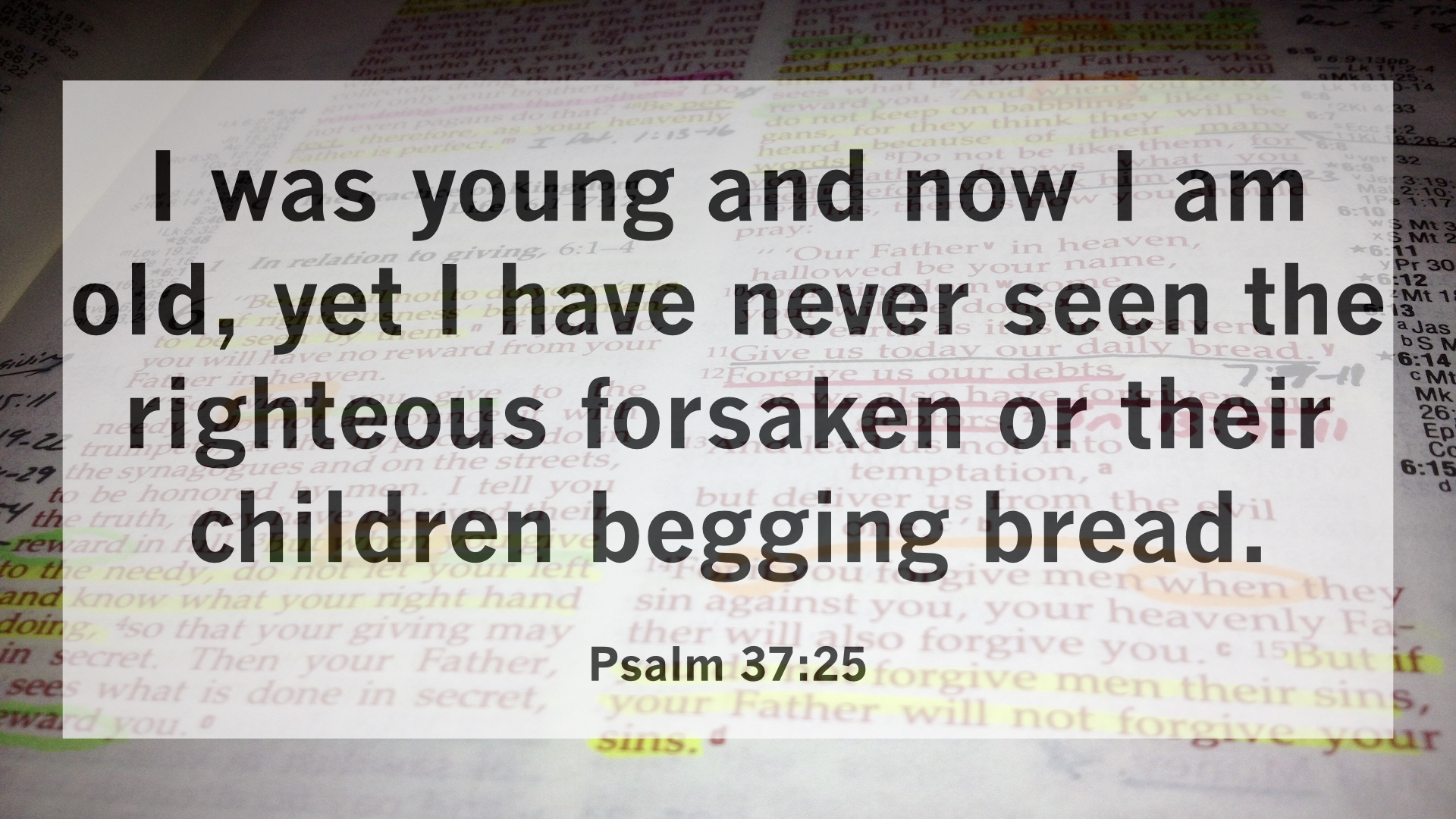 “Give us each day our daily bread” (Luke 11:3) hallows God as our Father. Our Father is the Bread Supplier and He never wants His children forsaken or embarrassed—
I was young and now I am old, yet I have never seen the righteous forsaken or their children begging bread. (Psalm 37:25)
The conclusion to the instructions Jesus gives us about prayer are continual asking, persistent seeking, and audacious knocking! P.U.S.H. = pray until something happens!
“Our giving depends much on the state of our minds at the moment. When depressed, we have no pleasure in giving; we either refuse, or we give merely to get quit of the applicant. Darkness of mind shrivels us up, makes us selfish, neglectful of others. When full of joy, giving seems our element—our joy overflows in this way; we cannot help giving; we delight in applications; we seek opportunities of giving. So with the blessed God. Being altogether happy, His delight is to give; His perfect blessedness flows out in giving. We can never come wrongly to such an infinitely happy Being.” —Horatius Bonar
Our importunate requests are opportunities for God to show His unequaled supply to others—to exalt His name. For that request, God will “get up and give you as much as you need” (Luke 11:8).
We are to keep on PUSHing for our Father’s “yes.”
Check out all of the other messages in this prayer series by clicking here.
►► Would you please prayerfully consider supporting this ministry? My Patreon supporters get behind-the-scenes access to exclusive materials. ◀︎◀︎


 Craig T. Owens
February 10, 2025 at 5:56 am
[…] Pushing For God’s “Yes” […]
LikeLike
February 17, 2025 at 5:05 am
[…] to their first request, did they immediately stop asking? Probably not. And that’s good, because Jesus tells us to keep PUSHing (Luke […]
LikeLike
February 17, 2025 at 9:33 am
[…] first request, did they immediately stop asking? Probably not. And that’s good, because Jesus tells us to keep PUSHing (Luke […]
LikeLike