


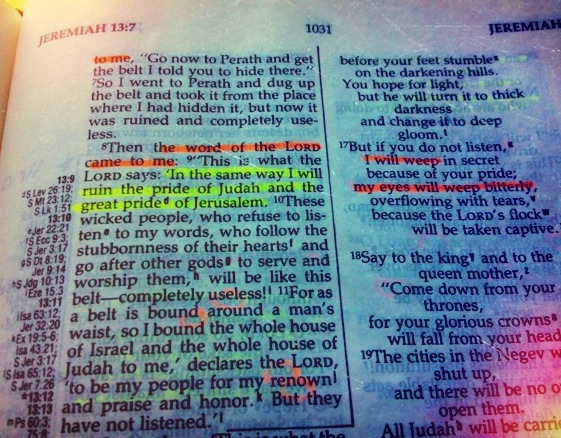
 This past week I’ve had two conversations that seemed like contradicting thoughts about the Bible, but they’re really exactly the same.
Conversation #1—Since Jesus Christ set us free from the law, there is no longer any need for us to read or study the Old Testament.
Conversation #2—The New Testament is a perversion of the Old Testament, so we should ignore it and stick with the “original” Scripture.
One thing that has helped me see the Scripture in a more correct light is a thought I picked up from Leonard Sweet and Frank Viola in their book Jesus: A Theography. Instead of the titles we’ve given the two divisions of the Bible, it will be better to call them the First and Second Testaments. “Old” and “New” have a tendency to make us think out-dated and updated; First and Second remind us that they go together.
Hosea is one of the first prophets in the First Testament whose words were put into writing. It’s interesting to note how many of the themes from the Pentateuch, Joshua and Judges are linked to Israel’s condition in the last few years before the northern tribes went into exile.
“Hosea’s allusions to Genesis through Judges are highly significant. First, they help to establish the fact that these books had already been written by the time of Hosea, in the eighth century B.C. (Many scholars consider these books to be from the sixth century B.C. and even later.) Second, Hosea’s construal of these books helps us to understand early Biblical interpretation, which in turn gives us a better understanding of how the [Second] Testament interprets the [First].” —Archeological Study Bible
When we move into the Second Testament, we see over 850 First Testament passages are quoted, sometimes entire paragraphs. In every instance, the Second Testament authors see the fulfillment of the First Testament in the life of Jesus Christ.
In fact, Jesus Himself quoted from 22 books of the First Testament, even on the day of His resurrection He explained to them what was said in all the Scriptures concerning Himself (Luke 24:27), and He said He would open our minds so that we too could understand all the Scriptures (Luke 24:45-47).
Finally there is the issue of fulfilled prophesy. Not only were First Testament prophesies fulfilled during the First Testament time, but even more were fulfilled during the Second Testament. In Jesus Christ alone about 200 such prophesies were fulfilled.
Both Testaments are equally important, and equally valuable. In fact, either Testament without the other robs God of His glory and robs us of seeing His fullness.


 Craig T. Owens
December 8, 2021 at 6:02 am
[…] Both Testaments […]
LikeLike
May 5, 2022 at 6:01 am
[…] words have stuck with me for nearly 50 years. I delight in reading my Bible as my daily Bread—both Old Testament and New Testament, the words of the prophets, the words of Jesus, and the words of the apostles. It’s all so […]
LikeLike
June 12, 2023 at 6:01 am
[…] talked before about the benefits of calling the Old and New Testaments the First and Second Testaments. This helps me not to subconsciously slip into the thought that “old” means outdated or that […]
LikeLike
August 28, 2024 at 5:05 am
[…] Both Testaments […]
LikeLike