


Listen to the podcast of this post by clicking on the player below, and you can also subscribe on Apple, Spotify, or Audible.
 A young man came to Jesus and asked Him, “What must I do to inherit eternal life?”
Jesus initially replied by listing some of the Ten Commandments that should be followed, and the young man quickly replied, “I have kept all of these since I was a boy!”
Then Jesus said, “There is just one more thing: sell everything you have and give to the poor, you will have treasure in Heaven. Then come, and follow Me.”
Even though this young man had received the answer that he was seeking, Luke records, “he became very sad because he was very wealthy.” (Check out this full exchange here.)
The word “very” is used twice by Luke (Luke 18:23). It speaks of a greatness or heaviness of something. It appears that when we are very wealthy, it is very hard to trust anything other than that wealth. The opposite also appears to be true: When worldly wealth is scant, our trust in God for our daily bread is high. This is what mathematicians would refer to as an inverse proportion.
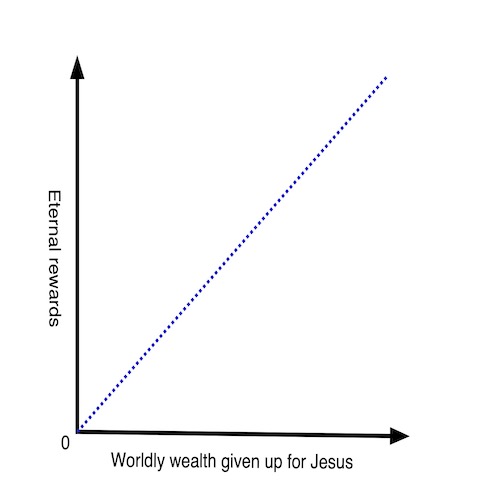 On the other hand, Jesus promised eternal rewards for those who replaced trust in possessions with trust in God (also see Matthew 6:19-21; Luke 18:28-30). This is what mathematicians would referred to as proportional.
Both this proportional treasure and the inverse proportional trust in God are God’s indisputable realities.
As this young man shows us, it’s not about what we do or about what commands we have kept. In fact, it’s not about us at all! It’s all about a total trust in the only One who is eternally trustworthy!
You may also want to check out:
- Faith over fear (another inverse proportion)
- Marriage math
- Illogical but true
►► Would you please prayerfully consider supporting this ministry? My Patreon supporters get behind-the-scenes access to exclusive materials. ◀︎◀︎


 Craig T. Owens