


 In 2007, Dave Kinnaman & Gabe Lyons published a book called unChristian. In it they reported the cultural view of Christians: haters, judgmental, hypocritical, too involved in politics, out of touch, insensitive, boring.
Do any of these words fit Jesus? No, I’ve never heard anyone—whether in the Bible or in the history of that day—call Jesus a hypocrite, or boring, or a hater. Do any of these words fit the apostles who began to spread the message of Jesus Christ after His ascension? No! Again, I’ve never read anywhere where the early Christians were called judgmental, or too political, or out of touch.
But if these labels are thrown at Christians today—Do not be surprised, my brothers, if the world hates you (1 John 3:13)—the Bible tells us how to reverse them: By living counter culture, by living according to God’s Word. In a word, by living in koinonia.
This is a Greek word that isn’t used in the Gospels, but shows up just after the first Church is born on the day of Pentecost. It’s a word and a concept that simply won’t work in a pragmatic culture, but works powerfully in a biblical counter culture. The word is usually translated fellowship in English.
Koinonia is how the Trinity operates (see 2 Corinthians 13:14). All three Persons of the Godhead are mentioned in fellowship with each other. There is no rivalry in the Trinity, but if any part of it is diminished, so is its total effectiveness and glory.
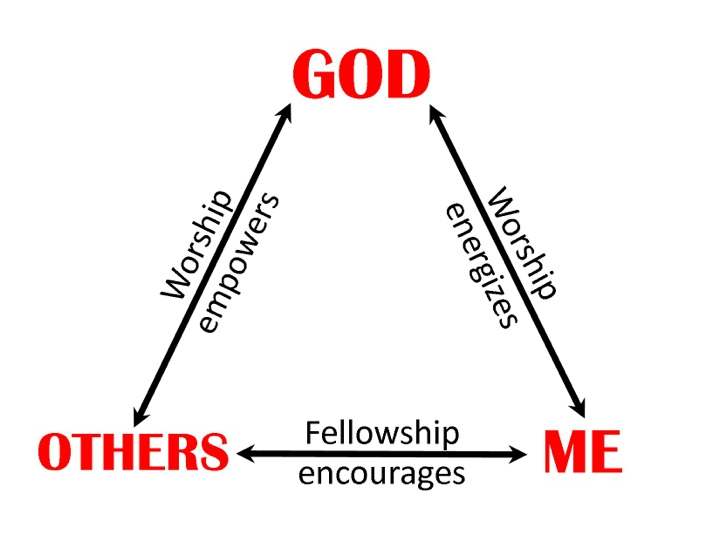 Christians are called to be part of a trinity of koinonia as well.
- When I worship God, I am energized to be in fellowship with others.
- My fellowship with others that flows from my love for God empowers them to worship God for themselves.
- The overflow of that relationship with God encourages others to be in fellowship with me.
- And that fellowship energizes me to worship God even more deeply, which encourages my fellowship with others, which empowers them for deeper worship… and on and on and on it goes!
Koinonia is an ALL IN relationship. It’s not something I can dabble in, or be involved with occasionally. I’m either in koinonia, or I’m not.
To see a great example, look at the Christians the very first time the word koinonia is used in Scripture. Acts 2:42-47 shows us how the Christians were not only all in (the Bible uses the word devoted), but how others in the community responded: they were in awe and viewed the Christians with favor. And as a result, lives were being changed every single day.
Yes! That’s what I want to be a part of! How about you?



 Craig T. Owens