
Bad Theology

I’m working on the next lesson in our Spiritual Self-Defense series. It’s a tough topic to address: the deity of Jesus, who was fully God and fully Man.

I know it’s very hard for a finite human mind to grasp an infinite concept like this. However in my studies I have found some really bad theology posted on the web. I realize as soon as I say, “It’s like this…” that I’ve already diminished the majesty of God coming to earth in human form, because Christ’s virgin birth, sinless life, sacrificial death and resurrection is nothing like anything we can comprehend. But still, I need to find a way to capture it and explain it to our students.

C.S. Lewis wrote about the need for good philosophy to address bad philosophy. I’m adapting his quote in this instance to say,

“Good [theology] must exist, if for no other reason, because bad [theology] needs to be answered.”

Prayerfully my good theology can answer the bad theology that I’ve been seeing.

Theology is a compound word: Theos (God) + Logos (wisdom, revelation, thought). I’ve been praying that God will give me greater revelation about Him. And I’m grateful that the Holy Spirit has given me some like analogies to use. But I’m still blown away by how unlike anything we’ve ever known was the coming of Jesus to earth. It is truly the grandest of all miracles.
Old And Valuable

During my freshman year of college, I was placed as a roommate with another freshman who was a theology major. Just so we’re all clear about this: theology is the study of God. And just so we’re all crystal clear about this: the study of God is typically based on the Bible.

I can hear some of you now, “Duh! Great insight!” But hang with me for a moment.

Near the start of our first semester together my roommate came into our dorm room very upset, slammed the door shut, and threw down his backpack. When I asked what was the matter he told me he had just come from a meeting with his academic advisor and was furious at his list of required classes. When I inquired what class he wasn’t allowed to take, he said, “No, it’s not what class I can’t take; it’s what classes I have to take!”

“So what classes are you upset that you have to take?” I asked, thinking maybe something like science or phys ed.

“Old Testament,” he responded. I was speechless, but he continued, “I mean, Old Testament! C’mon, that was stuff from a long time ago. We live under the new covenant now, so the old covenant has no purpose for us anymore!”

Although this is somewhat shocking to hear from a theology major, I’m afraid a lot of people feel this way.

Did you know…

  • The Old Testament (OT) is directly quoted by the New Testament (NT) writers nearly 700 times.
  • There are thousands of references to OT people, events, or principles in the NT.
  • Of the 27 books in the NT, only six don’t have direct OT quotations. But four of those six books refer back to OT people or passages.
  • Of the 39 books in the OT, all but nine of them are quoted in the NT.
  • Jesus Himself quoted from the five books of Moses (Genesis, Exodus, Leviticus, Numbers, Deuteronomy) nearly 60 times.

I love the Old Testament! There I read some great stories and meet some very colorful personalities. But I especially love reading the OT to see what was going to happen and then reading the NT to see both what did happen and what’s still going to happen.

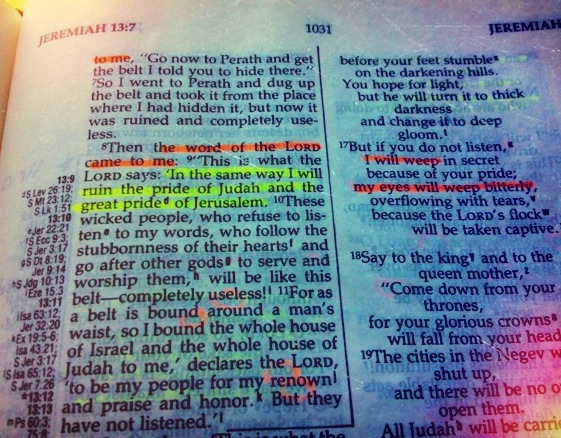
Those 39 books of the Old Testament may be old, but they’re so rich, and so valuable, and so enlightening to the New Testament. If you haven’t made the OT a part of your Bible reading time, I encourage you to do so.

The Old Testament is not old, as in worn out, archaic, useless. It’s old, as in priceless, valuable, foundational.