5 Quotes From “Questions Christians Hope No One Will Ask”

Earlier this week I reviewed Questions Christians Hope No One Will Ask Them (you can read my review here).

I wanted to share some of my favorite quotes from this book:

“When we fail to answer someone’s questions and objections, we become just one more excuse for them to disbelieve.” —Walter Martin

“I cannot believe that our existence in this universe is a mere quirk of fate. … We are truly meant to be here.” —Paul Davies, a physicist, cosmologist, and atheist

“Consider what you’d need for a protein molecule to form by chance. First, you need the right bonds between the amino acids. Second, amino acids come in right-handed and left-handed versions, and you’ve got to get only left-handed ones. Third, the amino acids must link up in a specified sequence, like letters in a sentence. Run the odds of these things falling into place on their own and you find that the probabilities of forming a rather short functional protein at random would be one chance in a hundred thousand trillion trillion trillion trillion trillion trillion trillion trillion trillion trillion. That’s a ten with 125 zeroes after it! And that would only be one protein molecule—a minimally complex cell would need between three hundred and five hundred protein molecules. … To suggest chance against those odds is really to invoke a naturalistic miracle.” —Stephen Meyer, a Cambridge-trained philosopher of science

“Here’s the key point to remember: there never was a time when the earliest community of followers of Jesus did not regard Him as far, far more than a good teacher.” —Mark Mittelberg

“If a good God made the world, why has it gone wrong? … My argument against God was that the universe seemed so cruel and unjust. But how had I got this idea of just and unjust? A man does not call a line crooked unless he has some idea of a straight line. What was I comparing this universe with when I called it unjust? If the whole show was bad and senseless from A to Z, so to speak, why did I, who was supposed to be part of the show, find myself in such violent reaction against it? … Thus in the very act of trying to prove that God did not exist—in other words, that the whole of reality was senseless—I found I was forced to assume that one part of reality—namely my idea of justice—was full of sense. Consequently, atheism turns out to be too simple. If the whole universe has no meaning, we should never have found out that it has no meaning: just as, if there were no light in the universe and therefore no creatures with eyes, we should never know it was dark. Dark would be without meaning.” —C.S. Lewis

George Washington Carver (book review)

I love reading biographies about our most prominent historical figures. A man that looms large at a pivotal time in US history is George Washington Carver, who is wonderfully captured in this biography by John Perry.

This book is a part of a wonderful series from Thomas Nelson called “The Christian Encounters Series.” Carver was a man strong in his Christian faith, and yet he showed it in his gentle lifestyle. As an African American born in the Jim Crow South, Dr. Carver endured his share of discrimination. But he also benefited by his share of helpful folks — both black and white — who treated him with dignity and respect, and opened doors of opportunity for him. Yet whether treated well or treated poorly, he treated everyone the same gracious, gentlemanly way.

Dr. Carver also lived out his Christian faith in his strong work ethic. He was busy learning more about creation and the Creator, and finding ways to show God through his discoveries. Although at times he was offered extraordinarily high salaries to leave Tuskegee Institute, he stayed right where he believed God had placed him.

Dr. Carver never had children of his own, but saw himself has a father to all his students. And those students gladly received his fatherly love and counsel. His Sunday evening Bible studies (which weren’t mandatory) were the best-attended event of the week. Even after graduation, many students maintained a lifelong correspondence with Father Carver.

Dr. Carver was revered as a father, a scientist, and a teacher. His impact on the advancement of science, and his example of hearing God’s whisper in all of His creation, are immeasurable. Regardless of race or age or background, all of us owe a debt of gratitude to this giant of a gentleman scientist.

I am a Thomas Nelson book reviewer.

You’re Better Than A Star

Listen to the podcast of this post by clicking on the player below, and you can also subscribe on Apple or Spotify.

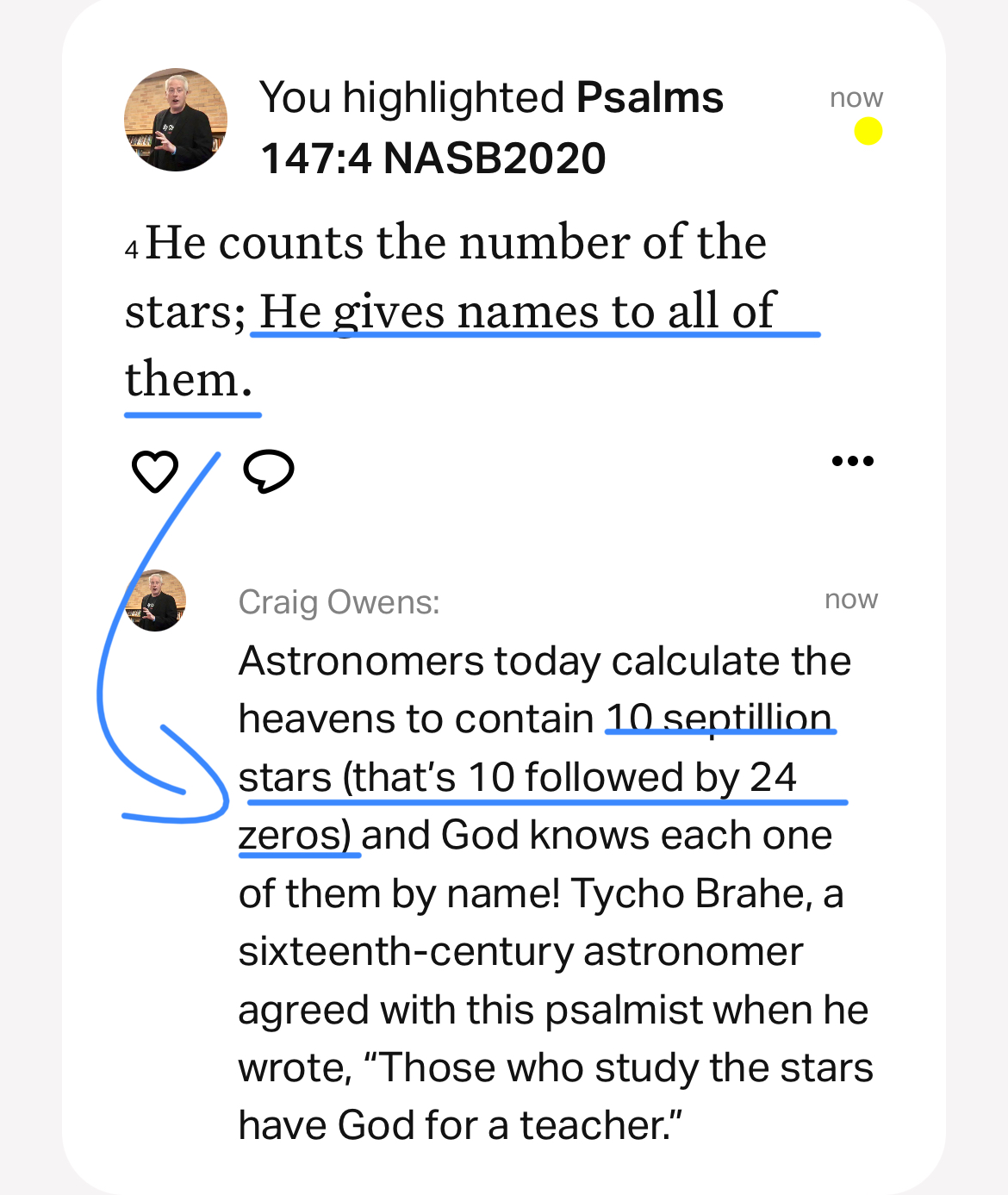
Astronomers admit that they cannot observe the entire universe, because it’s simply too vast for any equipment that has been made. In the Milky Way galaxy alone there are something like 10 trillion stars.

But that’s just one galaxy.

Astronomers used to estimate that there are another 10 trillion galaxies, but they have recently admitted that there are likely three times more stars than they originally thought. Which makes the total number in the observable universe 300 sextillion stars.

300,000,000,000,000,000,000,000 stars

But here’s what is more amazing: God knows each of those stars by name!

Lift your eyes and look to the heavens: Who created all these? He who brings out the starry host one by one, and calls them each by name. Because of His great power and mighty strength, not one of them is missing. (Isaiah 40:26)

As awesome as the stars are, here’s what God thinks about you

When I look at the night sky and see the work of Your fingers—the moon and the stars You set in place—what are mere mortals that You should think about them, human beings that You should care for them? Yet You made them only a little lower than God and crowned them with glory and honor. (Psalm 8:3-5)

And most amazingly of all, God not only knows the 300 sextillion stars by name, but He knows you by name too (Exodus 33:17)!

Friend, in God’s eyes you shine brighter than a star! He knows you by name. If not one star is missing from His view, how much more does He see you!

If you’re feeling discouraged or alone or forgotten, step outside tonight and look up at the stars. God knows them all by name, but He knows you too—and He thinks the world of you!

You are not alone—God sees you and He loves you!

►► Would you please prayerfully consider supporting this ministry? ◀︎◀︎

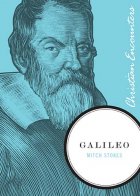
Galileo (book review)

You can quickly spot the influential people throughout history: they typically only need one name to distinguish them from all others. And Mitch Stokes does a masterful job showing why this noted scientist/mathematician/philosopher deserves the one-name designation in Galileo.

The first thing that stood out to me was how Galileo “found his way.” As the son of a musician, the field of science was never on his horizon. In fact, the start of his university career was in medicine. But as he quickly showed no aptitude nor passion for these pursuits, it was refreshing to see how his father let Galileo explore other areas of study to find his niche.

The next thing that amazed me was how Galileo’s new study and future employment in mathematics quickly evolved and expanded into areas such as philosophy, and later in life, astronomy and cosmology. Although Galileo is known today for his studies of the heavens through his improved telescope, those discoveries were only pursued to bolster his mathematic hypotheses.

Then it was amazing to see how deftly Galileo handled himself when he foresaw that his new discoveries that supported Copernicus’ claims of a heliocentric universe would upset those in the Catholic Church. Galileo said and wrote often that he was not trying to make new theology or correct old theology, but was simply trying to show how the Bible and science fit together. It was really the politically-minded (and Inquisition-minded) Cardinals in the Church that stirred up trouble for Galileo, but never the other way around.

Galileo demonstrated so beautifully through his observations and careful mathematic theorems how God had created an orderly and wonderfully-made universe. He believed that scientists had the responsibility to use their skills of observation and calculation to show how God and science are companions and not adversaries.

This is a part of Thomas Nelson’s Christian Encounters Series, and I not only highly recommend this book, but I’m looking forward to reading others in the series as well.

I am a Thomas Nelson book reviewer.

Holy Curiosity

Brandon and I spent the morning at the Van Andel Science Institute for a great father-son time called “Science On Saturday.”

What fun we had exploring God’s creation close-up and hands-on. Albert Einstein talked about the value of continual learning. He said, “Never lose a holy curiosity.” I’m a big believer in science and exploration because I believe the more we learn, the better we can worship God.

Here’s to lifelong learning and a greater wonder and awe of our Creator.

By the way, pictures of our exploration time are here.