My friend Jeff Hlavin wrote an article about making commitments. This is good stuff!
1. I cannot expect the strength of an emotion to turn a decision into a commitment.
Confusing a crisis with a commitment is a mistake — commitment can come out of a crisis, but the two are not the same thing.
2. I do not need to try to feel committed in order to validate a commitment.
True commitment shows itself in the very absence of feelings; any immature person can do what they feel like doing.
3. A commitment is best made by approaching the Lord out of the confidence that He wants to help me, rather than making elaborate promises to Him.
4. My best commitments come out of making specific, knowledgeable and attainable goals.
5. I need to ask for help from others whenever I need to do so,
6. Gaining a vision of myself accomplishing my commitments is a key to having them worked into my character.
If you are near Cedar Springs this Sunday, February 5, I am excited to invite you to come hear Jeff Hlavin speak at Calvary Assembly of God. We’ll get things rolling at 10:30am. Please come and join us!
John Maxwell has started a new teaching series where he presents a one-minute lesson on one word every day. Today’s lesson was on excuses. Watch the clip here.
Here are some other quotes on excuses:
“Ninety-nine percent of failures come from people who have the habit of making excuses.” —George Washington Carver
“There’s a difference between interest and commitment. When you are interested in doing something, you do it only when it is convenient. When you are committed to something, you accept no excuses only results.” —Kenneth Blanchard
“Obstacles are not excuses for failure, they are opportunities for growth.” —Craig T. Owens
“People who are good at making excuses are seldom good at anything else.” —Benjamin Franklin
Let’s stop making excuses and start taking responsibility!
This is a weekly series with things I’m reading and pondering from Oswald Chambers. You can read the original seed thought here, or type “Thursdays With Oswald” in the search box to read more entries.
Disentangled
A disciple of Jesus must know from what he is to be disentangled. The disentanglement is from things which would be right for us but for the fact that we have taken upon us the vows of God. There is a difference between disentanglement for our own soul’s sake and disentanglement for God’s sake. We are apt to think only about being disentangled from the things which would ensnare us—we give up this and that, not for Jesus Christ’s sake, but for our own development. A worker has to disentangle himself from many things that would advantage and develop him but which would turn him aside from being broken bread and poured out wine in his Lord’s hands. We are not here to develop our own spiritual life, but to be broken for Jesus Christ’s sake.
From Approved Unto God
My prayer: Break me … disentangle me … pour me out for Your glory, O God.
Listen to the podcast of this post by clicking on the player below, and you can also subscribe on Apple, Spotify, or Audible.
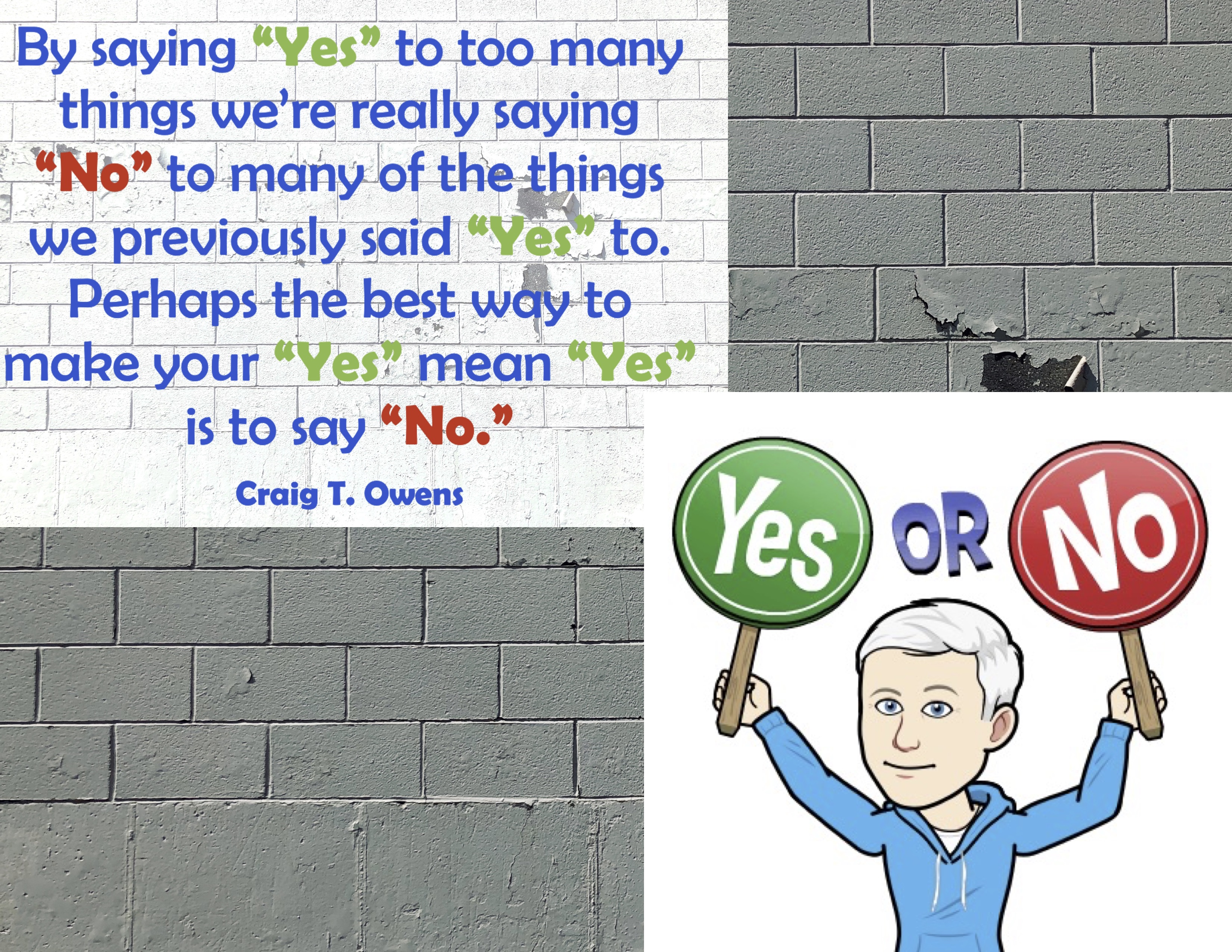
We all like “Yes.” That’s a nice word. But here’s the problem: By saying “Yes” to too many things we’re really saying “No” to many of the things we previously said “Yes” to.
Confused?
Let me try it this way. We all have only 24 hours in a day. No more; no less. We can all do a finite number of things during that 24-hour period. Some may be able to do slightly more, but even the most efficient people have a limit.
When we keep saying “Yes” over and over and over again, eventually our mouths are saying “Yes” but we cannot deliver. We’re out of time, out of resources, out of open places on our To Do list, out of patience, out of energy, out of money.
Perhapsthe best way to make your “Yes” mean “Yes” is to say “No.” To truly evaluate what is important, how much time you have, or how much money you have. And then say “No” to the things that you cannot truly commit to.
It’s hard to say “No.” But saying “No” more often will make your “Yes” so much more doable. Otherwise, your verbal “Yes” becomes an “I’ll try,” which eventually is a “Not really,” which in reality is a “No” anyway. So just say “No” upfront.
And don’t say anything you don’t mean. This counsel is embedded deep in our traditions. You only make things worse when you lay down a smoke screen of pious talk, saying, “I’ll pray for you,” and never doing it, or saying, “God be with you,” and not meaning it. You don’t make your words true by embellishing them with religious lace. In making your speech sound more religious, it becomes less true. Just say “yes” and “no.” When you manipulate words to get your own way, you go wrong. —Jesus (Matthew 5:33-37 in The Message paraphrase)
You can make your “Yes” so much more powerful by only saying “Yes” to those things that are truly important. That means you will need to get comfortable with saying a loving, but firm “No” more often than you probably have in the past.
Last night I took some of my youth group leaders to a Speed The Light banquet. For those of you who don’t know, STL is missions giving from youth, with the funds going to help missionaries speed the light of the Gospel. Many times STL funds go for items like 4-wheel-drive vehicles, sound systems, video production equipment, and the like.
Understand that up until a month or so ago our group had never really been exposed to STL. Our grand total to STL last year was $0. That’s right, nothing.
So I took them to this banquet to help them get a better understanding of what STL is. I’m a huge fan, so I wanted them to catch the vision for STL too.
Knowing that we were going to be asked to make a faith promise for 2010, I had a dollar figure in mind. I figured this amount would be doable, but a stretch, for a youth group that hadn’t given anything to STL yet.
Our District Youth Director Jeff Kennedy asked us to huddle as a team to talk about our faith promise amount. He said, “Remember: if it’s truly a faith promise, your amount will make you sweat.”
So I asked my team, “What amount do you think we can do?” And they totally blew me away! They came up with an amountthree times LARGER than I had been thinking.
I joyfully wrote in that larger amount on our faith promise card. As I did, I heard the Holy Spirit chide me a bit, “O you of little faith.”
Thanks, team, for dreaming big—bigger than me. Thanks for having such big faith. Thanks for stretching my faith too.
Listen to the podcast of this post by clicking on the player below, and you can also subscribe on Apple, Spotify, or Audible.
I’ve noticed a concerning trend in our busy culture. It’s in the way we can parse our words to make others think we are saying one thing, while we are actually giving ourselves an “out” in case we need it. You know, giving ourselves a little wiggle room.
Let me illustrate. I ask someone, “Are you going to the party on Friday night?” And the answers I get sound like this:
“I’m planning on it.”
“Sure gonna try.”
“It looks like I’ll be there.”
They walk away smiling, and I’m left standing there wondering, “Was that a ‘yes’? Are they really going to be there? Or are they keeping their options open in case a better offer comes along?”
Even on Facebook’s event invitations, I have the option to check “Attending,” “Not Attending” or “Maybe Attending.”
Are we truly undecided?
Or are we simply unwilling to commit to our decisions?
Here’s the danger in being undecided about something as innocent as going to a party: The indecision anywhere can start a pattern that carries over to everywhere in my life, and then undecided in one area can easily be uncommitted in all areas.
The greatest danger? Being uncommitted to the life God has called you and me to live. Like saying…
… “God, I’ll follow You anywhere (as long as I have a comfy bed every night).”
… “I’m totally committed to You (but I have to take care of my family).”
… “I’ve put You first (but I want to have some fun too).”
Undecided … parsing words … giving yourself an out … saying “Yes” to what you should say “No” to, and vice versa. Jesus directly addressed the dangers of this type of speech—
And don’t say anything you don’t mean. This counsel is embedded deep in our traditions. You only make things worse when you lay down a smoke screen of pious talk, saying, “I’ll pray for you,” and never doing it, or saying, “God be with you,” and not meaning it. You don’t make your words true by embellishing them with religious lace. In making your speech sound more religious, it becomes less true. Just say “yes” and “no.” When you manipulate words to get your own way, you go wrong. (Matthew 5:33-37, The Message)
If you say “yes,” make your “yes” mean “yes.”
Or else, just say “no.”
Say what you mean and mean what you say. Let’s commit to being totally committed!
These are not my words, but Christ’s: “Just say a simple, ‘Yes, I will,’ or ‘No, I won’t.’ Anything beyond this is from the evil one” (Matthew 5:37).
Decide what you are going to do … commit to it … say it … mean it … then do it!



 My friend Jeff Hlavin wrote an article about making commitments. This is good stuff!




 Craig T. Owens